
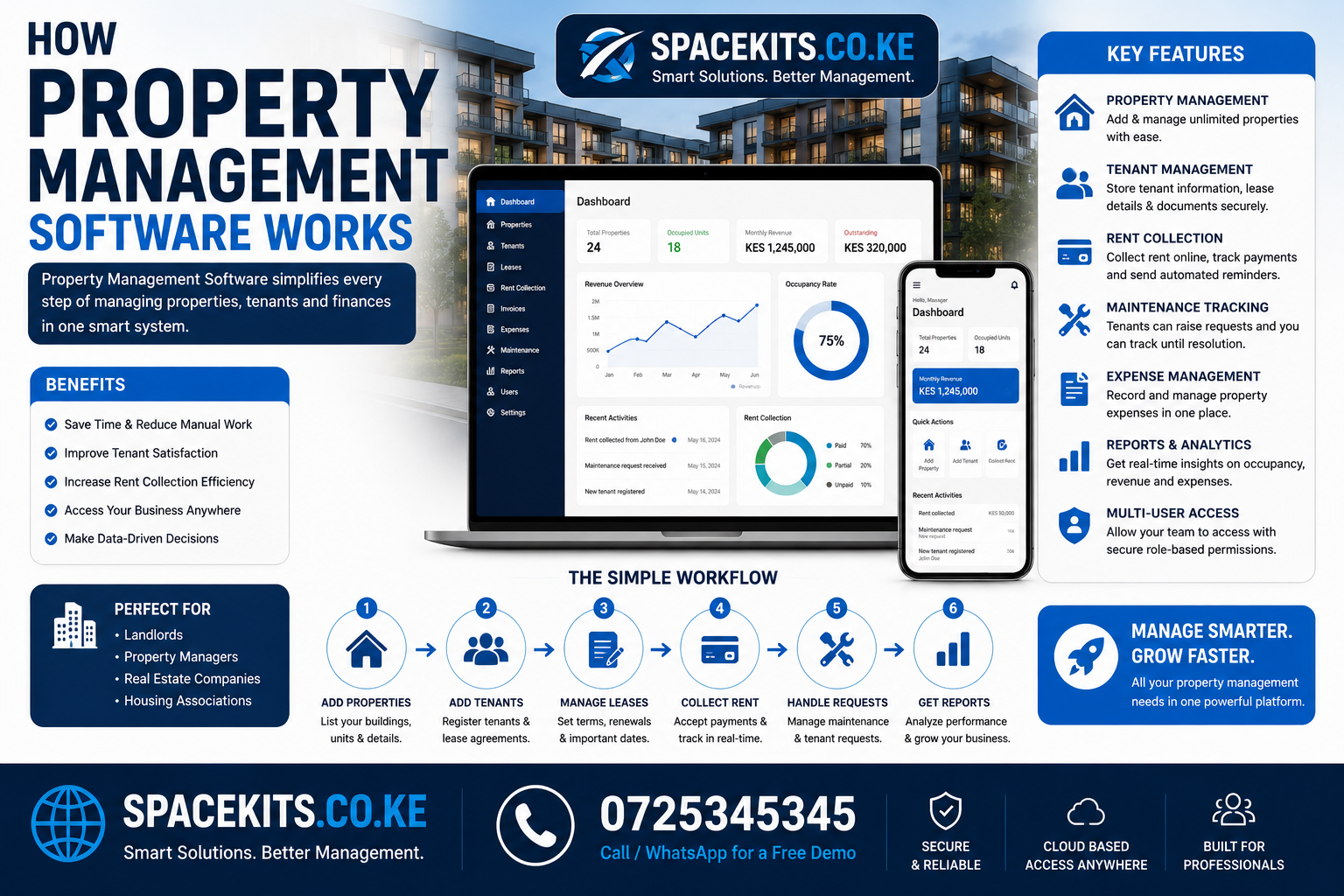
Understanding How Property Management Software Works can help landlords, property managers, real estate agencies, apartment managers, and estate operators determine whether moving away from spreadsheets and manual records is the right step for their rental business.
Modern property management platforms bring property records, tenants, leases, rent collection, maintenance, expenses, communication, and reporting into one centralized environment. Instead of keeping information in notebooks, Excel files, receipt books, WhatsApp conversations, and separate accounting records, managers can organize daily operations through a structured digital system.
For Kenyan rental businesses, this approach is particularly useful because rent collection frequently involves M-PESA, bank transfers, recurring invoices, receipts, arrears tracking, and tenant communication. PMS.co.ke describes its platform as a cloud-based property management system designed around these rental workflows, including M-PESA and bank reconciliation, maintenance, owner reporting, leases, and tenant management.
How Property Management Software Works Through a Centralized Property Database
The first part of understanding How Property Management Software Works is understanding the central database.
A property management platform normally begins by creating a digital record of the properties being managed. Instead of storing information separately for every building, the manager can organize buildings, units, tenants, leases, rent amounts, payment histories, expenses, and maintenance information within a connected system.
For example, a landlord managing three apartment blocks can create each property within the platform and then add individual units underneath each building. Each unit can have information such as:
- Unit number
- Monthly rent
- Occupancy status
- Tenant details
- Lease information
- Payment history
- Outstanding balance
- Maintenance records
- Utility information
- Relevant documents
This structure makes it easier to move from a general overview to a specific unit or tenant without searching through multiple files.
A centralized database also helps property managers maintain consistent information. If a tenant changes phone number, renews a lease, or clears an outstanding balance, the relevant information can be updated in the system rather than being recorded in several disconnected locations.
How Property Management Software Works When Adding Properties and Units
After creating an account, the manager normally begins by adding properties and rental units.
The property may represent an apartment block, estate, commercial building, hostel, mixed-use development, or collection of rental houses. Units are then associated with that property.
For every unit, the manager can establish the information required to operate it.
This may include:
- Rent amount
- Deposit requirements
- Unit type
- Occupancy status
- Tenant assignment
- Lease dates
- Utility charges
- Service charges
- Payment schedule
- Unit-specific notes
PMS.co.ke currently describes a workflow in which users can add buildings and units, define rent and availability, and manage property information from a centralized dashboard.
This is useful because property managers can see the portfolio as a structured collection rather than a collection of unrelated documents.
For example, if an estate has 150 units, the manager can determine which units are occupied, which are vacant, which have outstanding rent, and which leases are approaching expiry without manually opening 150 individual spreadsheets.
How Property Management Software Works With Digital Tenant Records
Tenant management is another important component.
Instead of relying on paper tenant files, the platform creates digital tenant profiles. These profiles can contain contact information, identification details, lease records, payment history, documents, maintenance requests, and communication records.
A digital tenant profile can make routine administration easier.
Suppose a tenant reports a plumbing problem. The property manager can locate the tenant’s profile, review the relevant unit, create a maintenance request, assign the job, and track its status.
Similarly, if a tenant asks about a previous payment, the manager can review the payment history rather than searching through physical receipts.
PMS.co.ke identifies tenant profiles, contacts, rent history, documents, communication logs, and maintenance information among the capabilities of its platform.
This creates a more organized record of the landlord-tenant relationship.
How Property Management Software Works Through Lease Management
Lease administration can become complicated when a landlord manages many tenants.
A property management system can centralize lease information, including start dates, expiry dates, rent amounts, renewal information, and relevant documents.
Instead of manually checking a spreadsheet every month to identify leases nearing expiry, the system can help managers identify upcoming deadlines and send reminders.
Digital lease management may include:
- Lease templates
- Digital document storage
- Renewal tracking
- Expiry notifications
- Tenant assignment
- Lease history
- E-signature workflows
PMS.co.ke currently lists digital lease workflows, e-signatures, renewals, expiry tracking, templates, and document storage among its features.
This can reduce the risk of overlooking an important lease date.
For larger portfolios, lease visibility becomes especially valuable because dozens or hundreds of agreements may have different expiry dates.
How Property Management Software Works With Automated Rent Invoicing
Rent collection is one of the most important functions in rental property administration.
A digital system can establish the amount payable by each tenant and generate recurring rent charges according to the configured payment schedule.
For example, if an apartment rents for KSh 25,000 per month, the system can maintain that amount as part of the tenant’s rental record. When the next billing period begins, the system can create the corresponding rent charge.
This reduces dependence on manual calculations.
The manager can then monitor:
- Rent expected
- Rent received
- Outstanding rent
- Arrears
- Part payments
- Payment dates
- Tenant balances
PMS.co.ke states that its platform supports recurring invoices, M-PESA and bank reconciliation, receipts, arrears tracking, and automated reminders.
For landlords managing multiple properties, this can make monthly collection significantly more structured.
How Property Management Software Works With M-PESA Rent Collection
Kenyan property management requires attention to local payment habits.
M-PESA is widely used for rental payments, meaning property managers need a practical way to match incoming payments with tenants and outstanding invoices.
A connected property platform can reduce manual work by matching payments to tenant accounts and updating balances.
For example, if a tenant makes a rent payment through a configured Paybill or Till workflow, the system can associate the payment with the relevant tenant and rental account.
This can help managers identify:
- Who has paid
- Who has not paid
- How much has been received
- Which payments remain unmatched
- Which tenants have arrears
- Which receipts need to be issued
PMS.co.ke currently describes M-PESA Paybill and Till workflows, payment matching, receipts, and arrears visibility as part of its Kenya-focused rental management functionality.
This is one reason local payment integration can be an important consideration when selecting rental software in Kenya.
How Property Management Software Works With Bank Payment Reconciliation
Not every tenant pays through M-PESA.
Some rental businesses receive payments through bank transfers, direct deposits, standing orders, or other channels.
A property management platform can help bring these transactions into the same financial workflow.
Instead of maintaining separate records for M-PESA payments and bank deposits, managers can reconcile the transactions against tenant accounts.
This creates a clearer financial picture.
For example:
Expected rent: KSh 2,000,000
M-PESA collections: KSh 1,250,000
Bank collections: KSh 550,000
Outstanding: KSh 200,000
The manager can then investigate the outstanding amount rather than manually calculating it from several sources.
PMS.co.ke states that its system supports bank deposit tracking and reconciliation alongside M-PESA collections.
How Property Management Software Works When Tracking Rent Arrears
Rent arrears are easier to manage when outstanding balances are visible.
A digital property platform can maintain the tenant’s expected charges and received payments, allowing the manager to identify accounts that remain unpaid.
Instead of waiting until the end of the month to review a spreadsheet, the property manager can monitor outstanding balances from the dashboard.
Arrears management can include:
- Current outstanding amount
- Previous balances
- Payment history
- Due dates
- Reminder status
- Tenant communication
- Aging information
This can make collection follow-up more systematic.
A manager can prioritize tenants with long-overdue balances, review payment histories, and send appropriate reminders.
PMS.co.ke lists aged receivables, arrears tracking, automated reminders, and payment histories among its rental-management capabilities.
How Property Management Software Works With Automated Tenant Reminders
Manual communication becomes difficult when a property manager has hundreds of tenants.
Automated reminders can help notify tenants about upcoming rent obligations, lease renewals, overdue balances, and other relevant events.
Communication can be organized around predefined templates and schedules.
For example, the system may support reminders relating to:
- Upcoming rent
- Overdue rent
- Lease renewal
- Maintenance updates
- Payment receipts
- Important notices
PMS.co.ke currently lists SMS, email, and in-app communication capabilities, together with automated rent and renewal reminders.
The objective is not to replace human communication but to reduce repetitive administrative work.
Property managers can reserve their time for cases that actually require personal attention.
How Property Management Software Works Through Maintenance Management
Maintenance is another area where digital property management can improve organization.
Traditional maintenance management may involve tenants calling, sending WhatsApp messages, or physically visiting the property office.
These requests can become difficult to track.
A maintenance module provides a structured way to create and monitor repair requests.
A tenant or property manager can record:
- Problem description
- Unit
- Date reported
- Photos
- Assigned vendor
- Status
- Estimated cost
- Actual cost
- Completion date
- Communication history
PMS.co.ke describes maintenance ticketing that allows tenants to submit requests with photos, assign vendors, monitor progress, and track service-level information.
This creates accountability because managers can see which repairs are pending, assigned, in progress, or completed.
How Property Management Software Works By Assigning Maintenance Vendors
Large property portfolios often rely on plumbers, electricians, painters, cleaners, security contractors, technicians, and other service providers.
A property management system can maintain vendor information and associate vendors with maintenance tasks.
For example, a plumbing request can be assigned to a preferred plumber. The property manager can then track whether the work has been accepted and completed.
This provides better visibility into maintenance expenditure.
Managers can compare:
- Number of jobs
- Vendor performance
- Job costs
- Completion times
- Recurring issues
- Property-specific maintenance expenses
The result is a more structured maintenance process.
Rather than relying entirely on memory or WhatsApp messages, managers have a record that can be reviewed later.
How Property Management Software Works With Expense Tracking
Rental income is only one side of property management.
Property owners also need to understand operating expenses.
These may include:
- Repairs
- Cleaning
- Security
- Utilities
- Landscaping
- Staff payments
- Property management fees
- Insurance
- Service costs
- Maintenance materials
A digital system can categorize these expenses and associate them with relevant properties or operations.
This helps property managers determine the difference between gross rental income and actual operating performance.
PMS.co.ke currently lists expense categorization, operating expenses, accounting records, and reporting among its capabilities.
With organized expense information, owners can make better decisions about maintenance budgets, property performance, and investment priorities.
How Property Management Software Works Through Financial Reporting
Reporting is where information from different modules becomes useful for decision-making.
A property management platform can turn operational data into reports that show the performance of a portfolio.
Common reports include:
- Rent roll
- Aged receivables
- Profit and loss
- Cash flow
- Expense reports
- Owner statements
- Occupancy reports
- Portfolio performance
PMS.co.ke currently identifies Rent Roll, Aged Receivables, P&L, Cash Flow, and owner reporting among its reporting functions.
This can be particularly valuable for property managers who handle properties belonging to several owners.
Instead of manually preparing monthly statements from different spreadsheets, the system can consolidate the underlying records.
How Property Management Software Works For Owner Statements
Property owners often want to know how their investment is performing.
An owner statement can summarize rental income, expenses, payments, outstanding balances, and other relevant financial information.
For agencies managing properties for multiple landlords, owner reporting becomes especially important.
The property manager needs to distinguish between:
- Owner A’s properties
- Owner B’s properties
- Agency income
- Property expenses
- Tenant payments
- Management fees
A centralized platform can make these records easier to organize.
PMS.co.ke identifies owner statements, revenue-share information, agency reporting, and portfolio KPIs as part of its capabilities.
This improves transparency between property managers and owners.
How Property Management Software Works Through Vacancy Management
Vacant units generate no rental income, so vacancy monitoring is an important property-management activity.
A digital platform can show which units are:
- Occupied
- Vacant
- Reserved
- Under maintenance
- Awaiting tenant onboarding
- Available for marketing
This gives property managers a clearer picture of occupancy.
If a unit becomes vacant, the manager can begin the process of marketing it, preparing it for occupation, and assigning a new tenant.
PMS.co.ke lists vacancy management and vacancy insights among its features.
For large portfolios, a vacancy dashboard can make it easier to identify units that require immediate attention.
How Property Management Software Works With Document Management
Property businesses generate many documents.
These can include:
- Lease agreements
- Tenant identification documents
- Inspection reports
- Notices
- Receipts
- Maintenance records
- Licenses
- Property documents
- Correspondence
Keeping these documents in separate physical files makes retrieval difficult.
A property management platform can provide digital document storage so relevant records remain associated with the property or tenant.
PMS.co.ke describes digital document storage for leases, inspection reports, licenses, and other property records.
This can save time when a manager needs to retrieve a document months after it was created.
It also reduces dependence on a single physical filing cabinet.
How Property Management Software Works With Cloud Access
Cloud-based systems allow authorized users to access property information through an internet-connected device and browser.
This is particularly useful for landlords who are frequently away from their properties.
A property owner living abroad, for example, can review rent collections and portfolio information without being physically present at the property office.
Property managers can also work from different locations while maintaining access to the same central database.
PMS.co.ke describes its platform as cloud-based and mobile-friendly, with access designed for users managing properties locally or remotely.
This changes the way property administration can be organized.
Instead of asking a caretaker to photograph a spreadsheet or send screenshots of payment records, authorized users can access the relevant information directly.
How Property Management Software Works With User Roles and Permissions
Not every person in a property business should have access to every record.
A property management platform can use user roles and permissions to control access.
For example:
Property owner:
May need financial reports and portfolio visibility.
Property manager:
May require broad operational access.
Caretaker:
May need tenant and maintenance functionality.
Accountant:
May need access to financial records.
Maintenance staff:
May only need assigned maintenance tasks.
PMS.co.ke currently lists roles and permissions, granular access controls, and audit trails among its features.
This can improve internal organization and reduce unnecessary access to sensitive information.
How Property Management Software Works for Multi-Property Portfolios
Managing one rental house is relatively straightforward.
Managing 500 or 1,000 units is very different.
As a portfolio grows, the volume of tenants, payments, maintenance requests, leases, expenses, and documents increases.
A centralized platform can allow managers to view multiple properties from one dashboard.
For example, an agency could manage:
- Residential apartments
- Commercial shops
- Student hostels
- Mixed-use properties
- Gated estates
- Individual rental houses
The manager can organize these assets under one account while maintaining property-level records.
PMS.co.ke states that its platform supports multi-property portfolios and is designed for landlords, property management companies, agencies, apartment managers, and other rental operators.
How Property Management Software Works for Real Estate Agencies
Real estate agencies often manage properties on behalf of multiple owners.
This creates additional administrative requirements.
The agency may need to track:
- Different property owners
- Different rent rates
- Management fees
- Owner payouts
- Tenant records
- Property expenses
- Agency revenue
- Owner statements
A centralized system can connect these records.
This reduces the need to maintain separate spreadsheets for each landlord.
PMS.co.ke currently identifies agencies as a target user group and supports multi-property reporting, owner statements, portfolio KPIs, and role-based workflows.
How Property Management Software Works From Data Entry to Daily Operations
The overall workflow can be understood as a sequence.
How Property Management Software Works Step 1: Create the Account
The property manager creates an account and establishes the organization or property-management profile.
How Property Management Software Works Step 2: Add Properties
Buildings and rental properties are added to the platform.
How Property Management Software Works Step 3: Add Units
Individual rentable spaces are created beneath the appropriate properties.
How Property Management Software Works Step 4: Add Tenants
Tenant profiles and relevant documents are added.
How Property Management Software Works Step 5: Configure Leases
Lease dates, rent amounts, deposits, and other terms are recorded.
How Property Management Software Works Step 6: Configure Payments
M-PESA and bank payment workflows can be connected where supported.
How Property Management Software Works Step 7: Monitor Collections
Payments are recorded and matched against tenant accounts.
How Property Management Software Works Step 8: Manage Maintenance
Repair requests are created, assigned, monitored, and closed.
How Property Management Software Works Step 9: Track Expenses
Property expenses are categorized and recorded.
How Property Management Software Works Step 10: Generate Reports
The accumulated information becomes the basis for financial and operational reports.
How Property Management Software Works to Reduce Manual Administration
One of the biggest advantages of digital property management is the reduction of repetitive manual work.
Without software, a manager may need to:
- Calculate monthly rent.
- Send reminders.
- Check M-PESA messages.
- Update spreadsheets.
- Prepare receipts.
- Calculate arrears.
- Track maintenance through WhatsApp.
- Prepare owner statements.
- Calculate expenses.
- Create monthly reports.
With a connected system, many of these tasks can be brought into one workflow.
The manager still makes important decisions, but the software handles much of the organization and calculation.
This is especially useful as the number of rental units increases.
How Property Management Software Works to Improve Tenant Communication
Tenants expect timely responses when dealing with payments, repairs, lease matters, and notices.
A property platform can create a communication record that helps property managers maintain continuity.
Instead of relying on one employee’s phone, communication can be connected to the tenant’s digital record.
This means another authorized staff member can understand what happened previously.
For example, if a tenant reports a leaking pipe and follows up two weeks later, the manager can review the maintenance ticket and communication history.
PMS.co.ke currently identifies centralized communication logs and SMS, email, and in-app messaging as part of its feature set.
How Property Management Software Works to Improve Financial Visibility
Financial visibility is one of the most valuable outcomes of connected rental records.
A landlord should be able to answer basic questions such as:
- How much rent was expected this month?
- How much has been collected?
- Which tenants have outstanding balances?
- Which properties generate the most income?
- What expenses were incurred?
- Which units are vacant?
- How much is owed to property owners?
A centralized system can bring the underlying information together.
This allows management decisions to be based on current records rather than assumptions.
For agencies, the benefit can be even greater because the manager can compare multiple properties and owners without manually consolidating numerous spreadsheets.
How Property Management Software Works for Diaspora Landlords
Property owners living outside Kenya often face a visibility problem.
They may own apartments in Nairobi, Mombasa, Kisumu, Nakuru, Eldoret, or other locations while relying on caretakers or agents for daily operations.
A cloud-based platform can give authorized owners access to portfolio information without requiring physical presence.
They can potentially review:
- Rental collections
- Tenant information
- Outstanding balances
- Maintenance activities
- Expenses
- Occupancy
- Owner reports
PMS.co.ke specifically identifies diaspora landlords among its user groups and describes remote visibility and collections as a use case.
This can help owners remain informed while delegating daily operations to property managers.
How Property Management Software Works to Support Property Growth
Software becomes increasingly valuable as the portfolio grows.
A landlord managing five units may be able to maintain records manually.
A landlord managing 50 units has more transactions and deadlines.
At 500 units, the complexity becomes much greater.
At 1,000 or more units, systematic processes become essential for maintaining reliable records.
A scalable platform can help managers add properties and tenants without redesigning their entire administrative process every time the portfolio grows.
PMS.co.ke currently describes plans for different portfolio sizes, including Starter, Growth, and Enterprise arrangements.
The right solution should therefore be evaluated not only according to today’s portfolio but also according to expected future growth.
How Property Management Software Works When Integrating Accounting and Financial Workflows
Property management and accounting overlap, but they are not identical.
The property platform records rental activity, expenses, payments, and property-level transactions. Those records can then support broader accounting processes.
PMS.co.ke describes expense categories, accounting exports, cash-flow reporting, profit-and-loss reporting, and financial records within its platform.
This can help reduce duplication.
For example, when a maintenance expense is recorded against a property, the financial report can reflect that transaction rather than requiring the accountant to recreate it manually from a receipt.
The exact accounting workflow should depend on the organization’s requirements and the systems it uses.
How Property Management Software Works With Security and Access Controls
Property management systems contain sensitive information.
Tenant records can include personal details, contact information, payment history, lease documents, and other records.
A professional platform therefore needs appropriate security controls.
PMS.co.ke states that its platform uses encryption in transit and at rest, daily encrypted backups, multi-factor authentication, granular access controls, and audit trails.
These controls help protect information and create accountability around system access.
Property managers should still establish strong internal policies, including appropriate passwords, user permissions, account management, and procedures for staff who leave the organization.
How Property Management Software Works in a Typical Kenyan Rental Business
Consider a landlord with 100 apartments.
Using a manual approach, the landlord might maintain:
- One spreadsheet for tenants.
- Another spreadsheet for rent.
- A notebook for repairs.
- M-PESA screenshots.
- Bank statements.
- Physical lease files.
- WhatsApp conversations.
- A separate expense spreadsheet.
Every month, the landlord must reconcile these records.
With a connected platform, the same landlord can structure the information around properties, units, tenants, leases, payments, maintenance, expenses, and reports.
When a tenant pays rent, the payment can be associated with the tenant account.
When the tenant reports a repair, a maintenance request can be created.
When the manager pays a contractor, the expense can be recorded.
At the end of the month, reports can be generated from the same underlying information.
This is the fundamental idea behind digital property management: one connected operational record instead of many disconnected records.
How Property Management Software Works for Different Property Types
The same principles can apply across different property categories.
How Property Management Software Works for Apartments
Apartment managers can track units, tenants, leases, rent, arrears, maintenance, and occupancy.
How Property Management Software Works for Commercial Properties
Commercial property managers can organize shops, offices, lease agreements, rent charges, expenses, and maintenance.
How Property Management Software Works for Student Hostels
Hostel managers can use centralized tenant or student accommodation records, payment tracking, occupancy information, and maintenance workflows.
How Property Management Software Works for Gated Estates
Estate managers can organize multiple units, service charges, tenant information, maintenance requests, and property-level reports.
How Property Management Software Works for Mixed-Use Buildings
Mixed-use properties can combine residential units, shops, offices, and other rentable spaces within one portfolio.
How Property Management Software Works When Choosing a Platform
Before selecting a system, landlords and managers should evaluate the actual requirements of their portfolio.
Important questions include:
Does it support Kenyan payment methods?
For businesses collecting rent through M-PESA or banks, payment integration can be important.
Can it manage multiple properties?
A growing landlord may need multi-property support.
Can it track arrears?
Outstanding rent should be visible without requiring complicated manual calculations.
Can it manage leases?
Lease expiry and renewal tracking can prevent missed deadlines.
Can it manage maintenance?
Repair requests should have clear statuses and accountability.
Can it produce owner reports?
Agencies need reliable financial reporting.
Can users access it remotely?
Cloud access can benefit landlords and managers working from different locations.
Does it provide user permissions?
Different employees may require different access levels.
PMS.co.ke currently presents these capabilities as part of its property management platform.
How Property Management Software Works Compared With Spreadsheets
Spreadsheets remain useful for many business tasks, but they can become difficult to maintain when property portfolios grow.
A spreadsheet may require manual updates for every payment, tenant change, lease renewal, expense, and maintenance activity.
A connected property platform can automate or centralize many of those processes.
| Manual approach | Digital property platform |
|---|---|
| Separate spreadsheets | Centralized records |
| Manual rent calculations | Automated recurring charges |
| Payment screenshots | Structured payment records |
| Manual arrears calculations | Arrears visibility |
| WhatsApp-only maintenance | Maintenance tickets |
| Physical files | Digital documents |
| Manual owner reports | Automated reporting |
| Local-only access | Cloud access |
| Repeated data entry | Connected records |
The objective is not simply to eliminate spreadsheets. The objective is to establish a system where property data can flow from daily transactions into useful reports.
How Property Management Software Works to Save Time for Property Managers
Time savings come from reducing repetitive administrative tasks.
Consider monthly rent collection.
Without automation, a manager might calculate tenant balances, send reminders, check payment messages, update spreadsheets, issue receipts, and prepare reports.
A connected platform can centralize these steps.
The manager can then focus on exceptions.
For example:
- Tenant has paid correctly → system records payment.
- Tenant has not paid → manager receives an arrears indication.
- Payment cannot be matched → manager investigates.
- Tenant reports a repair → maintenance workflow begins.
- Lease is nearing expiry → reminder is generated.
This shifts the manager’s role from repetitive data entry toward monitoring and decision-making.
How Property Management Software Works for Better Decision-Making
The value of property software extends beyond administration.
When data is structured, managers can identify trends.
They can ask:
- Which properties have the highest occupancy?
- Which units remain vacant for long periods?
- Which tenants frequently pay late?
- Which properties generate the highest expenses?
- Which maintenance problems occur repeatedly?
- How much rental income is outstanding?
- How is cash flow changing?
These questions are difficult to answer when information is spread across notebooks and spreadsheets.
A centralized system can turn routine operational data into management information.
This is why reporting should be considered a core feature rather than an optional extra.
How Property Management Software Works for a More Organized Rental Business
The main principle is straightforward: property management software connects the different activities involved in running rental properties.
Properties provide the structure.
Units define rentable spaces.
Tenants connect people to those units.
Leases establish rental agreements.
Invoices and payment records track financial obligations.
M-PESA and bank integrations support collections.
Maintenance modules organize repairs.
Expense tracking records costs.
Communication tools document interactions.
Reports turn the collected information into useful business insights.
When these components work together, the property manager does not need to repeatedly recreate information.
That is the central advantage of a connected property-management workflow.
How Property Management Software Works for Kenyan Landlords Ready to Digitize
For landlords and property managers in Kenya, the decision to digitize often begins with a simple problem: too much information is being handled manually.
If rent collection is difficult to reconcile, tenant records are scattered, leases are expiring without reminders, maintenance requests are lost in messages, or owner reports take days to prepare, a centralized property management platform can address the underlying administrative problem.
PMS.co.ke currently provides a Kenya-focused system covering property records, tenants, leases, rent collection, maintenance, expenses, communications, vacancies, reporting, and owner statements.
The platform’s current workflow involves signing up, adding properties and units, configuring payment collection, managing maintenance and communications, generating financial reports, and accessing the system remotely.
For landlords with a small portfolio, this can create better organization. For agencies and professional property managers, it can provide a framework for handling larger portfolios without relying entirely on manual administration.
The most important consideration is to choose a system that matches the actual operating requirements of the property business. Kenyan payment methods, tenant records, lease management, arrears, maintenance, reporting, user permissions, and remote access should all be evaluated before implementation.
For a landlord moving from paper files or spreadsheets, the best starting point is usually to organize the property portfolio, clean the existing tenant and lease records, import or enter the information, configure rent schedules, connect the required payment channels, and establish the reporting workflow.
Once the foundation is in place, daily property administration becomes a continuous process of recording transactions, monitoring exceptions, communicating with tenants, managing maintenance, and reviewing reports.
Explore PMS.co.ke’s Property Management System and review how its property, tenant, lease, payment, maintenance, expense, vacancy, and reporting modules can fit into your rental operation.
