
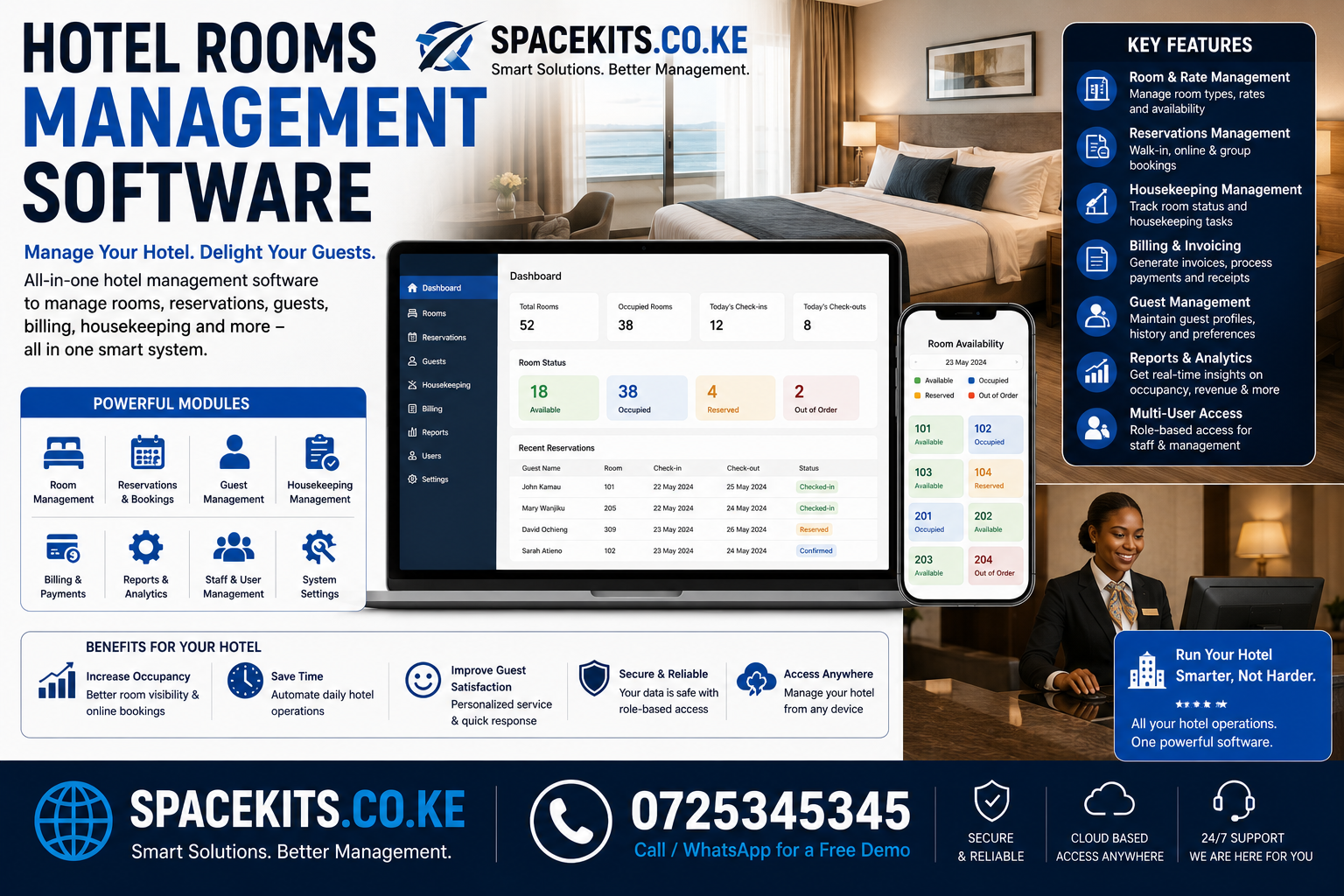
Managing hotel rooms manually can become increasingly difficult as the number of rooms, guests, bookings, staff, payments, and housekeeping activities grows. A modern digital platform can bring these operations together, helping hotel managers maintain accurate room availability, coordinate reservations, organize guest information, manage housekeeping, process payments, and monitor performance.
For hotels, guesthouses, lodges, serviced apartments, resorts, and other accommodation businesses, the ability to know exactly which rooms are occupied, vacant, reserved, being cleaned, or undergoing maintenance is essential. A centralized system can provide this visibility while reducing dependence on paper registers, spreadsheets, handwritten booking diaries, and disconnected communication channels.
PMS.co.ke has a hotel-focused property management system that covers reservations, room allocation, guest check-in and check-out, billing, housekeeping, maintenance, reporting, and mobile-money payment functionality.
Hotel Rooms Management Software for Centralized Room Management
The foundation of effective hotel operations is knowing what is happening with every room.
A hotel may have dozens or hundreds of rooms divided into categories such as standard rooms, executive rooms, deluxe rooms, suites, family rooms, or accessible rooms. Each room has its own status, pricing, booking history, maintenance requirements, and housekeeping condition.
A centralized system can allow hotel staff to organize this information from one dashboard.
Instead of checking a physical room-status board, reception can view information digitally. A room can be marked as:
- Available
- Occupied
- Reserved
- Checked out
- Awaiting cleaning
- Under cleaning
- Out of service
- Under maintenance
- Blocked for another operational reason
This makes it easier for reception and housekeeping teams to work from the same information.
PMS.co.ke’s hotel solution describes centralized room availability and booking management, helping hotels coordinate room allocation and avoid double bookings.
Hotel Rooms Management Software for Room Availability Tracking
Room availability changes throughout the day.
A guest may check out at 10 a.m., housekeeping may clean the room at 11 a.m., and another guest may arrive at 2 p.m. If these changes are recorded manually, delays and communication mistakes can occur.
Digital availability tracking helps the front desk understand the current status of every room.
For example, reception can quickly identify rooms that are:
- Ready for arrival
- Occupied
- Waiting for housekeeping
- Reserved for future guests
- Temporarily unavailable
This makes room allocation more efficient.
When a guest arrives early, staff can immediately check whether a suitable room has already been cleaned. When a reservation is cancelled, the room can be returned to the available inventory.
Real-time availability is particularly valuable during weekends, holidays, conferences, weddings, festivals, and other periods when demand increases.
Hotel Rooms Management Software for Reservation Management
Reservations are central to hotel operations.
Bookings can come through the hotel’s website, telephone calls, walk-in guests, travel agents, online travel agencies, social media, corporate clients, or other channels.
A centralized reservation system allows these bookings to be organized in one place.
Hotel staff can record details such as:
- Guest name
- Contact information
- Arrival date
- Departure date
- Room category
- Assigned room
- Number of guests
- Payment status
- Special requests
- Booking source
- Reservation notes
The reservation calendar provides a visual representation of room demand.
PMS.co.ke’s hotel-focused content identifies booking and reservation management as a core capability, including real-time availability and synchronization across online channels and reception operations.
This can reduce the likelihood of two employees assigning the same room to different guests.
Hotel Rooms Management Software for Preventing Double Bookings
Double bookings can create serious problems for hotel staff and guests.
Imagine a guest arriving at reception after travelling several hours only to discover that the room assigned to them has already been allocated to another customer.
A centralized booking system helps prevent this problem by maintaining a shared inventory.
When a room is booked, its availability is updated. When a reservation is cancelled, the inventory can be adjusted. When a guest checks in, the room status changes to occupied.
This creates a continuous relationship between bookings and room availability.
For hotels receiving reservations from multiple channels, synchronization is particularly important. PMS.co.ke states that its hotel solution can synchronize bookings across online travel agencies, the hotel website, and the reception desk.
Hotel Rooms Management Software for Guest Check-In and Check-Out
The front desk is one of the most visible parts of the guest experience.
Long queues, repeated data entry, and difficulty locating reservations can create frustration.
A digital system can help reception staff locate bookings quickly and complete check-in processes more efficiently.
At check-in, staff may verify:
- Guest identity
- Reservation details
- Room assignment
- Number of nights
- Payment status
- Special requests
- Additional services
At checkout, the system can help staff review the guest’s account, confirm charges, process outstanding payments, and update the room status.
PMS.co.ke’s hotel system specifically identifies guest check-in and check-out management as part of its functionality.
This connection between front-desk activity and room status is important because the room can move from occupied to awaiting housekeeping immediately after checkout.
Hotel Rooms Management Software for Housekeeping Coordination
Housekeeping has a direct effect on room availability and guest satisfaction.
A hotel cannot sell a room that has been checked out but has not yet been cleaned and inspected.
A digital housekeeping workflow can help staff prioritize rooms based on arrivals and departures.
For example, the housekeeping team can see which rooms need cleaning and which arrivals are expected soon.
Room statuses can help coordinate the workflow:
Dirty: Guest has departed and cleaning is required.
Cleaning: Housekeeping is working on the room.
Inspected: Room has been checked and approved.
Ready: Room is available for a new guest.
This reduces unnecessary communication between reception and housekeeping.
PMS.co.ke’s hotel-focused platform describes housekeeping scheduling and room-cleaning status tracking as part of its hospitality workflow.
Hotel Rooms Management Software for Maintenance Tracking
Not every unavailable room is waiting for housekeeping.
Some rooms may be blocked because of maintenance problems.
A leaking shower, broken air conditioner, electrical fault, damaged furniture, plumbing issue, or faulty door lock can prevent a room from being sold.
A digital maintenance workflow helps staff record the problem and track its resolution.
A maintenance record can include:
- Room number
- Problem description
- Date reported
- Assigned technician
- Priority
- Estimated repair time
- Status
- Completion date
- Cost
Once the repair is completed, the room can be inspected and returned to available inventory.
This prevents reception from accidentally assigning a room that is still experiencing a technical problem.
Hotel Rooms Management Software for Hotel Billing
Room charges are only one part of a guest’s final bill.
A guest may also purchase:
- Meals
- Drinks
- Laundry
- Airport transfers
- Conference services
- Room service
- Spa services
- Extra beds
- Late checkout
- Other hotel services
A centralized billing system can bring these charges together.
At checkout, reception can review the guest’s complete account rather than manually collecting information from several departments.
PMS.co.ke’s hotel solution identifies integrated billing and invoicing, bill splitting, payment processing, and mobile-payment support as hotel management functions.
This can improve billing accuracy and reduce disputes.
Hotel Rooms Management Software for M-PESA and Digital Payments
Kenyan hotels increasingly need flexible payment options.
Guests may pay through M-PESA, cards, bank transfers, or cash depending on the hotel’s setup.
A digital system can make payment information easier to associate with reservations and guest accounts.
PMS.co.ke’s hotel-specific content identifies M-PESA, Airtel Money, cards, and bank transfers as supported payment channels.
For hotels serving local and international guests, multiple payment options can make the booking and checkout process more convenient.
Digital receipts can also make recordkeeping easier for both the hotel and guest.
Hotel Rooms Management Software for Guest Information
Guest records are another essential component of hotel operations.
A hotel may need to retain information relating to previous stays, preferences, contact details, booking history, and other relevant information.
A centralized guest profile can help staff provide more consistent service.
For example, if a returning guest previously requested a particular room type or had a known preference, authorized staff can review the available information before the next stay.
Guest information can also support communication before arrival.
The system can be used to organize reservation details and help reception prepare for expected arrivals.
PMS.co.ke’s hotel system describes secure guest data management, including preferences, contact details, and stay history.
Hotel Rooms Management Software for Occupancy Monitoring
Occupancy is one of the most important hotel performance indicators.
Managers need to know how many rooms are occupied, how many are vacant, how many are unavailable, and how many are expected to become available.
A digital dashboard can make these figures easier to monitor.
For example, a hotel with 100 rooms might have:
- 70 occupied
- 10 reserved
- 8 awaiting housekeeping
- 5 under maintenance
- 7 available
The manager can immediately see where attention is needed.
Occupancy reports can also help management compare different periods and identify demand patterns.
PMS.co.ke identifies revenue reports, analytics, and occupancy reporting among the capabilities of its hotel-focused system.
Hotel Rooms Management Software for Revenue Monitoring
Hotel managers need more than occupancy numbers.
They also need to understand how rooms are generating revenue.
A digital platform can help organize information around:
- Room revenue
- Occupancy
- Average room rates
- Booking sources
- Payment collections
- Guest stays
- Additional services
These insights can support pricing and promotional decisions.
For example, if a hotel consistently has low occupancy on certain weekdays, management might consider corporate packages, promotional rates, meeting packages, or targeted campaigns.
During high-demand periods, managers may have more confidence adjusting room rates based on available inventory and booking activity.
The value of analytics is that decisions can be based on operational information rather than guesswork.
Hotel Rooms Management Software for Multi-Property Hotel Groups
Hotel groups often operate more than one property.
Managing each property independently can make consolidated reporting difficult.
A centralized platform can allow authorized managers to monitor multiple properties from one environment.
This can be useful for hotel groups operating in Nairobi, Mombasa, Kisumu, Nakuru, Eldoret, coastal destinations, or other locations.
Management can compare:
- Occupancy
- Revenue
- Reservations
- Room availability
- Maintenance
- Performance
- Guest activity
PMS.co.ke’s hotel-focused material identifies multi-property dashboards for hotel chains.
This can help senior management obtain a broader view of the business while allowing individual properties to maintain their daily workflows.
Hotel Rooms Management Software for Small Hotels and Guesthouses
Digital hotel management is not limited to large resorts.
Small hotels and guesthouses can also benefit from structured room management.
A small property may have only 10, 20, or 30 rooms, but the owner may still need to manage bookings, payments, housekeeping, maintenance, guest information, and reports.
Manual processes can consume valuable time even at smaller properties.
A digital system can help the owner or manager see the entire operation from one place.
PMS.co.ke’s hotel content states that its platform is designed to scale from smaller accommodation businesses to larger properties, including hotels, resorts, guesthouses, and multi-location groups.
This makes scalability an important consideration when selecting a platform.
Hotel Rooms Management Software for Serviced Apartments
Serviced apartments combine elements of hotel and residential accommodation.
Guests may stay for several days, weeks, or months, while still requiring hotel-style services.
The management system therefore needs to support room or unit availability, bookings, payments, housekeeping, maintenance, and guest records.
A centralized platform can help maintain these records.
For properties with different room categories, managers can configure the available inventory and associate reservations with the appropriate units.
This reduces reliance on separate booking calendars.
Hotel Rooms Management Software for Hotel Front Desk Operations
The front desk coordinates many activities simultaneously.
A receptionist may need to:
- Check arrivals
- Process departures
- Assign rooms
- Answer guest questions
- Confirm reservations
- Check payments
- Communicate with housekeeping
- Respond to room changes
- Handle extensions
A centralized dashboard can reduce the need to switch between separate systems.
The receptionist can access booking and room information from one place.
PMS.co.ke’s hotel industry material specifically identifies front-desk operations, room assignment, check-ins, and check-outs as core functions.
This can make daily operations more predictable.
Hotel Rooms Management Software for Automated Communication
Communication is important before, during, and after a guest’s stay.
Hotels may send:
- Booking confirmations
- Arrival reminders
- Payment information
- Check-in instructions
- Service notifications
- Checkout reminders
- Follow-up messages
Centralized communication can help staff maintain consistent records.
PMS.co.ke’s broader platform includes SMS, email, and in-app communication capabilities, while its hotel-focused material emphasizes centralized hospitality operations.
Automated communication can also reduce the amount of repetitive work performed by front-desk employees.
Hotel Rooms Management Software for Digital Reporting
Hotel managers need regular reports to understand business performance.
Reports can cover:
- Occupancy
- Room revenue
- Payments
- Reservations
- Guest stays
- Expenses
- Housekeeping
- Maintenance
- Revenue trends
A digital reporting system can produce these insights more quickly than manual calculations.
PMS.co.ke’s hotel-focused content identifies revenue reports and analytics as key functions, while the broader PMS platform provides financial reports such as cash flow, P&L, and rent-related reporting.
The exact reports required will depend on the hotel’s operating model.
Hotel Rooms Management Software for Reducing Administrative Errors
Manual records can introduce errors.
A receptionist may accidentally enter the wrong room number. A booking may be written in the wrong date column. A payment may not be recorded correctly. A housekeeping update may not reach the front desk.
When information is centralized, staff work from a shared record.
This does not eliminate every possible error, but it can reduce duplicated data entry and improve visibility.
For example, once a reservation is entered, other departments can access the information they need rather than recreating the booking separately.
The result is a more connected workflow.
Hotel Rooms Management Software for Better Housekeeping Prioritization
Housekeeping teams often have competing priorities.
Some rooms need routine cleaning. Others have guests waiting to check in. Some require deep cleaning. Others may need inspection before being released.
A digital system can help prioritize work according to room status and expected arrivals.
For example:
- Guest checks out.
- Room becomes dirty.
- Housekeeping receives the task.
- Cleaning begins.
- Room is inspected.
- Room becomes ready.
- Reception sees the updated status.
- New guest can be assigned.
This simple workflow can significantly improve coordination between departments.
Hotel Rooms Management Software for Maintenance and Room Availability
Maintenance problems can directly affect revenue.
If an air-conditioning fault makes a room unavailable for three days, those three days represent potential lost revenue.
A maintenance workflow helps management identify unavailable rooms and track how long they remain blocked.
Managers can then monitor recurring maintenance issues.
If several rooms experience the same plumbing problem, for example, management can investigate the underlying cause rather than repeatedly treating individual incidents.
This turns maintenance records into operational intelligence.
Hotel Rooms Management Software for Managing Room Categories
Hotels rarely have only one type of room.
A digital system can organize rooms according to categories.
Examples include:
- Standard single
- Standard double
- Deluxe
- Executive
- Family
- Suite
- Premium
- Accessible rooms
Each category can have its own pricing and availability.
This makes it easier for reception to identify suitable rooms for specific reservations.
A guest booking a family room should not accidentally be assigned a standard single simply because the physical room number was available.
Room categories provide a structured layer between the guest’s reservation and the physical room inventory.
Hotel Rooms Management Software for Managing Guest Extensions
Guests sometimes extend their stays.
When a guest requests an additional night, the system needs to reflect the new departure date and ensure that the room is not simultaneously reserved for another guest.
A centralized reservation calendar makes this easier to check.
Staff can review upcoming bookings before approving the extension.
If the room is available, the reservation can be updated. If another guest is arriving, reception can identify alternative accommodation.
This reduces the possibility of creating scheduling conflicts.
Hotel Rooms Management Software for Handling Cancellations
Cancellations are part of hotel operations.
When a booking is cancelled, staff need to update the reservation and room inventory.
If the cancellation is not recorded, the room may incorrectly remain unavailable.
If it is recorded incorrectly, the room may become available when another operational restriction exists.
A centralized reservation workflow creates a clear record of cancellation activity.
The hotel can then monitor cancelled bookings and understand how cancellations affect occupancy.
Hotel Rooms Management Software for Improving Guest Experience
Technology should ultimately support better service.
Guests may never see the hotel management dashboard, but they experience its effects.
A well-organized system can help staff:
- Find reservations faster
- Reduce check-in delays
- Identify clean rooms
- Process payments efficiently
- Respond to requests
- Coordinate maintenance
- Maintain accurate booking information
These operational improvements can contribute to a smoother guest experience.
PMS.co.ke’s hotel-focused platform positions centralized management as a way to improve efficiency and guest service.
Hotel Rooms Management Software for Data Security
Hotel systems contain valuable information.
Guest details, booking histories, payment records, staff information, and operational records should be protected.
PMS.co.ke states that its broader platform uses encryption in transit and at rest, daily encrypted backups, MFA, and role-based access controls.
Hotels should also establish internal procedures covering passwords, user access, data retention, device security, and staff permissions.
A secure system is particularly important when multiple employees access the same platform.
Hotel Rooms Management Software for Mobile and Cloud Access
Hotel managers are not always sitting at the reception desk.
They may be inspecting rooms, meeting suppliers, travelling between properties, or working remotely.
Cloud-based access allows authorized users to view operational information from connected devices.
PMS.co.ke describes its hotel system as cloud-based and accessible from mobile and desktop environments.
This can be useful for owners and managers who need visibility without being physically present at the property.
Hotel Rooms Management Software for Growing Accommodation Businesses
A hotel’s administrative needs change as it grows.
A property that begins with 20 rooms may eventually expand to 50 or 100 rooms.
Additional properties may also be added.
Choosing a scalable platform early can prevent the business from having to migrate between systems every time its room inventory increases.
PMS.co.ke’s hotel content states that its solution can support properties ranging from small accommodation businesses to larger operations, including properties with hundreds of rooms.
Growth should therefore be considered when evaluating software.
Hotel Rooms Management Software for Performance Analysis
Operational data becomes more useful when it can be analyzed.
Managers can examine occupancy trends and identify periods of strong or weak demand.
They can also compare performance between room categories.
For example, if deluxe rooms consistently have high occupancy while standard rooms remain vacant, management may investigate pricing, marketing, room positioning, or guest preferences.
Similarly, if occupancy is high but revenue remains weak, managers may need to examine pricing and additional-service revenue.
Digital reporting gives management the information required to ask these questions.
Hotel Rooms Management Software for Managing Hotel Staff Workflows
Hotels depend on coordinated teams.
Reception, housekeeping, maintenance, accounts, food and beverage, security, and management all contribute to the guest experience.
A centralized platform can give each department access to the information relevant to its responsibilities.
Reception needs reservations.
Housekeeping needs room status.
Maintenance needs repair requests.
Accounts needs payment information.
Management needs reports.
Role-based access can ensure that employees see the information necessary for their jobs without giving everyone unrestricted access.
PMS.co.ke’s broader platform includes roles, permissions, and access controls.
Hotel Rooms Management Software for Hotels Using Multiple Booking Channels
Modern hotels may receive reservations from several sources.
These may include:
- Direct website bookings
- Telephone reservations
- Walk-ins
- Corporate accounts
- Travel agencies
- Online travel agencies
- Social media
- Repeat customers
Managing these sources manually can become difficult.
A centralized reservation system helps maintain one view of available inventory.
PMS.co.ke’s hotel material states that its system can synchronize bookings across OTAs, the hotel website, and the reception desk.
This is particularly important for hotels with high booking volumes.
Hotel Rooms Management Software for Better Financial Control
Financial control requires accurate information.
Management should be able to understand what has been billed, what has been collected, and what remains outstanding.
Digital billing can reduce manual calculations and create a clearer audit trail.
A guest’s account can contain room charges and additional services, while payments can be recorded against the account.
At checkout, the final amount can be calculated from the stored transactions.
This can reduce disputes caused by incomplete or inconsistent records.
Hotel Rooms Management Software for Hotel Chains and Multiple Locations
Hotel chains face additional complexity because each property may have different room inventories, managers, staff, and operating patterns.
A centralized multi-property dashboard can provide senior management with a consolidated view.
Individual properties can continue managing their daily operations while management reviews overall performance.
PMS.co.ke’s hotel platform identifies multi-property dashboards as a feature for hotel chains.
This structure can support expansion without requiring completely separate management systems for every location.
Hotel Rooms Management Software for Choosing the Right System
Before adopting a digital platform, hotel operators should assess their requirements carefully.
Important considerations include:
Hotel Rooms Management Software for Reservation Requirements
Determine whether the platform can handle direct bookings, walk-ins, cancellations, room changes, extensions, and online booking channels.
Hotel Rooms Management Software for Housekeeping Requirements
Check whether housekeeping teams can view room statuses, receive assignments, and update cleaning progress.
Hotel Rooms Management Software for Billing Requirements
Confirm whether the system supports room charges, additional services, receipts, invoices, and the hotel’s preferred payment channels.
Hotel Rooms Management Software for Reporting Requirements
Identify the occupancy, revenue, payment, and operational reports required by management.
Hotel Rooms Management Software for Scalability Requirements
Consider the number of rooms today and the number the business expects to manage in the future.
Hotel Rooms Management Software for Replacing Manual Room Registers
Many smaller accommodation businesses still rely on notebooks and spreadsheets.
These methods may appear inexpensive, but they can become increasingly difficult to manage as bookings increase.
A notebook does not automatically update availability.
A spreadsheet does not necessarily communicate housekeeping changes to reception.
A handwritten payment receipt cannot automatically update an occupancy report.
A centralized system connects these activities.
The goal is not simply to make the business more technological. The goal is to make daily operations more organized and easier to monitor.
Hotel Rooms Management Software for Better Operational Visibility
The greatest benefit of a connected system is visibility.
Management can see what is happening without waiting for several departments to send separate reports.
A room’s journey can be tracked from reservation to check-in, occupancy, checkout, housekeeping, and eventual availability.
A guest’s financial account can be monitored from booking through payment and checkout.
A maintenance problem can be tracked from reporting to assignment and completion.
This creates a continuous digital record of the hotel’s operations.
Hotel Rooms Management Software for Kenyan Hotels
Kenyan hotels have specific operational requirements, particularly around mobile-money payments, local business practices, multiple booking channels, and the need for mobile access.
PMS.co.ke’s hotel-specific platform is positioned for hospitality businesses in Kenya and includes M-PESA and Airtel Money support, cloud access, booking management, room allocation, housekeeping, billing, and reporting.
This local orientation can be useful for hotels that want their digital operations to reflect the payment and management environment in Kenya.
Hotel Rooms Management Software for Modern Hotel Administration
Hotel room administration involves much more than knowing whether a room is occupied.
Managers need to coordinate reservations, guest arrivals, departures, payments, housekeeping, maintenance, room categories, staff activities, and financial reporting.
A centralized digital platform brings these functions together.
The workflow becomes more connected:
Reservation → Room allocation → Check-in → Guest stay → Billing → Check-out → Housekeeping → Room readiness → New reservation.
Every department participates in the same operational cycle.
When information is centralized, managers have greater visibility into the entire process.
Hotel Rooms Management Software for Hotels Ready to Digitize Their Operations
For a hotel considering digital transformation, the starting point should be an assessment of current workflows.
Identify where information is currently stored.
Determine how reservations are recorded.
Review how room availability is communicated.
Examine how housekeeping receives assignments.
Check how payments are reconciled.
Assess how reports are produced.
Then identify which manual processes consume the most time.
A suitable digital platform can be introduced around these workflows rather than forcing staff to maintain multiple disconnected systems.
PMS.co.ke provides hotel-focused functionality around reservations, room allocation, guest management, billing, housekeeping, maintenance, payments, reporting, and multi-property operations.
For a hotel looking to improve room visibility and daily coordination, this approach provides a practical starting point.
A well-implemented system can help staff know what rooms are available, what guests are arriving, which rooms require cleaning, which rooms require maintenance, what payments have been received, and how the property is performing.
The result is a more structured operating environment where information moves between departments instead of remaining trapped in separate notebooks, spreadsheets, messages, and paper files.
For hotel owners, managers, guesthouse operators, serviced-apartment managers, and hospitality groups in Kenya, the next step is to compare the available features against the actual needs of the property.
Explore the PMS.co.ke hotel property management solution and review how centralized reservations, room allocation, guest management, housekeeping, billing, payments, maintenance, and reporting can support your accommodation business.
