
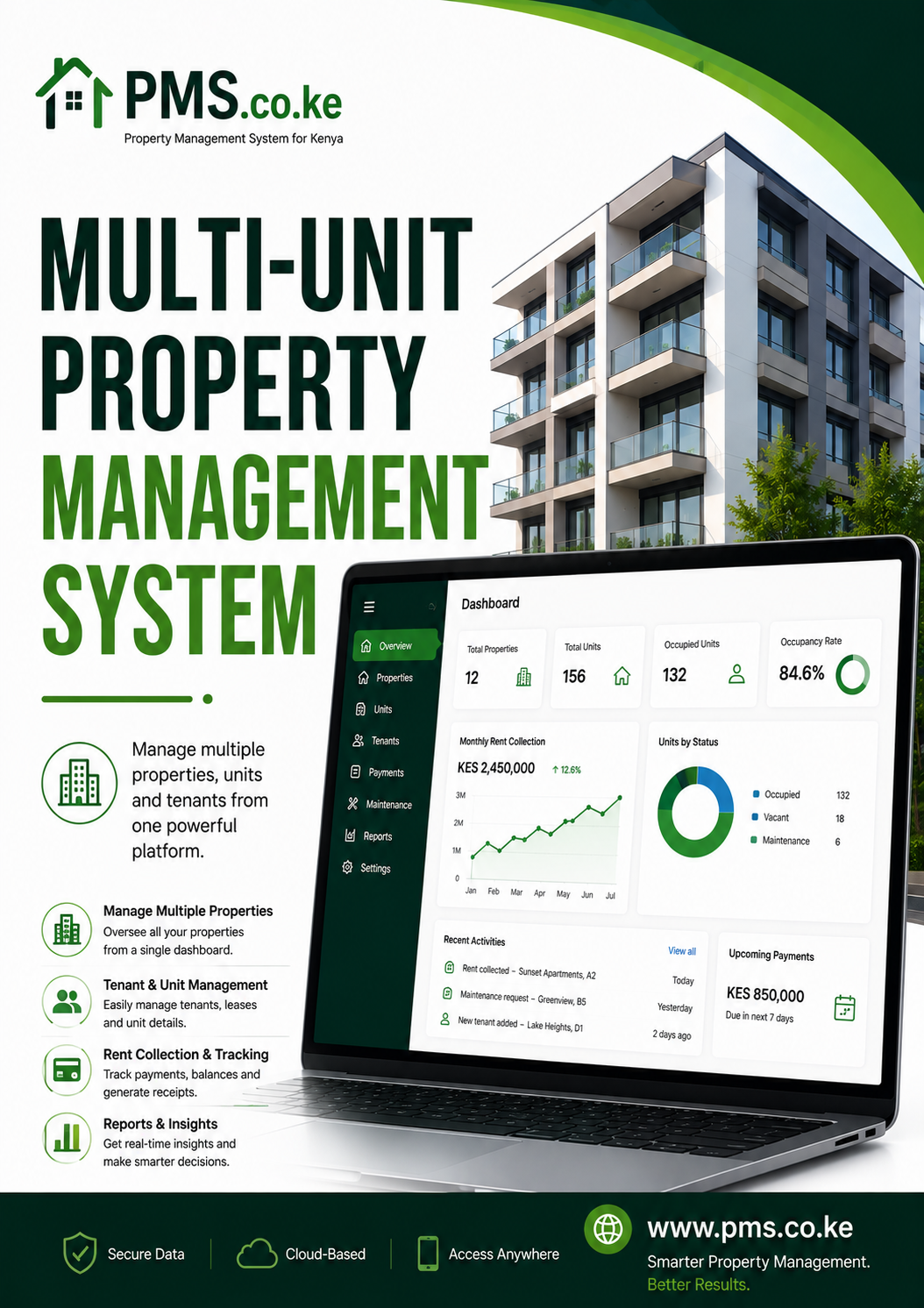
Multi-Unit Property Management System provides centralized tools that help property managers oversee tenants, leases, maintenance, finances, and occupancy across numerous units from a single platform.
As Kenya’s real estate market continues to expand, property managers require efficient solutions that improve visibility, reduce administrative workload, and enhance tenant satisfaction. A Multi-Unit Property Management System enables property professionals to manage growing portfolios while maintaining operational excellence.
Table of Contents
- Understanding Multi-Property Operations
- Why Centralized Property Management Matters
- Core Features of Modern Management Platforms
- Unit and Building Administration
- Tenant and Lease Coordination
- Maintenance and Service Management
- Financial Tracking and Reporting
- Challenges of Traditional Property Management
Understanding Multi-Property Operations
A Multi-Unit Property Management System is designed to help landlords, property managers, and real estate companies manage multiple units within one or more properties using a centralized platform.
Whether overseeing apartment complexes, gated communities, office buildings, student housing, or mixed-use developments, a Multi-Unit Property Management System provides a unified view of operations. Managers can monitor occupancy, lease status, maintenance activities, rent collection, and financial performance from a single dashboard.
This centralized approach improves decision-making and eliminates the inefficiencies associated with disconnected systems.
Why Centralized Property Management Matters
Managing multiple units manually often leads to operational bottlenecks, data inconsistencies, and communication challenges.
A Multi-Unit Property Management System addresses these issues by providing:
- Centralized property oversight
- Real-time occupancy visibility
- Standardized workflows
- Improved communication
- Better financial control
- Faster maintenance coordination
- Enhanced reporting capabilities
For property managers in Kenya, centralized management is becoming increasingly important as portfolios expand and tenant expectations rise.
The ability to access information instantly across all units improves responsiveness and operational efficiency.
Core Features of Modern Management Platforms
A modern Multi-Unit Property Management System includes a wide range of features designed to simplify day-to-day operations.
Key capabilities include:
Property Portfolio Management
Manage multiple buildings, properties, and units from a single platform.
Occupancy Tracking
Monitor vacant, occupied, reserved, and unavailable units in real time.
Lease Management
Track lease agreements, renewals, expirations, and tenant histories.
Tenant Communication
Provide efficient communication channels between tenants and management teams.
Maintenance Coordination
Automate maintenance requests and work order management.
Financial Reporting
Generate detailed income, expense, and occupancy reports.
These features help create a more organized and scalable property management environment.
Unit and Building Administration
Effective property operations require detailed oversight of every unit within a portfolio.
A Multi-Unit Property Management System allows managers to:
- Create building hierarchies
- Organize units by property
- Monitor occupancy status
- Track unit attributes
- Manage availability
- Record inspections
- Store property documentation
Having all unit information stored in one platform improves operational consistency and reduces administrative effort.
Property managers can quickly locate information about specific units without searching through spreadsheets or paper records.
Tenant and Lease Coordination
Tenant management becomes significantly easier with a Multi-Unit Property Management System.
The platform supports:
- Tenant registration
- Digital tenant records
- Lease administration
- Move-in management
- Move-out processing
- Lease renewal tracking
- Occupancy monitoring
By centralizing tenant information, property managers can improve service delivery and reduce delays caused by fragmented record systems.
The result is a smoother tenant experience and stronger long-term occupancy performance.
Maintenance and Service Management
Maintenance is one of the most resource-intensive aspects of property management.
A Multi-Unit Property Management System helps coordinate maintenance activities by providing:
- Maintenance request portals
- Work order tracking
- Vendor coordination
- Preventive maintenance scheduling
- Service history records
- Asset monitoring
Property teams can prioritize tasks, track completion status, and ensure service requests are addressed efficiently.
For large residential developments and commercial properties in Kenya, maintenance automation significantly improves operational performance.
Financial Tracking and Reporting
Financial visibility is essential when managing multiple units and properties.
A Multi-Unit Property Management System provides tools for:
- Rent tracking
- Payment monitoring
- Income reporting
- Expense management
- Budget planning
- Occupancy analysis
- Financial forecasting
Managers gain access to accurate real-time financial data that supports informed decision-making.
Centralized reporting also improves transparency for property owners and investors.
Challenges of Traditional Property Management
Organizations that rely on manual processes often encounter numerous operational challenges.
Common issues include:
- Disconnected property records
- Delayed maintenance coordination
- Inconsistent reporting
- Manual rent tracking
- Duplicate data entry
- Poor visibility across properties
- Increased administrative workload
Without a Multi-Unit Property Management System, managing large portfolios becomes increasingly difficult as property numbers grow.
Manual systems limit scalability and make it harder to maintain service quality across multiple locations.
Benefits for Property Managers
A Multi-Unit Property Management System provides significant operational advantages for property managers responsible for overseeing multiple buildings and units. Instead of managing separate spreadsheets, documents, and communication channels, managers can centralize operations within one platform.
Key benefits include:
- Centralized portfolio oversight
- Improved occupancy management
- Faster maintenance coordination
- Reduced administrative workload
- Better tenant communication
- Streamlined lease administration
- Enhanced reporting capabilities
A Multi-Unit Property Management System also improves visibility across properties, enabling managers to quickly identify vacancies, overdue maintenance tasks, expiring leases, and financial performance indicators.
For property management companies in Kenya, the ability to manage large portfolios efficiently can directly impact profitability and growth.
Benefits for Property Owners
Property owners gain valuable insights and control through a Multi-Unit Property Management System.
By centralizing operational and financial data, owners can monitor portfolio performance without relying solely on manual reports.
Benefits include:
- Greater transparency
- Improved investment oversight
- Accurate occupancy reporting
- Better financial visibility
- Enhanced property performance monitoring
- More effective budgeting
- Improved asset utilization
A Multi-Unit Property Management System allows property owners to evaluate how individual buildings, units, and developments contribute to overall portfolio performance.
This level of visibility supports smarter investment decisions and long-term property growth strategies.
Benefits for Tenants
Tenants benefit when property operations are organized and responsive. A modern Multi-Unit Property Management System helps improve service quality throughout the tenant lifecycle.
Key tenant advantages include:
- Faster response to maintenance requests
- Improved communication channels
- Simplified payment processes
- Better service tracking
- Enhanced property experiences
- More efficient move-in and move-out processes
Because all tenant information is centralized, property teams can resolve issues more quickly and provide more consistent service.
A well-implemented Multi-Unit Property Management System ultimately contributes to higher tenant satisfaction and retention rates.
Improving Efficiency Through Automation
Automation is one of the most powerful capabilities of a Multi-Unit Property Management System.
Routine administrative tasks can be automated, including:
- Lease reminders
- Rent collection notifications
- Occupancy updates
- Maintenance scheduling
- Work order assignments
- Inspection tracking
- Financial reporting
Automation reduces manual effort while improving accuracy and consistency across operations.
Property managers can spend less time on repetitive tasks and more time focusing on tenant relationships, property improvements, and business growth.
As property portfolios expand, automation becomes essential for maintaining operational efficiency.
Compliance, Security, and Risk Management
Professional property management requires accurate records, secure data handling, and operational accountability.
A Multi-Unit Property Management System helps organizations maintain compliance through:
- Centralized record keeping
- Lease documentation management
- Maintenance history tracking
- Financial audit trails
- User access controls
- Secure cloud-based storage
- Automated reporting
Maintaining organized records reduces operational risk and supports stronger governance practices.
For property managers operating within Kenya’s competitive real estate sector, compliance and transparency contribute to greater trust among owners, tenants, and stakeholders.
The system also minimizes risks associated with missing documentation, inaccurate reporting, and operational inefficiencies.
Why RentalDesk Is the Ideal Solution
RentalDesk offers a comprehensive Multi-Unit Property Management System built specifically to support modern property management operations.
With RentalDesk, users can:
- Manage multiple properties from one dashboard
- Track occupancy in real time
- Coordinate maintenance activities
- Manage tenant information
- Administer leases efficiently
- Monitor financial performance
- Generate operational reports
RentalDesk combines multiple operational functions into a unified platform, including:
- Tenant management
- Lease administration
- Property operations
- Maintenance management
- Occupancy tracking
- Financial reporting
This integrated approach allows a Multi-Unit Property Management System to become the central hub for property operations.
For property managers and landlords across Kenya, RentalDesk provides the tools necessary to improve efficiency, increase visibility, and support portfolio growth.
Future Trends
The future of Multi-Unit Property Management System technology will continue to focus on automation, intelligence, and connectivity.
Emerging trends include:
Artificial Intelligence
AI-powered insights will help managers predict occupancy trends, maintenance needs, and operational risks.
Predictive Maintenance
Systems will identify potential equipment failures before they disrupt operations.
Mobile Property Management
Property managers will increasingly manage operations through mobile-first platforms.
Smart Building Integration
Management systems will connect directly with smart locks, sensors, utility monitoring tools, and access control systems.
Advanced Analytics
Real-time dashboards will provide deeper insights into property performance and tenant behavior.
Automated Portfolio Optimization
Future Multi-Unit Property Management System solutions will recommend operational improvements based on performance data and market trends.
These innovations will help property organizations remain competitive while delivering superior tenant experiences.
Getting Started
Successfully implementing a Multi-Unit Property Management System requires a structured approach.
Recommended steps include:
- Assess portfolio requirements
- Organize property and unit data
- Configure user roles and permissions
- Import tenant and lease records
- Establish maintenance workflows
- Set reporting objectives
- Train staff members
- Monitor adoption and performance
Organizations that invest in proper implementation often achieve faster operational improvements and stronger long-term results.
A professionally deployed Multi-Unit Property Management System becomes a strategic asset that supports growth, efficiency, and portfolio scalability.
