
Table of Contents
ToggleHow to Manage Multiple Rental Properties Kenya Without Losing Money
Many articles explaining how to manage multiple rental properties Kenya focus on convenience, automation, or growth but rarely show actual numbers. Most property management platforms claim landlords can “save time,” “grow faster,” or “scale easily,” yet they often fail to explain exactly how much money a landlord can make, what it costs to manage multiple properties, or how long it takes to recover investments. Looking at leading Kenyan property management platforms, the common themes are centralized dashboards, M-Pesa rent collection, tenant tracking, maintenance management, and vacancy monitoring. However, very few provide real profit calculations or break-even projections.
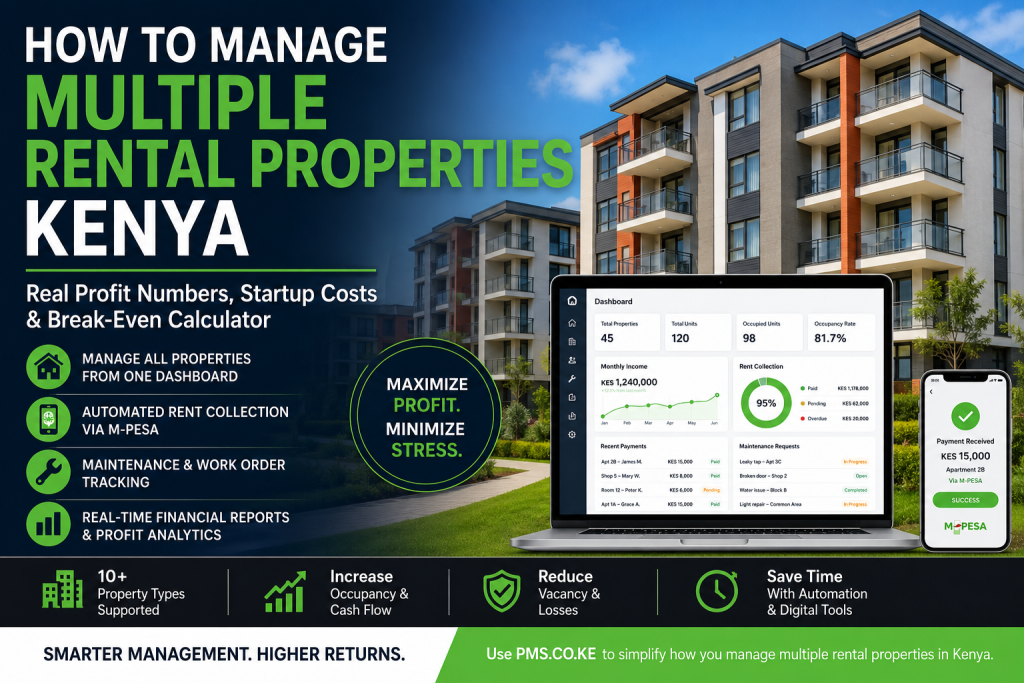
This guide goes beyond vague promises. We will explain how to manage multiple rental properties Kenya using actual Kenyan market figures, operational costs, software expenses, maintenance budgets, staffing costs, and expected returns.
Advanced Strategies on How to Manage Multiple Rental Properties Kenya for Long-Term Profitability
Many landlords believe that buying additional properties automatically increases profits. In reality, the difference between a profitable landlord and a stressed landlord often comes down to understanding how to manage multiple rental properties Kenya efficiently. The larger the portfolio becomes, the more important systems, automation, financial controls, and tenant management processes become. A landlord with five well-managed properties can often generate better returns than another landlord with twenty poorly managed units.
One of the most overlooked aspects of how to manage multiple rental properties Kenya is portfolio standardization. Every property should follow similar procedures for tenant onboarding, rent collection, maintenance requests, inspections, lease renewals, and move-outs. When every property uses different processes, management becomes confusing and expensive. Standard operating procedures reduce errors, improve accountability, and make it easier to delegate tasks to staff members or property managers.
For example, every new tenant should complete the same onboarding process. This should include identity verification, lease signing, deposit payment, emergency contact collection, utility registration, and digital record creation. By standardizing onboarding, landlords can reduce disputes and maintain accurate records across all properties.

Another important lesson in how to manage multiple rental properties Kenya is tracking performance at the property level rather than focusing only on total income. Many landlords know how much rent they collect monthly but have no idea which buildings are most profitable. Every property should have separate reports showing revenue, maintenance expenses, occupancy rates, arrears, and net cash flow. This allows investors to identify underperforming properties and make informed decisions.
Managing multiple properties becomes easier with the right systems. This guide on how to manage multiple rental properties Kenya covers rent collection, tenant management, maintenance tracking, profit calculations, software tools, and break-even analysis. Learn practical strategies to increase occupancy, reduce costs, improve cash flow, and scale your rental portfolio efficiently.
The Importance of Occupancy Rate Management
Occupancy is one of the biggest drivers of profitability.
Consider a 20-unit apartment building charging KES 15,000 per unit.
At 100% occupancy:
20 × 15,000
= KES 300,000 monthly revenue
At 90% occupancy:
18 × 15,000
= KES 270,000 monthly revenue
The landlord loses:
KES 30,000 monthly
KES 360,000 annually
This simple calculation demonstrates why understanding how to manage multiple rental properties Kenya requires constant monitoring of vacancies. Even a few empty units can significantly reduce annual profits.
To maintain high occupancy rates, landlords should:
- Respond quickly to inquiries
- Conduct property inspections regularly
- Improve tenant satisfaction
- Offer flexible payment arrangements where appropriate
- Use digital marketing platforms
- Encourage tenant referrals
Many successful property investors focus more on occupancy management than rent increases because maintaining occupied units is often more profitable than constantly searching for new tenants.
How Technology Improves How to Manage Multiple Rental Properties Kenya
Technology has transformed property management in Kenya. A decade ago, landlords relied heavily on physical files, paper receipts, and manual bookkeeping. Today, cloud-based systems provide a much more efficient way of managing multiple properties.
Modern property management software allows landlords to:
- Track rent payments automatically
- Generate receipts instantly
- Monitor arrears
- Schedule maintenance
- Store lease agreements
- Manage inspections
- Generate financial reports
For investors researching how to manage multiple rental properties Kenya, technology should not be viewed as an expense but as an investment.
Consider a landlord managing 100 units manually.
If rent reconciliation takes:
3 minutes per tenant
100 tenants × 3 minutes
= 300 minutes
= 5 hours monthly
With software automation, the same process may take less than 30 minutes.
Over a year, this can save dozens of hours while reducing accounting errors.
Platforms such as RentalDesk, PMS, EstateAdmin, Dexa, and Zivo provide valuable tools for automating property operations and improving tenant communication.
Financial Planning and Budgeting
Understanding how to manage multiple rental properties Kenya also requires strong financial discipline.
A common mistake among landlords is mixing personal finances with rental income.
Instead, every portfolio should maintain:
- Separate bank accounts
- Separate expense records
- Separate maintenance reserves
- Separate tax documentation
Example:
Monthly rent collected:
KES 500,000
Monthly expenses:
- Maintenance: KES 40,000
- Caretaker salaries: KES 30,000
- Utilities: KES 20,000
- Security: KES 25,000
- Software: KES 5,000
Total expenses:
KES 120,000
Net operating income:
KES 380,000
Without proper accounting systems, it becomes difficult to determine actual profitability.
Successful investors reviewing how to manage multiple rental properties Kenya typically prepare monthly, quarterly, and annual financial reports. These reports help identify trends and support future expansion decisions.
Tenant Retention Strategies
Tenant turnover is expensive.
Many landlords focus heavily on attracting new tenants while neglecting existing tenants.
However, retaining tenants is often far cheaper than replacing them.
Suppose a tenant moves out.
The landlord may incur:
- Cleaning costs: KES 5,000
- Marketing costs: KES 3,000
- Vacancy loss: KES 15,000
- Agent fees: KES 10,000
Total:
KES 33,000
If several tenants leave annually, these costs accumulate rapidly.
Therefore, a key component of how to manage multiple rental properties Kenya involves reducing turnover through better tenant experiences.
Effective strategies include:
- Prompt maintenance responses
- Transparent communication
- Secure premises
- Reliable water supply
- Fair rent reviews
- Digital payment options
Satisfied tenants often remain longer and recommend properties to friends and family.
Maintenance Management Best Practices
Maintenance can either protect property value or destroy profitability depending on how it is managed.
One of the biggest mistakes landlords make when learning how to manage multiple rental properties Kenya is waiting until problems become emergencies.
Preventive maintenance is almost always cheaper than emergency repairs.
Example:
Routine plumbing inspection:
KES 3,000
Major pipe burst repair:
KES 40,000
Roof inspection:
KES 5,000
Emergency roof replacement:
KES 150,000
The numbers clearly show why preventive maintenance should be part of every management strategy.
A practical maintenance schedule should include:
Monthly
- Water system checks
- Security inspections
- Cleaning inspections
Quarterly
- Plumbing inspections
- Electrical inspections
- Drainage checks
Annually
- Painting touch-ups
- Roof inspections
- Structural assessments
Property owners who consistently invest in maintenance generally achieve higher occupancy rates and stronger property valuations.
Scaling From 10 Units to 100 Units
Many landlords start with one property and gradually expand.
The challenge is that strategies that work for 10 units often fail at 100 units.
For example:
10 units:
- Manual tracking may be manageable
50 units:
- Spreadsheets become difficult
100 units:
- Dedicated systems become essential
When studying how to manage multiple rental properties Kenya, investors should prepare for growth before it happens.
A scalable management structure typically includes:
Stage 1: 1–20 Units
- Self-management
- Basic software
- Minimal staffing
Stage 2: 20–50 Units
- Dedicated caretaker
- Digital rent collection
- Maintenance tracking system
Stage 3: 50–100 Units
- Property manager
- Accounting support
- Tenant support processes
Stage 4: 100+ Units
- Full property management team
- Advanced reporting
- Automated workflows
Building systems early makes future expansion much easier.
Legal Compliance and Documentation
A critical aspect of how to manage multiple rental properties Kenya is maintaining proper documentation.
Every property should have:
- Lease agreements
- Tenant records
- Payment history
- Inspection reports
- Maintenance records
- Utility records
Digital storage systems reduce the risk of losing important documents.
Documentation also protects landlords during disputes.
Without proper records, resolving disagreements regarding rent payments, deposits, damages, or maintenance responsibilities becomes much more difficult.
Performance Metrics Every Landlord Should Track
Investors who understand how to manage multiple rental properties Kenya monitor key performance indicators regularly.
Important metrics include:
Occupancy Rate
Target:
95% or higher
Rent Collection Rate
Target:
98% or higher
Maintenance Cost Ratio
Target:
Below 15% of revenue
Tenant Retention Rate
Target:
Above 80%
Net Operating Income
Track monthly and annually.
These indicators provide a clear picture of portfolio performance.
Building a Sustainable Property Management Business
Ultimately, learning how to manage multiple rental properties Kenya is not simply about collecting rent. It is about building a sustainable business capable of generating consistent cash flow over many years.
The most successful landlords focus on:
- Systems
- Automation
- Tenant satisfaction
- Financial controls
- Maintenance planning
- Data-driven decisions
Whether managing apartments, hostels, mixed-use developments, commercial spaces, kiosks, or event venues, the same principles apply.
Property ownership alone does not guarantee profitability. Effective management does.
By implementing proper processes, investing in technology, maintaining accurate financial records, and focusing on tenant retention, landlords can scale their portfolios confidently and avoid many of the common problems that affect growing property businesses.
For anyone researching how to manage multiple rental properties Kenya, the most important takeaway is simple: treat rental property management as a business, not a hobby. The landlords who build systems today are the ones most likely to enjoy stable income, higher occupancy rates, stronger property values, and long-term wealth creation in Kenya’s growing real estate market.
Why Most Landlords Struggle
When landlords start with one property, management is relatively simple.
Once the portfolio grows to:
- 10 units
- 20 units
- 50 units
- 100 units
the complexity increases dramatically.
The biggest challenges include:
- Rent collection
- Tenant communication
- Maintenance tracking
- Vacancy management
- Utility billing
- Expense monitoring
- Arrears management
- Document storage
Many landlords still rely on:
- WhatsApp messages
- M-Pesa screenshots
- Excel spreadsheets
- Physical receipt books
This becomes difficult once multiple properties are involved. Community discussions among landlords consistently highlight maintenance tracking, lease management, and payment monitoring as major pain points when portfolios expand.
How to Manage Multiple Rental Properties Kenya Successfully
The answer to how to manage multiple rental properties Kenya starts with systems.
Successful landlords focus on five areas:
1. Centralized Rent Collection
Every payment should enter one reporting system.
2. Tenant Records
Store:
- ID copies
- Lease agreements
- Contacts
- Payment history
3. Maintenance Tracking
Every repair request should be logged.
4. Vacancy Monitoring
Track occupancy rates continuously.
5. Financial Reporting
Know:
- Monthly income
- Expenses
- Net profit
- Arrears
- Vacancy losses
Property management platforms increasingly provide these capabilities through centralized dashboards and automated reporting.
Startup Cost Table for Managing Multiple Properties
Assume a landlord manages 50 units across several locations.
| Item | Cost (KES) |
|---|---|
| Property management software setup | 30,000 |
| Training | 15,000 |
| Computer | 60,000 |
| Smartphone | 25,000 |
| Internet setup | 10,000 |
| Documentation digitization | 20,000 |
| Initial marketing | 25,000 |
| Accounting setup | 30,000 |
| Maintenance reserve | 150,000 |
| Emergency reserve | 160,000 |
| Total Startup Cost | 525,000 |
A professional landlord learning how to manage multiple rental properties Kenya should budget between KES 300,000 and KES 800,000 depending on portfolio size.
Revenue Scenario 1: 10-Unit Apartment
Assumptions:
- Rent per unit: KES 12,000
- Occupancy: 95%
Monthly revenue:
10 × 12,000 × 95%
= KES 114,000
Monthly expenses:
| Expense | Cost |
|---|---|
| Maintenance | 8,000 |
| Caretaker | 15,000 |
| Software | 3,000 |
| Utilities | 4,000 |
| Total | 30,000 |
Net monthly profit:
114,000 − 30,000
= KES 84,000
This is often the first step in learning how to manage multiple rental properties Kenya.
Revenue Scenario 2: Roadside Kiosk Property
Assumptions:
- 10 kiosks
- Rent KES 8,000
Monthly revenue:
10 × 8,000
= KES 80,000
Monthly costs:
| Expense | Cost |
|---|---|
| Maintenance | 5,000 |
| Security | 8,000 |
| Management | 7,000 |
| Total | 20,000 |
Net profit:
80,000 − 20,000
= KES 60,000
Revenue Scenario 3: School Hostel Property
Assumptions:
- 50 students
- KES 6,000 per bed
Monthly revenue:
50 × 6,000
= KES 300,000
Monthly expenses:
| Expense | Cost |
|---|---|
| Utilities | 25,000 |
| Caretaker | 20,000 |
| Cleaning | 15,000 |
| Maintenance | 10,000 |
| Total | 70,000 |
Net profit:
300,000 − 70,000
= KES 230,000
Understanding these numbers is critical when evaluating how to manage multiple rental properties Kenya as a business rather than a side investment.
Revenue Scenario 4: Event Space Rental Property
Assumptions:
- 12 events monthly
- KES 35,000 per event
Monthly revenue:
12 × 35,000
= KES 420,000
Monthly expenses:
| Expense | Cost |
|---|---|
| Staff | 35,000 |
| Cleaning | 15,000 |
| Security | 15,000 |
| Utilities | 20,000 |
| Total | 85,000 |
Net profit:
420,000 − 85,000
= KES 335,000
Monthly Operating Costs
One major lesson in how to manage multiple rental properties Kenya is budgeting for recurring costs.
| Cost Category | Monthly KES |
|---|---|
| Maintenance | 5,000–100,000 |
| Software | 1,000–20,000 |
| Internet | 2,000–10,000 |
| Caretakers | 15,000–60,000 |
| Security | 10,000–80,000 |
| Utilities | 5,000–100,000 |
| Accounting | 5,000–30,000 |
| Marketing | 5,000–50,000 |
Maintenance Budget Planning
Many landlords underestimate maintenance.
Annual maintenance reserve:
Property Value × 1%
Example:
KES 20 million apartment block
20,000,000 × 1%
= KES 200,000 annually
Monthly reserve:
200,000 ÷ 12
= KES 16,667
Maintenance should cover:
- Plumbing
- Electrical repairs
- Painting
- Roof repairs
- Security upgrades
- Water systems
- Gate repairs
This is a crucial part of how to manage multiple rental properties Kenya profitably.
Break-Even Timeline
Using startup cost:
KES 525,000
Apartment Example
525,000 ÷ 84,000
= 6.25 months
Kiosk Example
525,000 ÷ 60,000
= 8.75 months
School Hostel Example
525,000 ÷ 230,000
= 2.28 months
Event Space Example
525,000 ÷ 335,000
= 1.57 months
Break-Even Table
| Property Type | Monthly Profit | Break-Even |
|---|---|---|
| Apartment | 84,000 | 6.3 Months |
| Kiosk | 60,000 | 8.8 Months |
| School Hostel | 230,000 | 2.3 Months |
| Event Space | 335,000 | 1.6 Months |
These numbers provide a much clearer picture than generic advice about how to manage multiple rental properties Kenya.
Software for Managing Multiple Properties
Modern landlords should automate operations.
Recommended platforms include:
- RentalDesk Property Management System
- PMS Kenya Property Management Platform
- EstateAdmin Property Software
- Dexa Business Workflow System
- Zivo Customer Communication Platform
- Vega POS System
- Ratibu School Management System
- ChurchesAdmin Platform
Additional SaaS solutions include:
- Prim Salon Management Software
- Dereva Driver Marketplace
- Vota Campaign Management Platform
- Wito RSVP System
- Fama Platform
- Jaat Platform
- KayaPro360
- Musa Music AI
- Awasam
Risks and How to Mitigate Them
1. Tenant Defaults
Risk:
Missed rent payments.
Mitigation:
- Automated reminders
- Credit checks
- Deposits
2. Vacancy Risk
Risk:
Empty units.
Mitigation:
- Digital marketing
- Fast tenant onboarding
3. Maintenance Emergencies
Risk:
Unexpected repairs.
Mitigation:
- Emergency fund
- Preventive maintenance
4. Fraud
Risk:
Fake payment claims.
Mitigation:
- M-Pesa integration
- Automated receipts
5. Poor Record Keeping
Risk:
Lost income visibility.
Mitigation:
- Cloud property management software
Many landlords report that relying on screenshots and WhatsApp records creates significant tracking challenges as portfolios grow.
Is It Worth It?
Yes, but only if you build systems.
Most landlords fail because they manage:
- Payments manually
- Maintenance reactively
- Tenants through WhatsApp
- Reports using spreadsheets
Learning how to manage multiple rental properties Kenya is less about owning more buildings and more about creating repeatable systems.
A 50-unit portfolio generating KES 600,000 monthly rent with 20% operating expenses can still produce approximately KES 480,000 monthly cash flow.
Without systems, the same portfolio becomes difficult to control.
With automation, the business scales efficiently.
That is the real answer to how to manage multiple rental properties Kenya.
FAQ
1. What is the best software for managing multiple properties in Kenya?
Property management platforms such as RentalDesk, PMS, EstateAdmin, and other cloud-based systems help automate rent collection, tenant records, and reporting.
2. How many properties can one person manage?
With software, a single manager can oversee dozens or even hundreds of units efficiently.
3. How much should I budget for maintenance?
A common benchmark is approximately 1% of property value annually.
4. Is M-Pesa integration necessary?
Yes. Automated payment collection significantly improves efficiency.
5. When should I hire a property manager?
Once your portfolio grows beyond a few units or when administration begins consuming excessive time.
