
What Is Homeowners Management Software?
The property management industry is rapidly moving away from spreadsheets, paper receipts, WhatsApp-only communication, and manual service charge collection. Modern residential communities require structured systems capable of managing thousands of resident interactions every month. This is where Homeowners management software becomes essential.
A modern platform centralizes resident records, service charge billing, maintenance requests, visitor approvals, communication notices, facility reservations, accounting records, and security workflows. Instead of handling each activity separately, property managers can monitor everything from a single dashboard.
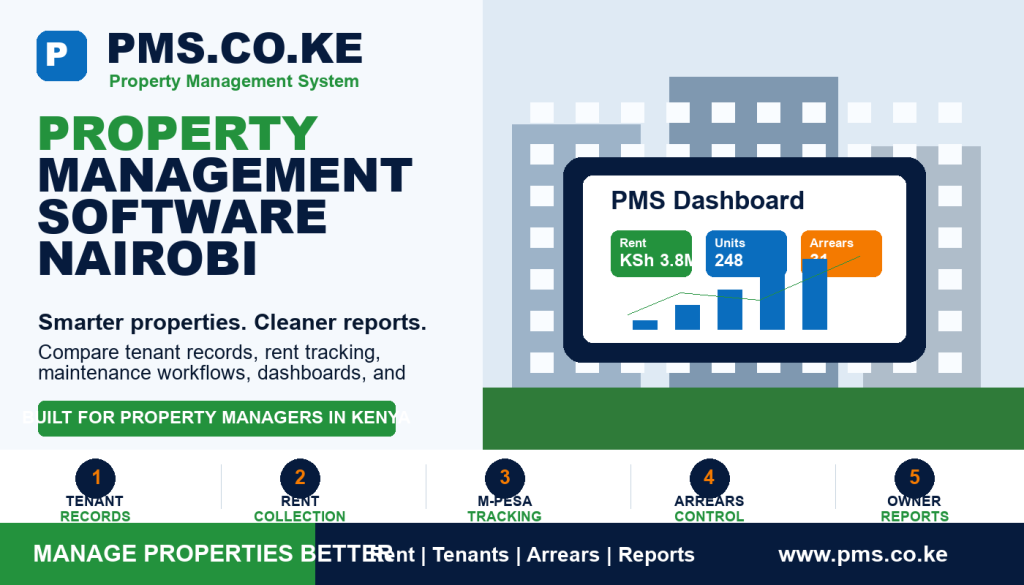
Across Kenya, more gated communities are adopting Homeowners management software to improve transparency, increase collection rates, and reduce administrative workload. Residents now expect digital services similar to those offered by banks, telecom providers, and online businesses. They want mobile payments, self-service portals, instant notifications, and online maintenance tracking.
Without digital systems, community managers often spend hours reconciling payments, following up on arrears, updating spreadsheets, and generating reports. The result is higher operational costs and lower resident satisfaction.
The adoption of Homeowners management software is therefore no longer a luxury. For many communities, it has become a competitive necessity.
Why Communities Need Homeowners Management Software
Residential estates have become increasingly complex. A community of one hundred homes can generate hundreds of transactions, complaints, maintenance tickets, security approvals, and facility bookings every month.
Managing these processes manually creates delays, errors, and accountability issues.
With Homeowners management software, every transaction becomes traceable. Service charge invoices can be generated automatically. Residents receive reminders without staff intervention. Visitor approvals can happen digitally. Maintenance requests can be assigned and monitored in real time.
This level of automation reduces administrative workload while improving resident confidence.
Many estate managers discover that a significant percentage of operational inefficiencies originate from poor record keeping. Once Homeowners management software is introduced, hidden inefficiencies become visible and measurable.
Homeowners Management Software Features That Matter Most
Not every system provides the same value.
The most important features include resident management, online payments, service charge tracking, maintenance workflows, facility booking, communication tools, visitor management, accounting integration, and reporting dashboards.
A quality Homeowners management software solution should also support M-Pesa payments, SMS notifications, audit trails, role-based permissions, and cloud backups.
Security management is particularly important in gated communities. Visitor records, contractor approvals, and access logs help communities maintain accountability.
Another important feature is maintenance management. Residents can submit issues online while managers track completion status and response times.
The best Homeowners management software solutions combine all these functions into a single platform.
Market Opportunity for Homeowners Management Software in Kenya
Kenya continues to experience rapid urban development. New apartment developments, gated communities, mixed-use estates, and managed properties are being built across Nairobi, Kiambu, Nakuru, Eldoret, Kisumu, Machakos, and Mombasa.
Every new development creates demand for operational systems.
Property developers increasingly market technology-enabled communities because buyers prefer convenience and transparency.
As more communities adopt digital tools, demand for Homeowners management software is expected to continue growing throughout 2026 and beyond.
Useful industry references include:
These resources demonstrate the global trend toward digital community management.
Startup Cost of Homeowners Management Software
| Expense Item | Estimated Cost (KES) |
|---|---|
| System setup | 30,000 |
| Data migration | 20,000 |
| Staff onboarding | 25,000 |
| Resident onboarding | 20,000 |
| SMS integration | 10,000 |
| M-Pesa integration | 30,000 |
| Customization | 80,000 |
| Contingency budget | 35,000 |
| Total | 250,000 |
For most communities, implementing Homeowners management software costs between KES 150,000 and KES 500,000 depending on customization requirements.
Revenue Model: 10-Unit Apartment
A 10-unit apartment charging KES 6,000 monthly service charge generates KES 60,000 monthly revenue.
If collection efficiency improves from 80% to 95% after adopting Homeowners management software, monthly collections increase from KES 48,000 to KES 57,000.
Additional revenue:
- KES 9,000 monthly
- KES 108,000 annually
Revenue Model: Roadside Kiosk
A kiosk inside a residential estate paying KES 20,000 monthly rent often suffers from delayed invoicing and payment tracking.
Using Homeowners management software ensures invoices are issued automatically and payments tracked accurately.
Estimated annual revenue improvement:
- KES 60,000–120,000
Revenue Model: School
Schools operating within residential communities handle large numbers of transactions.
When integrated with Homeowners management software, payment tracking becomes more efficient.
Assuming monthly collections of KES 500,000:
- Collection improvement: 5%
- Additional monthly revenue: KES 25,000
- Additional annual revenue: KES 300,000
Revenue Model: Event Space
Community halls and clubhouses frequently experience scheduling conflicts.
By implementing Homeowners management software, utilization rates can improve by 10%.
Example:
- Monthly bookings: KES 100,000
- Revenue increase: KES 10,000
- Annual increase: KES 120,000
Monthly Operating Costs
| Cost Item | Monthly Cost (KES) |
|---|---|
| Subscription | 15,000 |
| SMS | 5,000 |
| Support | 5,000 |
| Backups | 2,000 |
| Internet | 5,000 |
| Maintenance | 8,000 |
| Total | 40,000 |
Homeowners Management Software Break-Even Timeline
A community investing KES 250,000 and realizing KES 25,000 monthly gains would recover its investment within ten months.
Larger communities generating KES 50,000 monthly efficiency gains may break even within five months.
Smaller communities often reach break-even between twelve and eighteen months.
This makes Homeowners management software one of the few technology investments that can generate measurable operational returns within the first year.
Risks of Investing in Homeowners Management Software
Technology projects do not always succeed.
One common challenge is resistance to change. Residents accustomed to manual systems may initially hesitate to adopt digital platforms.
Another risk involves poor data migration. Incorrect records can create confusion during implementation.
Cybersecurity is another consideration. Communities should ensure providers follow strong security practices and maintain backups.
Training is equally important. Even the best Homeowners management software cannot deliver value if users fail to utilize its capabilities.
Proper onboarding, phased rollout, and continuous support significantly reduce these risks.
What Is Homeowners Management Software?
Managing a residential estate today is far more complicated than it was a decade ago. Property managers and homeowners associations are expected to handle resident communication, service charge collection, maintenance requests, visitor management, security coordination, financial reporting, and facility bookings efficiently and transparently. As communities grow larger and residents become more digitally connected, manual management methods such as spreadsheets, notebooks, and paper records are becoming increasingly ineffective.
Homeowners management software is a digital platform designed to centralize and automate the daily operations of residential communities. Instead of relying on multiple systems and manual processes, property managers can manage everything from a single dashboard. Residents can make payments online, submit maintenance requests, receive notifications, book community facilities, and communicate with management without visiting the estate office.
The shift toward digital estate management is being driven by rising resident expectations. People now expect the same convenience from their residential communities that they receive from banks, e-commerce platforms, and mobile applications. Communities that fail to embrace technology often struggle with delayed payments, poor communication, and inefficient operations.
A modern homeowners management platform helps eliminate these challenges while improving accountability and transparency across the entire community.
Why Residential Communities Are Adopting Homeowners Management Software
Across Kenya and many other countries, urbanization continues to drive the development of gated communities, apartment complexes, mixed-use developments, and managed estates. As these developments expand, the volume of daily administrative tasks also increases.
Without a centralized management system, estate managers often spend a significant amount of time responding to resident inquiries, updating records, reconciling payments, tracking maintenance issues, and preparing reports. These repetitive tasks consume valuable resources that could be used to improve community services and resident satisfaction.
Homeowners management software simplifies these processes by automating routine activities. Service charge reminders can be sent automatically. Maintenance requests can be tracked from submission to completion. Financial reports can be generated instantly. Visitor approvals can be processed digitally.
This automation reduces administrative workload while improving the overall experience for both residents and management teams.
Many communities discover that once they implement homeowners management software, operational visibility improves dramatically. Managers can quickly identify outstanding payments, monitor maintenance performance, track facility usage, and access detailed reports whenever needed.
Improving Service Charge Collection
One of the biggest challenges faced by residential communities is collecting service charges consistently. Delayed payments can affect security services, landscaping, cleaning, utility payments, and general maintenance activities.
Traditional collection methods often rely on manual reminders, phone calls, or physical notices. These approaches are time-consuming and frequently ineffective.
Homeowners management software transforms the collection process by providing automated billing, payment reminders, and digital payment options. Residents receive notifications before due dates and can make payments conveniently through integrated payment systems.
The result is often improved collection rates and better cash flow management.
Communities that previously struggled with payment tracking can benefit significantly from real-time payment records and automated reconciliation. Instead of manually matching payments with resident accounts, transactions are recorded automatically, reducing errors and saving administrative time.
Improved collections also help communities maintain consistent service levels because management teams have access to the funds required to support daily operations.
Enhancing Resident Communication
Communication is one of the most important aspects of community management. Residents want timely updates regarding maintenance activities, security notices, community events, utility interruptions, and policy changes.
Many estates rely heavily on WhatsApp groups, printed notices, or email chains. While these methods can be useful, they often create communication gaps and make it difficult to ensure that everyone receives important information.
Homeowners management software provides a centralized communication platform that allows management teams to distribute announcements efficiently.
Residents can receive updates through mobile notifications, SMS messages, emails, or resident portals. Communication records are stored within the system, creating accountability and reducing misunderstandings.
Effective communication improves trust between residents and management while helping communities operate more smoothly.
Streamlining Maintenance Management
Maintenance is another area where homeowners management software delivers substantial value. In many communities, maintenance requests are reported through phone calls, text messages, or informal conversations with staff members.
This approach often results in delays, lost requests, and poor accountability.
With a digital system, residents can submit maintenance requests directly through the platform. Each request receives a unique reference number and can be tracked throughout its lifecycle.
Management teams can assign tasks to maintenance personnel, monitor progress, and communicate updates to residents. Completed tasks are recorded within the system, creating a historical maintenance database.
This structured approach improves response times, enhances resident satisfaction, and provides management with valuable insights into recurring maintenance issues.
Over time, the collected data can help communities identify areas requiring preventive maintenance, reducing long-term repair costs.
Visitor and Security Management
Security remains a top priority for residential communities. Traditional visitor management methods typically involve paper visitor books maintained at security gates.
While simple, these systems have limitations. Visitor records can be incomplete, difficult to search, and vulnerable to human error.
Homeowners management software improves security by digitizing visitor approvals and access management processes.
Residents can pre-approve visitors using mobile applications or resident portals. Security personnel can verify approvals instantly, reducing delays at entry points.
Digital visitor records provide accurate logs that can be searched whenever needed. This improves accountability while enhancing overall security operations.
Communities can also use the software to manage contractors, delivery personnel, and temporary workers entering the estate.
The result is a more secure and professionally managed environment.
Facility Booking and Resource Management
Many residential communities offer shared facilities such as clubhouses, meeting rooms, sports courts, swimming pools, gardens, and event spaces.
Managing these facilities manually can lead to scheduling conflicts, double bookings, and disputes among residents.
Homeowners management software simplifies facility management by providing an online booking system.
Residents can view availability, make reservations, and receive confirmations automatically. Management teams can monitor usage patterns, establish booking rules, and collect facility usage fees when applicable.
This improves resident convenience while maximizing utilization of community resources.
Accurate booking records also help communities evaluate demand for various facilities and make informed investment decisions regarding future amenities.
Financial Reporting and Transparency
Financial transparency is essential for maintaining trust within residential communities. Residents want assurance that service charges and other community funds are being managed responsibly.
Manual financial reporting processes are often time-consuming and prone to errors.
Homeowners management software provides real-time financial reporting capabilities that improve transparency and accountability.
Management teams can generate reports on collections, expenditures, outstanding balances, maintenance costs, and budget performance with minimal effort.
These reports support better decision-making while giving residents confidence in the management process.
Access to accurate financial information also helps communities plan future projects and allocate resources effectively.
Supporting Community Growth
As communities expand, administrative complexity increases. Processes that work effectively for a small development may become unsustainable as the number of residents grows.
Homeowners management software provides a scalable foundation that supports long-term growth.
Whether a community consists of twenty homes or several hundred units, the software can accommodate increasing operational requirements without requiring proportional increases in administrative staffing.
This scalability makes technology investments particularly attractive for developers and property management companies planning future expansion.
Communities that adopt digital management systems early often find themselves better positioned to handle growth efficiently.
The Resident Experience Advantage
Beyond operational efficiency, homeowners management software significantly improves the resident experience.
Residents appreciate the convenience of accessing community services through a single platform. They can review payment histories, submit maintenance requests, receive announcements, book facilities, and communicate with management without visiting an office.
This convenience creates a more positive living environment and strengthens resident satisfaction.
Happy residents are more likely to comply with community regulations, participate in community activities, and recommend the development to others.
For developers and property managers, a superior resident experience can become a valuable competitive advantage in an increasingly crowded real estate market.
Why Digital Transformation Is No Longer Optional
The real estate industry is undergoing rapid digital transformation. Communities that continue relying exclusively on manual processes risk falling behind resident expectations and industry standards.
Homeowners management software enables communities to operate more efficiently while providing the transparency and convenience that modern residents demand.
The benefits extend beyond cost savings and operational improvements. Digital systems create stronger communities by improving communication, accountability, security, and service delivery.
As technology adoption continues to increase across Kenya and other emerging markets, homeowners management software is likely to become a standard requirement rather than an optional enhancement.
Communities that invest in modern management systems today are positioning themselves for sustainable growth, improved resident satisfaction, and long-term operational success.
For residential estates, apartment complexes, gated communities, and property management companies seeking to modernize operations, homeowners management software represents one of the most practical and impactful technology investments available in 2026.
Internal Resources You Should Explore
Property managers often combine Homeowners management software with other specialized systems:
- PMS.co.ke – Property management platform
- RentalDesk.co.ke – Rental management software
- EstateAdmin.co.ke – Estate administration platform
Is Homeowners Management Software Worth It?
For communities managing more than twenty units, the financial case is compelling.
Improved payment collection, reduced administrative workload, better resident communication, and increased transparency often generate returns that exceed implementation costs.
The biggest advantage of Homeowners management software is not simply automation. It is the ability to make better operational decisions using accurate, real-time information.
Communities that continue relying on spreadsheets and manual processes frequently experience avoidable losses through delayed collections, reporting errors, and inefficient workflows.
For most estates, the investment pays for itself within the first year.
Frequently Asked Questions
What is Homeowners management software?
A platform used to manage residents, service charges, maintenance requests, communication, and estate operations.
How much does Homeowners management software cost?
Most implementations range between KES 150,000 and KES 500,000.
Can Homeowners management software integrate with M-Pesa?
Yes. Modern solutions support M-Pesa payment collection and reconciliation.
How long does implementation take?
Typically between two and eight weeks.
Who should use Homeowners management software?
Residential estates, gated communities, apartments, mixed-use developments, schools, and property management companies.
Start With PMS Today
PMS provides a modern Homeowners management software solution built for Kenyan property managers, residential communities, gated estates, and apartment developments.
The platform helps automate collections, resident communication, maintenance management, visitor approvals, reporting, and daily operations from a centralized dashboard.
If your estate still relies on spreadsheets, manual receipts, and disconnected communication channels, PMS can help you modernize operations, improve transparency, and achieve faster growth in 2026 and beyond.
