
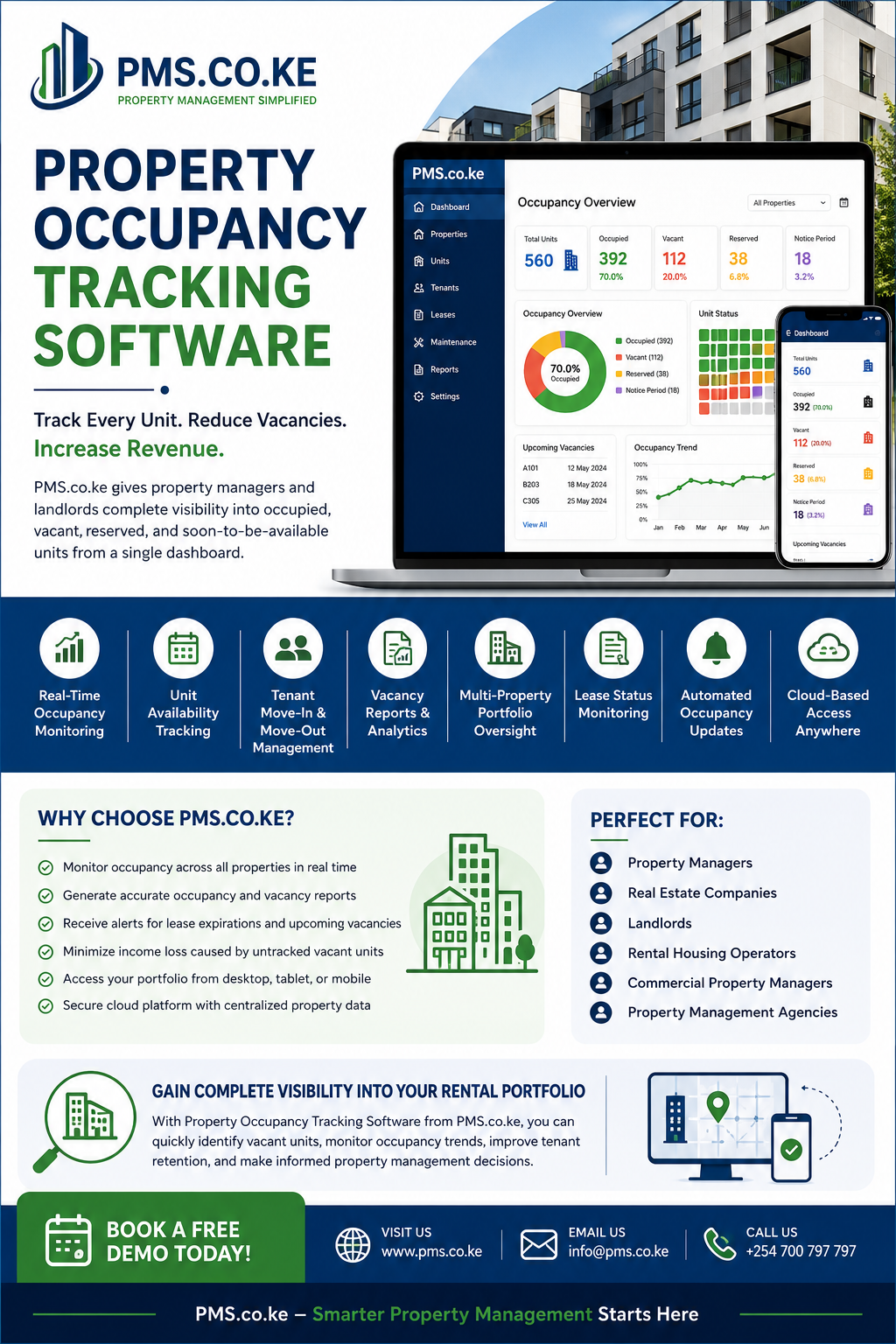
Property Occupancy Tracking Software is becoming an essential tool for landlords, property managers, real estate investors, and housing companies seeking greater visibility into occupancy levels, tenant movement, and property performance. In Kenya’s evolving real estate market, maintaining accurate occupancy records is critical for maximizing rental income, reducing vacancies, and improving operational efficiency.
As residential and commercial portfolios continue to expand, manual occupancy tracking methods are becoming increasingly difficult to manage. Property managers require reliable systems that provide real-time insights into occupied units, vacant units, upcoming move-outs, lease expirations, and tenant transitions. Property Occupancy Tracking Software simplifies these processes by centralizing occupancy data and automating reporting.
Table of Contents
- Understanding Occupancy Monitoring
- Importance of Vacancy Visibility
- Key Features of Modern Solutions
- Occupancy Data Management
- Lease and Tenant Tracking
- Reporting and Performance Analytics
- Challenges of Manual Occupancy Tracking
Understanding Occupancy Monitoring
Property Occupancy Tracking Software provides a centralized platform for monitoring occupancy status across residential, commercial, mixed-use, and multi-unit properties. Instead of relying on spreadsheets, notebooks, or disconnected systems, property managers gain instant access to accurate occupancy information.
Occupancy management plays a major role in rental profitability. Every vacant unit represents lost income, making it important to monitor occupancy levels continuously. Property Occupancy Tracking Software enables managers to view occupancy metrics in real time and make informed decisions based on reliable data.
The software allows managers to identify occupied units, vacant units, reserved units, maintenance units, and units scheduled for turnover. This visibility improves planning and ensures vacancies are addressed quickly.
For growing property portfolios, Property Occupancy Tracking Software provides consistency across multiple buildings and locations. Teams can monitor occupancy performance from a single dashboard, reducing administrative workload while improving accuracy.
Importance of Vacancy Visibility
Vacancy management is one of the most important aspects of property operations. Without accurate tracking, vacancies may remain unfilled longer than necessary, reducing rental income and portfolio performance.
Property Occupancy Tracking Software provides clear visibility into current and upcoming vacancies. Managers can identify units nearing lease expiration and begin marketing activities before tenants move out. This proactive approach helps minimize vacancy periods.
Real-time vacancy visibility enables property owners to:
- Monitor occupancy rates across properties
- Track turnover trends
- Reduce income loss
- Improve leasing performance
- Support revenue forecasting
- Increase portfolio efficiency
Property Occupancy Tracking Software also allows managers to compare occupancy rates between properties and identify areas requiring attention. These insights support strategic planning and investment decisions.
For property investors, occupancy visibility is a critical performance indicator because it directly impacts return on investment and long-term asset value.
Key Features of Modern Solutions
Modern Property Occupancy Tracking Software includes powerful tools designed to simplify occupancy monitoring and improve operational control.
Key features often include:
Real-Time Occupancy Dashboards
Managers can instantly view occupancy levels, vacancies, lease statuses, and tenant activity from a centralized dashboard.
Unit Status Tracking
Property Occupancy Tracking Software categorizes units according to their current status, helping teams understand occupancy distribution across the portfolio.
Automated Notifications
The software sends alerts regarding lease expirations, move-outs, renewals, and occupancy changes.
Multi-Property Management
Organizations managing multiple buildings can monitor occupancy performance from a single system.
Occupancy Reports
Detailed reports provide insights into occupancy percentages, vacancy trends, turnover rates, and portfolio performance.
Tenant Movement Tracking
The platform records move-ins, move-outs, transfers, renewals, and lease updates automatically.
Historical Occupancy Data
Property Occupancy Tracking Software maintains historical records for long-term performance analysis and forecasting.
These features help property managers improve visibility, reduce errors, and increase efficiency throughout occupancy management processes.
Occupancy Data Management
Accurate occupancy data is the foundation of effective property management. Property Occupancy Tracking Software centralizes information and ensures records remain current and accessible.
Property managers can maintain detailed information about:
- Units
- Buildings
- Tenants
- Lease agreements
- Occupancy status
- Move-in dates
- Move-out dates
- Renewal schedules
Centralized occupancy records eliminate duplicate data entry and reduce administrative errors. Teams can update occupancy information once and make it immediately available throughout the organization.
Property Occupancy Tracking Software also supports data consistency across departments, ensuring leasing teams, finance teams, maintenance teams, and management personnel access the same information.
Reliable occupancy data improves planning and helps organizations maintain accurate portfolio records.
As portfolios grow larger, data management becomes increasingly important. Software-based tracking provides scalability while maintaining accuracy and operational efficiency.
Lease and Tenant Tracking
Occupancy levels are closely connected to lease management and tenant activity. Property Occupancy Tracking Software integrates occupancy monitoring with lease and tenant tracking processes.
Managers can monitor:
- Active leases
- Expiring leases
- Lease renewals
- Tenant transfers
- Move-ins
- Move-outs
- Vacancy schedules
By linking occupancy records to lease information, the software ensures accurate occupancy reporting at all times.
Property Occupancy Tracking Software helps teams identify upcoming vacancies before they occur. This allows leasing teams to begin marketing vacant units early, reducing turnover delays.
Tenant lifecycle events are automatically reflected within occupancy records, improving reporting accuracy and operational transparency.
For large property portfolios, automated lease and occupancy synchronization reduces manual work and improves management efficiency.
The ability to monitor tenant movement alongside occupancy trends provides valuable insights into retention rates and leasing effectiveness.
Reporting and Performance Analytics
Property managers require meaningful data to make informed decisions. Property Occupancy Tracking Software delivers comprehensive reporting tools that transform occupancy information into actionable insights.
Common reports include:
- Occupancy rate reports
- Vacancy reports
- Lease expiration reports
- Tenant turnover reports
- Portfolio performance reports
- Occupancy trend analysis
- Revenue forecasting reports
These reports help managers identify patterns and evaluate operational performance.
Property Occupancy Tracking Software enables organizations to measure occupancy performance across different property types, locations, and management teams. This visibility supports continuous improvement initiatives.
Historical analytics help predict future occupancy levels and improve budgeting accuracy. Managers can evaluate seasonal trends, identify recurring vacancy issues, and adjust strategies accordingly.
Performance analytics also provide valuable information for investors, property owners, and stakeholders who require regular portfolio reporting.
By leveraging occupancy data effectively, organizations can make more strategic decisions and improve long-term profitability.
Challenges of Manual Occupancy Tracking
Many property managers still rely on spreadsheets and manual processes for occupancy management. While these methods may work for small portfolios, they become increasingly difficult as operations grow.
Common challenges include:
Data Errors
Manual data entry increases the risk of inaccuracies and inconsistent records.
Limited Visibility
Teams struggle to access real-time occupancy information across multiple properties.
Delayed Reporting
Generating occupancy reports manually requires significant time and effort.
Poor Coordination
Different departments may maintain separate records, leading to inconsistencies.
Missed Opportunities
Without accurate occupancy tracking, managers may fail to identify upcoming vacancies quickly enough.
Scalability Issues
Manual systems become inefficient as portfolios expand.
Property Occupancy Tracking Software addresses these challenges by automating occupancy management processes and providing centralized visibility into portfolio performance.
Organizations that adopt digital occupancy tracking solutions often experience improved accuracy, faster reporting, better decision-making, and stronger operational control.
The growing complexity of modern property management makes Property Occupancy Tracking Software an increasingly valuable investment for property owners and managers seeking sustainable growth and improved occupancy performance.
Benefits of Property Occupancy Tracking Software for Property Managers
Property managers face increasing pressure to maintain high occupancy rates while managing tenant relationships, lease administration, maintenance coordination, and financial reporting. Property Occupancy Tracking Software provides a structured and efficient way to oversee occupancy performance across an entire portfolio.
One of the biggest advantages of Property Occupancy Tracking Software is real-time visibility. Managers no longer need to gather information from multiple spreadsheets or manually verify occupancy status across properties. Instead, they can instantly identify occupied units, vacant units, pending move-ins, and upcoming lease expirations from a centralized dashboard.
Property Occupancy Tracking Software also improves operational efficiency by reducing manual administrative work. Automated updates ensure occupancy records remain accurate and current, allowing teams to spend more time on strategic activities such as tenant retention and portfolio growth.
Another major benefit is improved vacancy management. By identifying expiring leases and upcoming vacancies early, managers can begin marketing efforts sooner and reduce vacancy periods. This contributes directly to higher rental income and stronger property performance.
The reporting capabilities offered by Property Occupancy Tracking Software further enhance decision-making. Managers can analyze occupancy trends, turnover rates, renewal performance, and vacancy patterns to identify opportunities for improvement.
As portfolios expand, scalability becomes increasingly important. Property Occupancy Tracking Software allows managers to oversee multiple buildings and locations without significantly increasing administrative complexity.
Benefits of Property Occupancy Tracking Software for Property Owners
Property owners depend on consistent occupancy levels to maintain profitability and maximize returns on investment. Property Occupancy Tracking Software provides owners with accurate information that supports better financial and operational decisions.
One key advantage is increased transparency. Owners gain visibility into occupancy rates, vacancy trends, tenant turnover, and leasing performance without relying solely on periodic reports.
Property Occupancy Tracking Software helps owners understand how effectively their assets are performing. Real-time occupancy data enables faster responses to emerging issues and supports proactive portfolio management.
Financial forecasting also improves significantly. Since occupancy levels directly influence rental income, accurate occupancy tracking helps owners project revenue with greater confidence. This supports budgeting, investment planning, and long-term growth strategies.
Property Occupancy Tracking Software can also contribute to higher asset values. Properties with strong occupancy performance typically generate more stable income streams and may attract greater investor interest.
For owners managing multiple assets, centralized occupancy tracking simplifies portfolio oversight while reducing dependence on manual reporting processes.
Improving Tenant Retention Through Occupancy Insights
Tenant retention is often more cost-effective than acquiring new tenants. Property Occupancy Tracking Software helps managers identify trends that influence tenant retention and occupancy stability.
By monitoring lease renewals and tenant movement patterns, managers can detect potential retention challenges before they affect occupancy levels. Occupancy data can reveal properties with higher turnover rates and help management teams investigate underlying causes.
Property Occupancy Tracking Software also enables proactive renewal planning. Instead of reacting to move-out notices, managers can engage tenants early and encourage lease renewals before vacancies occur.
Improved retention contributes to:
- Lower turnover costs
- Reduced vacancy periods
- More predictable rental income
- Better tenant satisfaction
- Stronger portfolio performance
Organizations that leverage occupancy insights effectively often achieve higher occupancy rates and greater long-term stability.
Using Property Occupancy Tracking Software for Portfolio Growth
Growth requires accurate information. Property Occupancy Tracking Software provides the data necessary to support expansion and investment decisions.
Property managers can use occupancy analytics to determine which properties perform best and identify opportunities for improvement across underperforming assets. Occupancy trends often reveal valuable insights regarding market demand, tenant preferences, and operational effectiveness.
Property Occupancy Tracking Software supports strategic planning by providing historical and real-time occupancy metrics. Investors and owners can evaluate acquisition opportunities using occupancy benchmarks and compare performance across existing assets.
As organizations expand into new regions or property categories, centralized occupancy tracking ensures consistent management practices and reporting standards.
Growth-focused organizations increasingly view Property Occupancy Tracking Software as an essential component of modern portfolio management because it provides the visibility needed to scale operations successfully.
Why RentalDesk Is the Ideal Solution
RentalDesk provides property managers and owners with powerful tools designed to simplify occupancy monitoring and improve property performance.
With RentalDesk, organizations can monitor occupancy levels, track vacancies, manage tenant movement, oversee lease activity, and generate comprehensive occupancy reports from a single platform.
RentalDesk helps eliminate the challenges associated with manual occupancy tracking by centralizing information and automating critical workflows. Property managers gain immediate visibility into occupancy status across multiple properties, enabling faster and more informed decision-making.
The platform supports:
- Occupancy monitoring
- Tenant management
- Lease administration
- Vacancy tracking
- Portfolio reporting
- Financial oversight
- Multi-property management
By integrating occupancy tracking with broader property management functions, RentalDesk creates a unified operational environment that improves efficiency and supports sustainable growth.
Whether managing residential apartments, commercial buildings, mixed-use developments, or large rental portfolios, RentalDesk provides the tools necessary to maintain strong occupancy performance and maximize property value.
Future Trends in Property Occupancy Tracking Software
The future of Property Occupancy Tracking Software will be shaped by automation, predictive analytics, artificial intelligence, and deeper integration across property management ecosystems.
AI-powered forecasting tools will help managers predict occupancy trends and identify potential vacancy risks before they occur. Predictive analytics will support smarter leasing strategies and more accurate revenue projections.
Cloud-based Property Occupancy Tracking Software solutions will continue to gain popularity due to their accessibility, scalability, and real-time collaboration capabilities.
Mobile accessibility will become increasingly important as property managers seek to monitor occupancy data and respond to changes while working remotely or visiting properties.
Future systems may also integrate with smart building technologies, allowing occupancy information to be combined with maintenance, energy management, and tenant experience data.
As competition within the rental market increases, organizations that adopt advanced Property Occupancy Tracking Software solutions will be better positioned to improve efficiency, increase occupancy rates, and achieve long-term success.
Getting Started with Property Occupancy Tracking Software
Implementing Property Occupancy Tracking Software begins with evaluating current occupancy management processes and identifying areas where automation can deliver the greatest value.
Organizations should prioritize solutions that offer:
- Real-time occupancy visibility
- Automated reporting
- Lease integration
- Vacancy management tools
- Multi-property support
- Scalable infrastructure
- Comprehensive analytics
A successful implementation ensures accurate occupancy records, streamlined workflows, and improved reporting capabilities from the outset.
As property portfolios grow, Property Occupancy Tracking Software becomes increasingly valuable for maintaining operational control and maximizing rental performance.
Organizations that invest in modern occupancy tracking solutions today position themselves for greater efficiency, stronger tenant retention, reduced vacancies, and sustainable growth in the future.
