
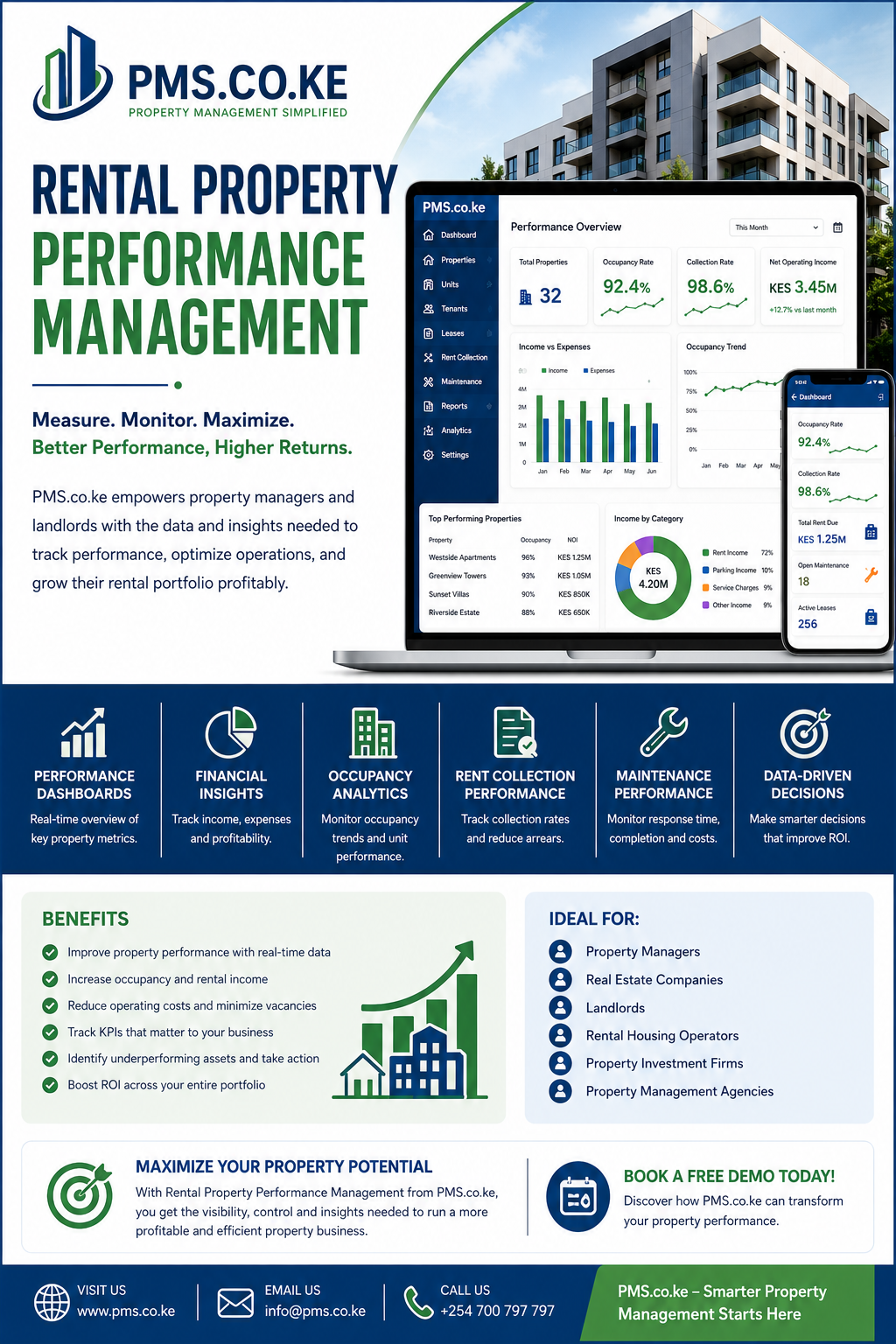
Rental Property Performance Management is a critical aspect of modern property management that focuses on measuring, monitoring, and improving the overall performance of rental properties. In Kenya’s competitive real estate market, property owners and managers need accurate performance data to maximize profitability, increase occupancy rates, improve tenant retention, and ensure long-term portfolio growth.
As rental portfolios become larger and more complex, traditional methods of evaluating property performance are no longer sufficient. Manual spreadsheets and disconnected reporting systems often lead to delayed insights, inaccurate data, and missed opportunities. Rental Property Performance Management provides a structured framework that enables stakeholders to track key metrics and make informed decisions based on real-time information.
Whether managing residential apartments, commercial buildings, mixed-use developments, student housing, or large rental portfolios, Rental Property Performance Management allows organizations to evaluate operational efficiency, financial health, and tenant satisfaction from a centralized perspective.
Table of Contents
- Understanding Property Performance
- Importance of Performance Measurement
- Key Metrics for Success
- Revenue and Expense Analysis
- Occupancy and Tenant Performance
- Performance Reporting and Analytics
- Challenges of Traditional Management Methods
Understanding Property Performance
Rental Property Performance Management involves continuously assessing how effectively a rental property generates income, controls costs, retains tenants, and maintains operational efficiency.
Property performance extends beyond simple rent collection. It includes analyzing occupancy rates, tenant turnover, maintenance expenses, lease renewal rates, operational costs, revenue growth, and asset utilization. These factors collectively determine whether a property is achieving its financial and operational objectives.
Rental Property Performance Management provides a structured approach to collecting and analyzing performance data. Property managers can evaluate individual properties, compare multiple assets, and identify trends that influence profitability.
For organizations managing multiple properties, Rental Property Performance Management creates consistency by ensuring all performance metrics are measured using standardized processes and reporting methods.
Accurate performance tracking enables property managers to identify strengths, address weaknesses, and develop strategies that improve overall portfolio performance.
Importance of Performance Measurement
Performance measurement is essential because it provides visibility into how rental properties are performing relative to established goals.
Without clear performance metrics, property owners may struggle to understand whether their investments are generating acceptable returns. Rental Property Performance Management eliminates uncertainty by providing measurable indicators of success.
Performance measurement helps organizations:
- Monitor profitability
- Improve occupancy rates
- Reduce operational costs
- Enhance tenant retention
- Increase revenue
- Strengthen asset value
- Support investment decisions
Rental Property Performance Management also helps managers identify underperforming properties before issues become significant. Early intervention often prevents revenue losses and improves long-term outcomes.
In Kenya’s growing real estate market, access to reliable performance data can provide a competitive advantage by enabling faster and more informed decision-making.
Key Metrics for Success
Successful Rental Property Performance Management depends on tracking meaningful performance indicators that accurately reflect operational and financial outcomes.
Important metrics include:
Occupancy Rate
Occupancy rate measures the percentage of units currently occupied. High occupancy rates generally indicate strong demand and effective property management.
Vacancy Rate
Vacancy rate helps managers understand how much rental income may be lost due to unoccupied units.
Rental Income
Rental income remains one of the most important indicators within Rental Property Performance Management because it directly impacts profitability.
Lease Renewal Rate
Renewal rates measure tenant retention and indicate tenant satisfaction levels.
Maintenance Costs
Tracking maintenance expenses helps organizations control operational costs and maintain property quality.
Net Operating Income
Net operating income provides insight into overall financial performance after operating expenses are deducted from revenue.
Tenant Turnover Rate
Tenant turnover affects occupancy stability and leasing costs. Monitoring turnover helps managers improve retention strategies.
Rental Property Performance Management combines these metrics into comprehensive reports that support strategic planning and operational improvement.
Revenue and Expense Analysis
Financial performance is a central component of Rental Property Performance Management. Understanding revenue and expenses allows organizations to improve profitability and allocate resources more effectively.
Revenue analysis includes:
- Rent collection performance
- Rental growth trends
- Additional income streams
- Payment compliance
- Occupancy-related revenue
Expense analysis focuses on:
- Maintenance costs
- Administrative expenses
- Utilities
- Security services
- Property improvements
- Vendor payments
Rental Property Performance Management enables managers to compare expenses against revenue and identify areas where cost reductions may improve profitability.
Financial visibility also supports budgeting and forecasting. Property managers can anticipate future expenses, plan capital improvements, and develop strategies for sustainable growth.
Organizations that maintain detailed financial performance records are generally better positioned to maximize returns and manage risk.
Occupancy and Tenant Performance
Occupancy and tenant performance have a direct impact on rental property success. Rental Property Performance Management helps organizations understand how tenant behavior influences overall portfolio performance.
High occupancy rates typically contribute to stable cash flow and improved profitability. However, occupancy alone does not provide a complete picture. Managers must also evaluate tenant quality, retention rates, lease compliance, and payment performance.
Rental Property Performance Management provides visibility into:
- Occupied units
- Vacant units
- Lease renewals
- Tenant movement
- Delinquency trends
- Retention rates
- Tenant satisfaction indicators
These insights help managers develop more effective leasing and retention strategies.
By monitoring tenant-related metrics continuously, organizations can improve occupancy stability while reducing turnover costs and vacancy periods.
Tenant performance data also supports proactive communication and relationship management, leading to better long-term outcomes.
Performance Reporting and Analytics
Modern Rental Property Performance Management relies heavily on reporting and analytics to transform raw data into actionable insights.
Performance reports help stakeholders understand how properties are performing across different operational areas. These reports often include occupancy trends, revenue growth, maintenance costs, renewal rates, and financial performance indicators.
Rental Property Performance Management provides dashboards that consolidate information into easy-to-understand visual formats. Managers can quickly identify performance trends and focus attention on areas requiring improvement.
Analytics capabilities help organizations:
- Evaluate property performance
- Identify emerging risks
- Measure operational efficiency
- Compare assets
- Forecast future outcomes
- Support investment decisions
Historical reporting also allows managers to analyze long-term trends and assess the effectiveness of previous strategies.
Data-driven decision-making is becoming increasingly important in property management, making advanced analytics a valuable component of Rental Property Performance Management.
Challenges of Traditional Management Methods
Many property organizations continue to rely on manual processes for performance evaluation. While these methods may be sufficient for small portfolios, they often create significant challenges as operations grow.
Common challenges include:
Fragmented Data
Information may be stored across multiple systems, making performance analysis difficult.
Delayed Reporting
Manual reporting processes often produce outdated information.
Limited Visibility
Managers may struggle to obtain a complete view of portfolio performance.
Human Error
Manual calculations increase the risk of inaccuracies.
Poor Decision-Making
Without reliable data, organizations may make decisions based on assumptions rather than evidence.
Scalability Constraints
Traditional methods become increasingly inefficient as property portfolios expand.
Rental Property Performance Management addresses these challenges by centralizing information, automating reporting, and providing real-time performance visibility.
Organizations that adopt modern performance management solutions gain greater operational control, improved efficiency, and stronger long-term results.
Benefits of Rental Property Performance Management for Property Managers
Property managers are responsible for maintaining occupancy, maximizing revenue, controlling costs, and ensuring tenant satisfaction. Rental Property Performance Management provides the visibility and control necessary to achieve these objectives efficiently.
One of the primary advantages of Rental Property Performance Management is improved decision-making. Managers gain access to real-time data regarding occupancy levels, revenue trends, maintenance expenses, and tenant performance. This allows them to make informed operational decisions based on measurable results rather than assumptions.
Rental Property Performance Management also increases operational efficiency by consolidating critical property information into a centralized system. Instead of collecting data from multiple spreadsheets and reports, managers can access comprehensive performance metrics from a single source.
Another important benefit is enhanced financial oversight. Managers can identify areas where expenses are increasing, monitor income performance, and implement strategies that improve profitability. Regular performance reviews help prevent minor operational issues from becoming major financial challenges.
The reporting capabilities offered by Rental Property Performance Management enable property managers to communicate effectively with owners and stakeholders by providing clear and accurate performance updates.
As rental portfolios grow, performance management systems help maintain consistency, accountability, and operational excellence across all properties.
Benefits of Rental Property Performance Management for Property Owners
Property owners rely on accurate information to evaluate investment performance and plan for future growth. Rental Property Performance Management provides the insights necessary to make informed investment decisions.
One of the most valuable benefits is increased transparency. Owners can access detailed information regarding occupancy rates, rental income, operating expenses, lease renewals, and overall property performance.
Rental Property Performance Management also supports better financial planning. Accurate performance metrics allow owners to forecast revenue, estimate expenses, and evaluate potential investment opportunities with greater confidence.
Property owners can use performance data to identify underperforming assets and implement targeted improvement strategies. This helps maximize return on investment while reducing operational risks.
Another significant advantage is improved asset value. Properties that demonstrate strong occupancy rates, stable revenue, and efficient operations are often viewed more favorably by investors and financial institutions.
By leveraging Rental Property Performance Management, property owners gain greater control over their portfolios while supporting long-term growth and profitability.
Enhancing Portfolio Performance Through Data-Driven Decisions
Modern property management increasingly depends on data-driven decision-making. Rental Property Performance Management transforms operational and financial information into actionable insights that support continuous improvement.
Managers can analyze performance trends across multiple properties to identify successful strategies and areas requiring attention. Data-driven decision-making helps eliminate guesswork and promotes more consistent results.
Rental Property Performance Management allows organizations to evaluate:
- Occupancy performance
- Revenue growth
- Expense management
- Tenant retention
- Lease renewal effectiveness
- Property maintenance efficiency
- Asset utilization
These insights enable managers to allocate resources more effectively and prioritize initiatives that deliver the greatest impact.
Organizations that embrace performance analytics often experience stronger occupancy rates, reduced operating costs, and improved tenant satisfaction.
Strengthening Tenant Retention and Revenue Stability
Tenant retention plays a major role in property performance because acquiring new tenants often costs more than retaining existing ones. Rental Property Performance Management helps managers identify factors that influence tenant satisfaction and renewal decisions.
By monitoring lease renewal rates, tenant turnover patterns, and occupancy trends, managers can develop proactive retention strategies that reduce vacancies and maintain stable revenue streams.
Rental Property Performance Management provides visibility into tenant-related performance indicators that help organizations improve communication, resolve issues quickly, and enhance the overall tenant experience.
Benefits of stronger tenant retention include:
- Lower turnover costs
- Reduced vacancy periods
- More predictable rental income
- Increased tenant satisfaction
- Improved portfolio stability
Maintaining high retention rates contributes directly to long-term financial performance and operational efficiency.
Why RentalDesk Is the Ideal Solution
RentalDesk provides a comprehensive platform designed to support effective Rental Property Performance Management across residential, commercial, and mixed-use properties.
The system helps property managers and owners monitor key performance indicators from a centralized dashboard. Users can track occupancy rates, rental income, maintenance activities, lease performance, tenant retention, and overall portfolio health in real time.
RentalDesk simplifies Rental Property Performance Management by integrating multiple operational functions into a single solution. This eliminates fragmented reporting processes and improves visibility across the entire property portfolio.
Key capabilities include:
- Tenant management
- Lease administration
- Occupancy monitoring
- Maintenance tracking
- Financial reporting
- Performance analytics
- Portfolio oversight
- Multi-property management
By combining operational efficiency with powerful reporting tools, RentalDesk enables organizations to make faster and more informed decisions.
Whether managing a small residential portfolio or a large property operation, RentalDesk provides the technology needed to improve performance, increase profitability, and support sustainable growth.
Future Trends in Rental Property Performance Management
The future of Rental Property Performance Management will be shaped by advanced analytics, automation, artificial intelligence, and cloud-based technologies.
Artificial intelligence will play an increasingly important role in forecasting occupancy trends, predicting tenant turnover, and identifying performance risks before they impact operations. These predictive capabilities will help managers make proactive decisions that improve outcomes.
Cloud-based Rental Property Performance Management platforms will continue to gain popularity due to their scalability, accessibility, and ability to support remote property management teams.
Automation will further reduce administrative workloads by streamlining reporting, data collection, and performance monitoring processes. Managers will spend less time gathering information and more time implementing strategic improvements.
Future systems may also integrate with smart building technologies, enabling organizations to combine operational, maintenance, and occupancy data into comprehensive performance models.
As competition within the property sector continues to increase, organizations that invest in advanced Rental Property Performance Management solutions will be better positioned to achieve operational excellence and long-term success.
Getting Started with Rental Property Performance Management
Implementing Rental Property Performance Management begins with establishing clear performance objectives and identifying the metrics most relevant to organizational goals.
Property managers should focus on solutions that provide:
- Real-time performance monitoring
- Automated reporting
- Occupancy analytics
- Revenue tracking
- Expense management
- Tenant performance insights
- Portfolio-wide visibility
- Scalable infrastructure
Successful implementation requires accurate data collection, consistent reporting practices, and regular performance reviews.
As organizations become more data-driven, Rental Property Performance Management serves as a foundation for continuous improvement and strategic growth.
By investing in modern performance management tools, property managers and owners can improve profitability, strengthen tenant relationships, reduce operational inefficiencies, and maximize the value of their rental assets.
