
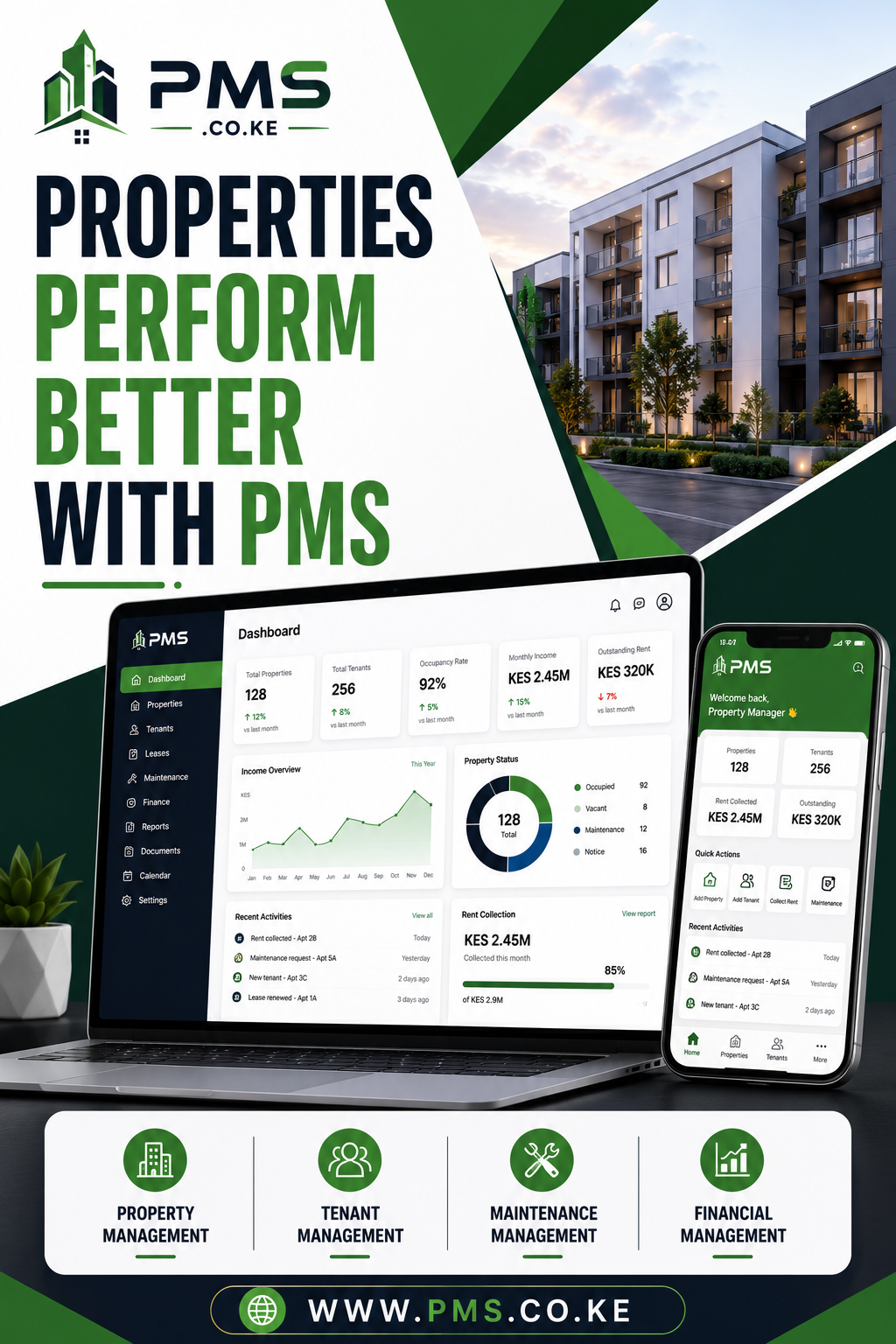
Property manager software Nairobi is becoming an important solution for landlords, real estate agencies, estate managers, and professional property management companies that need to manage tenants, rent, leases, maintenance, properties, and financial records from one centralized platform.
Managing rental properties manually can become increasingly difficult as the portfolio grows. A property manager may have to track dozens or hundreds of tenants, follow up on rent payments, monitor vacancies, respond to maintenance requests, manage lease documents, prepare owner reports, and reconcile M-PESA transactions.
Using spreadsheets, notebooks, WhatsApp conversations, paper files, and separate accounting records can make these responsibilities more time-consuming and increase the possibility of missing important information.
Modern property management platforms are designed to bring these activities together. PMS.co.ke, for example, combines property management, tenant management, leases, M-PESA rent collection, maintenance, service charges, owner statements, and reporting within a cloud-based system designed for Kenyan rental operations.
What Is Property Manager Software?
Property manager software is a digital platform designed to help professionals manage rental properties and the daily activities associated with them.
Instead of maintaining separate records for each responsibility, property managers can use one system to manage:
- Properties
- Buildings
- Units
- Tenants
- Leases
- Rent
- M-PESA payments
- Bank payments
- Arrears
- Maintenance
- Expenses
- Documents
- Service charges
- Owner information
- Financial reports
The main objective is to create one reliable source of information for the property business.
For a property manager in Nairobi, this can make it easier to move from reactive administration to organized property operations.
Why Nairobi Property Managers Need Digital Management Tools
Nairobi’s rental market includes apartments, residential estates, commercial buildings, student accommodation, mixed-use developments, offices, shops, and other rental properties.
Each property can have different rental rates, lease periods, payment arrangements, service charges, maintenance requirements, and tenant needs.
Managing this information manually can become complicated.
Imagine a property manager responsible for 300 units.
Every month, the manager may need to:
- Generate rent charges
- Monitor M-PESA payments
- Identify unpaid rent
- Send payment reminders
- Respond to tenant requests
- Track maintenance
- Record expenses
- Manage lease renewals
- Monitor vacant units
- Prepare owner statements
- Review property performance
If these activities are handled through different spreadsheets and communication channels, it becomes difficult to maintain a complete picture of the portfolio.
A centralized platform can connect these processes.
Managing Properties and Units
One of the first functions of property management software is organizing the property portfolio.
Each property can contain multiple buildings, floors, and units.
For example:
Property: Westlands Heights
Building: Block A
Unit: A-204
Type: Two-bedroom apartment
Monthly Rent: KSh 65,000
Status: Occupied
Tenant: Assigned tenant
The same structure can be used across an entire portfolio.
This makes it easier to search for specific units and understand their current status.
A system can distinguish between:
- Occupied units
- Vacant units
- Reserved units
- Units under maintenance
- Units awaiting tenants
This information is particularly useful when property managers need to understand current occupancy.
Centralized Tenant Management
Tenant information is one of the most important parts of property management.
A tenant profile can contain:
- Full name
- Phone number
- Email address
- Identification details
- Property
- Unit
- Lease
- Rent amount
- Deposit
- Payment history
- Outstanding balance
- Documents
- Maintenance requests
Instead of searching through multiple files to determine a tenant’s status, a property manager can open the tenant’s record and see the relevant information.
This is where Tenant Management Software can provide significant value to property managers managing multiple units.
A centralized tenant database also makes it easier to maintain consistent records when tenants move between units or renew their agreements.
Rent Collection Management
Rent collection is one of the most important responsibilities of a property manager.
A property manager needs to know:
- How much rent was billed
- How much was collected
- Which tenants have paid
- Which tenants are partially paid
- Which tenants are overdue
- How much remains outstanding
Modern property management systems can automate parts of this process.
PMS.co.ke describes M-PESA Paybill and Till automation, rent rolls, arrears visibility, and payment tracking as part of its Kenyan property management platform.
This means management can spend less time manually checking payment messages and more time managing exceptions.
M-PESA Integration
M-PESA is an important payment channel for rental businesses in Kenya.
However, receiving a payment is only one part of the process.
The payment must also be connected to the correct:
Tenant → Unit → Invoice → Rental period → Payment → Receipt
Without proper reconciliation, a property manager may still have to manually determine who made a payment and which account should receive the credit.
Integrated systems can automate or simplify this matching process.
For example, a tenant pays KSh 50,000 through the property’s M-PESA Paybill.
The system can associate the payment with the relevant tenant and update the outstanding balance.
This reduces manual data entry and can improve the accuracy of rent records.
Several Kenya-focused property platforms now emphasize M-PESA collection and reconciliation as core property management capabilities.
Tracking Rent Arrears
Rent arrears can quickly become a serious problem if they are not identified early.
A property manager should be able to see:
Tenant A: KSh 0 outstanding
Tenant B: KSh 15,000 outstanding
Tenant C: KSh 60,000 outstanding
Tenant D: KSh 120,000 outstanding
A digital dashboard can make these balances visible.
Management can then prioritize follow-up based on the amount and age of the outstanding balance.
Instead of discovering arrears at the end of the month, managers can monitor balances continuously.
Automated Rent Reminders
A property manager may have hundreds of tenants.
Manually contacting every tenant about upcoming rent can consume significant time.
Property software can support automated reminders through available communication channels.
Depending on the platform, reminders can be used for:
- Upcoming rent
- Overdue rent
- Lease expiry
- Maintenance updates
- Inspection dates
- Other property notices
This allows staff to focus on tenants who actually require personal attention.
Digital Lease Management
Lease administration is another major responsibility for property managers.
Every tenant can have different:
- Lease start dates
- Lease expiry dates
- Rental amounts
- Deposit amounts
- Renewal periods
- Occupancy terms
Keeping these records in spreadsheets makes it easy to miss an important expiry date.
A digital lease system can connect the agreement to the relevant tenant and unit.
PMS.co.ke describes digital leases and lease-related management alongside rent collection and maintenance.
This allows management to monitor the entire lease lifecycle.
Lease Expiry Alerts
Lease expiry dates should be monitored well in advance.
A property manager could organize the portfolio into:
- Leases expiring within 30 days
- Leases expiring within 60 days
- Leases expiring within 90 days
- Leases expiring within six months
This gives management time to contact tenants and plan renewals.
Early visibility can also help reduce unexpected vacancies.
Lease Renewal Management
When a tenant wants to continue occupying a property, management needs to update the tenancy records.
The process may involve:
- Reviewing the existing agreement
- Confirming the tenant’s intention
- Reviewing rental terms
- Preparing renewal documentation
- Recording the new lease period
- Updating billing
- Storing the new agreement
A centralized system keeps these activities connected.
Property Maintenance Management
Property managers are also responsible for maintenance.
A tenant may report:
- Plumbing problems
- Electrical faults
- Broken doors
- Water issues
- Damaged fixtures
- Security concerns
- General repairs
Without a digital maintenance system, requests can arrive through WhatsApp, phone calls, SMS, or verbal conversations and become difficult to track.
Property software can provide a structured maintenance workflow.
For example:
Tenant submits request
↓
Manager reviews request
↓
Technician assigned
↓
Work completed
↓
Cost recorded
↓
Request closed
This provides greater visibility into maintenance activity.
Maintenance History
Maintaining a history of repairs can help property managers understand recurring problems.
For example, if the same unit experiences plumbing problems several times in one year, the manager can review the maintenance history and investigate whether a larger repair is required.
Maintenance records can also help when evaluating property expenses.
Expense Management
Property management involves many expenses.
These can include:
- Repairs
- Security
- Cleaning
- Landscaping
- Utilities
- Contractor payments
- Property inspections
- Management costs
- Supplies
A digital system can associate expenses with the relevant property.
For example:
Property: Kilimani Apartments
Maintenance expense: KSh 25,000
Security: KSh 80,000
Cleaning: KSh 35,000
This allows management to understand how much each property costs to operate.
Property-Level Financial Visibility
A property manager should not only know how much rent was collected.
They should also understand the property’s overall financial performance.
A property management system can bring together:
Rental income
- Service charges
− Maintenance
− Operating expenses
= Property performance
This makes financial reporting more useful for property owners.
PMS.co.ke currently provides reports covering rent rolls, profit and loss, aged receivables, and cash flow.
Owner Reporting
Property managers often manage properties on behalf of owners.
Owners want to know what is happening with their investment.
A professional owner report can show:
- Rent billed
- Rent collected
- Arrears
- Expenses
- Maintenance
- Occupancy
- Net income
Instead of preparing these reports manually every month, property software can generate them from the underlying records.
This can save time and improve transparency.
Service Charge Management
Apartment buildings and estates may collect service charges separately from rent.
These funds can support:
- Security
- Cleaning
- Garbage collection
- Landscaping
- Common-area electricity
- Shared facilities
- Repairs
A property management platform can separate service charge transactions from ordinary rental income.
This creates better financial visibility for estate managers and property owners.
Some Kenya-focused property platforms specifically provide service charge management for estates and homeowner associations.
Managing Vacant Units
Vacancies directly affect rental income.
Property managers should know which units are:
- Currently vacant
- Becoming vacant
- Under maintenance
- Available for viewing
- Reserved
- Occupied
A centralized dashboard makes this information easier to monitor.
For example:
500 total units
460 occupied
25 vacant
10 under maintenance
5 reserved
Management can immediately see the current occupancy position.
Rental Property Management Software
A broader Rental Property Management Software platform can bring property, tenant, lease, payment, maintenance, and reporting functions together.
This is useful because property management responsibilities are interconnected.
A tenant’s lease determines the rental amount.
The rental amount determines billing.
Billing generates an amount due.
The tenant makes a payment.
The payment updates the tenant account.
Maintenance generates an expense.
All of these activities affect the property’s financial performance.
When they are stored in separate systems, management has to manually connect the information.
An integrated platform creates these connections automatically or through structured workflows.
Property Management System Kenya
A Property Management System Kenya solution can be particularly useful when the software is designed around local rental operations.
Kenyan property managers may need to deal with:
- M-PESA payments
- Bank deposits
- Local tenant communication
- Service charges
- Rental arrears
- Property maintenance
- Local reporting requirements
PMS.co.ke states that its system is designed for Kenyan landlords, agencies, and property managers and supports M-PESA Paybill and Till workflows, bank reconciliation, lease documents, utility billing, and owner statements.
Other Kenya-focused platforms are also emphasizing local workflows. For example, Nyumba Zetu combines M-PESA and bank collections, accounting, tenant and owner portals, maintenance, and KRA eTIMS-related functionality.
Property Manager Dashboard
A good property manager dashboard should provide quick access to the information that matters most.
A typical dashboard may show:
Total Properties
Total Units
Occupied Units
Vacant Units
Rent Collected
Rent Outstanding
Upcoming Lease Expiries
Open Maintenance Requests
Property Expenses
This eliminates the need to open multiple spreadsheets to understand what is happening across the portfolio.
Why Centralization Matters
The biggest advantage of property management software is not simply automation.
It is centralization.
Instead of having:
Rent records in Excel
Lease documents in folders
Payment confirmations in WhatsApp
Maintenance requests in phone messages
Expenses in another spreadsheet
Owner reports created manually
everything can be connected within one system.
This creates a much clearer operational picture.
Who Can Use Property Manager Software?
Property management platforms are useful for different types of rental businesses.
Individual Landlords
Landlords managing several apartments or houses can use software to organize their growing portfolio.
Property Management Companies
Professional agencies can use centralized software to manage properties belonging to different clients.
Apartment Managers
Apartment managers can manage tenants, rent, maintenance, leases, and occupancy.
Estate Managers
Large estates can use digital systems to coordinate service charges, tenants, maintenance, and financial records.
Real Estate Agencies
Agencies can manage properties, owners, tenants, leases, and collections from one platform.
Property Investors
Investors can monitor income, expenses, occupancy, and performance across their portfolios.
Advanced Features, Automation and Better Portfolio Management
Property manager software Nairobi is becoming an essential tool for landlords, property managers, real estate agencies, apartment operators, and estate management teams that want to manage rental operations from one centralized platform.
Once a property portfolio grows beyond a few units, property management becomes more than collecting rent. Managers have to coordinate tenants, leases, payments, maintenance, expenses, vacancies, owner communication, documents, and financial reporting.
Modern property management platforms can connect these functions so that information entered in one area can support other parts of the business. Kenyan platforms increasingly combine M-PESA and bank collections, tenant portals, accounting, maintenance, communication, reporting, and lease management in one system.
Part 1 covered property and unit management, tenant records, rent collection, M-PESA integration, arrears, leases, maintenance, expenses, vacancies, owner reporting, and centralized property operations.
Part 2 looks deeper into advanced features that can help Nairobi property managers improve efficiency, communication, financial control, and portfolio visibility.
Tenant Self-Service Portals
One of the biggest improvements modern property software can provide is tenant self-service.
Instead of contacting the property office every time they need basic information, tenants can access a dedicated portal where available features may include:
- Rent balance
- Payment history
- Invoices
- Receipts
- Lease information
- Maintenance requests
- Notices
- Statements
- Communication with management
Tenant portals are increasingly offered by Kenya-focused property management platforms. Some systems allow tenants to view balances, make payments, raise maintenance requests, and download statements without requiring staff assistance.
This can significantly reduce repetitive administrative requests.
For example, instead of receiving dozens of messages asking, “How much do I owe?”, the tenant can log in and view the current balance.
Automated Tenant Communication
Communication is a major part of property management.
Managers regularly need to communicate with tenants about:
- Rent
- Arrears
- Lease renewals
- Inspections
- Maintenance
- Notices
- Service charges
- Property announcements
Manually sending every message can take considerable time.
Modern platforms can support automated communication through channels such as SMS, email, WhatsApp, or in-app messaging, depending on the provider.
For example, a property manager could configure a workflow where an overdue balance triggers a payment reminder.
The manager can then focus on tenants requiring personal follow-up rather than sending every reminder manually.
Automated Rent Invoicing
Rent invoicing is another area where automation can save time.
Instead of creating invoices manually every month, the system can generate recurring invoices based on the configured tenant and lease information.
For example:
Tenant: Jane
Unit: A-104
Monthly rent: KSh 45,000
Service charge: KSh 5,000
Total due: KSh 50,000
The system can generate the appropriate charge according to the configured billing cycle.
Some Kenya-focused platforms advertise automated monthly invoicing for rent and other property charges.
Automated M-PESA Reconciliation
Receiving M-PESA payments is only part of the rent collection process.
The payment must be matched with the appropriate tenant and invoice.
A connected system can automate this workflow.
The process can look like:
Tenant makes payment
↓
M-PESA transaction received
↓
System identifies payment
↓
Payment matched to tenant
↓
Invoice updated
↓
Receipt generated
↓
Balance updated
This reduces the need for employees to manually copy transaction references from payment messages.
Kenyan property platforms such as Nyumba Zetu and EzRent advertise automated M-PESA payment matching and reconciliation.
Bank Payment Reconciliation
M-PESA is not the only payment method used by rental businesses.
Some tenants, particularly commercial tenants, may pay through:
- Bank transfers
- Direct deposits
- Standing orders
- Other approved channels
A property management platform should therefore be capable of tracking multiple payment channels.
Bank reconciliation allows management to compare actual bank activity with the transactions recorded in the system.
This helps identify:
- Missing payments
- Duplicate transactions
- Unmatched deposits
- Incorrect amounts
- Unrecorded transactions
PMS.co.ke specifically highlights bank deposit reconciliation alongside M-PESA workflows for Kenyan rental operations.
Property Accounting
Advanced property manager software Nairobi can include accounting functionality rather than simply recording rent.
A connected accounting system can track:
- Rental income
- Service charges
- Maintenance expenses
- Utilities
- Supplier payments
- Accounts receivable
- Accounts payable
- Property expenses
- General ledger transactions
Some Kenyan platforms provide double-entry accounting, journals, ledgers, trial balances, profit and loss statements, and balance sheets.
This allows property managers to understand the financial position of each property.
Property-Level Profit and Loss
Different properties can have very different financial results.
For example:
Property A
Rental income: KSh 2,000,000
Operating expenses: KSh 500,000
Net operating income: KSh 1,500,000
Property B
Rental income: KSh 1,800,000
Operating expenses: KSh 750,000
Net operating income: KSh 1,050,000
Without property-level reporting, these differences can be difficult to identify.
A digital platform can organize income and expenses according to the relevant property.
Owner Statements
Property managers often need to provide regular financial information to property owners.
An owner statement can show:
- Rent billed
- Rent collected
- Outstanding balances
- Expenses
- Maintenance costs
- Management fees
- Net amount payable to the owner
Automating these statements can save property managers considerable administrative time.
Some Kenya-focused platforms provide owner portals and automated owner statements containing income, expenses, and amounts paid to owners.
Owner Portals
An owner portal gives property owners direct visibility into their properties.
Instead of calling the property manager for every update, an owner may be able to access:
- Property information
- Occupancy
- Rent collection
- Tenant balances
- Expenses
- Maintenance
- Financial statements
This can be particularly useful for property owners who live outside Nairobi or outside Kenya.
Multi-Property Management
A professional property manager may be responsible for several buildings.
A centralized system can organize:
Owner A
→ Property 1
→ Property 2
Owner B
→ Property 3
→ Property 4
Owner C
→ Property 5
This structure helps prevent financial and operational information from different properties becoming mixed.
PMS.co.ke describes its platform as supporting landlords, agencies, property managers, apartment operators, and portfolios ranging from individual properties to multi-block developments.
Multi-Owner Management
Property agencies may manage properties belonging to different owners.
The system should therefore make it possible to distinguish:
- Owner
- Property
- Unit
- Tenant
- Lease
- Income
- Expenses
This is particularly important when preparing owner statements.
A payment collected from a tenant in one owner’s building should not accidentally appear in another owner’s report.
Role-Based Staff Access
Property management companies often have different employees performing different responsibilities.
For example:
Property Manager
Can manage properties, tenants, and leases.
Accountant
Can manage financial transactions and reports.
Caretaker
Can handle maintenance and property operations.
Owner
Can view approved property information.
Role-based permissions ensure that employees only access the information required for their responsibilities.
Kenyan property platforms increasingly provide role-based access for managers, accountants, agents, owners, and other users.
Audit Trails
An audit trail records important actions performed within the system.
For example:
User: Accountant
Action: Updated payment
Date: August 27, 2026
Time: 10:35 AM
This creates accountability.
Audit trails can be useful when management needs to investigate:
- Incorrect balances
- Changed rental amounts
- Deleted records
- Modified expenses
- Payment adjustments
- User activity
Some modern Kenyan property platforms advertise detailed audit logging for financial and operational activities.
Maintenance Management
Property maintenance can generate significant administrative work.
A tenant may report a problem through a phone call, WhatsApp, SMS, or email.
If requests are not properly recorded, they can be forgotten.
A maintenance module provides a structured process:
Tenant submits request
↓
Request recorded
↓
Manager reviews
↓
Technician assigned
↓
Work completed
↓
Cost recorded
↓
Request closed
This gives management visibility into every maintenance request.
Maintenance Work Orders
A maintenance request can be converted into a work order.
The work order may include:
- Property
- Unit
- Tenant
- Problem
- Priority
- Assigned technician
- Estimated cost
- Actual cost
- Completion date
- Photos
- Supporting documents
This makes maintenance more accountable.
Modern Kenyan property platforms advertise ticketing, work orders, vendor assignment, job costing, and completion tracking.
Maintenance Cost Tracking
Property managers should know how much maintenance costs each property.
For example:
| Property | Maintenance Cost |
|---|---|
| Kilimani Apartments | KSh 120,000 |
| Westlands Heights | KSh 85,000 |
| South B Estate | KSh 150,000 |
This can help identify properties with unusually high maintenance costs.
Vendor Management
Property managers often work with:
- Plumbers
- Electricians
- Painters
- Security companies
- Cleaners
- Landscapers
- Construction contractors
A centralized system can store supplier information and connect vendors to maintenance work and expenses.
This can make it easier to review supplier performance and spending.
Lease Expiry Automation
Lease renewals can become difficult when hundreds of agreements are involved.
A property management system can provide an expiry dashboard showing agreements that need attention.
For example:
Expiring within 30 days: 10
31–60 days: 18
61–90 days: 25
91–180 days: 40
This gives managers enough time to begin renewal discussions.
Several Kenya-focused property systems advertise lease-expiry alerts and automated renewal workflows.
Tenant Retention
Lease information can also help managers understand tenant retention.
Management can compare:
- Lease renewals
- Tenant move-outs
- Vacancy periods
- Rental changes
If many tenants leave the same property, management can investigate possible causes.
These could include:
- Maintenance problems
- Service quality
- Rental pricing
- Security concerns
- Property conditions
The software provides the data; management must determine the underlying cause.
Vacancy Management
Vacant units represent potential lost income.
A property management platform can show which units are:
- Occupied
- Vacant
- Reserved
- Under maintenance
- Available for viewing
- Awaiting tenant onboarding
Some modern systems also provide public vacancy listings so property managers can market available units digitally.
Rental Marketing
Some property management platforms are expanding beyond administration into vacancy marketing.
A vacant unit can be displayed with:
- Photos
- Location
- Rental amount
- Property information
- Availability
- Viewing instructions
This can help connect property management with the leasing process.
Service Charge Management
Large apartment buildings and estates may collect service charges separately from rent.
These funds can cover:
- Security
- Cleaning
- Landscaping
- Garbage collection
- Common-area electricity
- Shared facilities
- Estate maintenance
A property management platform can create separate service-charge records and reports.
Some Kenya-focused systems specifically provide service-charge billing, arrears management, and committee approval workflows.
Utility Billing
Some rental properties require tenants to pay separately for utilities.
These can include:
- Water
- Electricity
- Garbage
- Internet
- Other services
Software can incorporate these charges into tenant invoices.
This means a tenant can see rent and other approved charges in one account.
Water Meter Management
Properties that charge tenants according to water usage can benefit from digital meter management.
A system can record:
- Previous reading
- Current reading
- Consumption
- Rate
- Amount due
Some Kenya-focused property systems include water billing and even offline meter workflows for caretakers.
Digital Document Management
Property managers deal with many documents.
These can include:
- Lease agreements
- Tenant identification documents
- Inspection reports
- Notices
- Invoices
- Receipts
- Maintenance documents
- Supplier invoices
Centralized document storage makes it easier to locate the correct file.
Instead of asking, “Which folder contains this tenant’s lease?”, the manager can search for the tenant and open the associated documents.
Tenant Communication History
A useful system can keep a record of communication.
This can include:
- Payment reminders
- Lease notices
- Maintenance messages
- Announcements
- Tenant responses
A communication history can help staff understand what has already been discussed with a tenant.
WhatsApp and SMS Communication
Communication tools are particularly useful in the Kenyan rental environment.
Some property platforms integrate SMS, WhatsApp, and email communication with property management workflows.
This can allow managers to send:
- Rent reminders
- Arrears notices
- Maintenance updates
- Lease renewal reminders
- General announcements
The exact communication channels available depend on the platform.
Financial Dashboards
A financial dashboard can give management an immediate overview of portfolio performance.
It may show:
Rent billed
KSh 8,000,000
Rent collected
KSh 7,600,000
Outstanding
KSh 400,000
Collection rate
95%
Operating expenses
KSh 1,800,000
This allows management to identify important changes quickly.
Collection Rate Monitoring
The rent collection rate is a useful operational indicator.
A simple calculation is:
Rent collected ÷ Rent billed × 100
For example:
KSh 7,600,000 collected
÷
KSh 8,000,000 billed
=
95% collection rate
Management can compare this figure across months and properties.
Arrears Aging
Not all outstanding balances are equally urgent.
A system can categorize arrears by age.
For example:
| Age | Outstanding |
|---|---|
| Current | KSh 150,000 |
| 1–30 days | KSh 100,000 |
| 31–60 days | KSh 75,000 |
| 61–90 days | KSh 50,000 |
| 90+ days | KSh 80,000 |
This allows managers to prioritize older balances.
Property Performance Reports
Property managers can compare properties using:
- Occupancy
- Rental income
- Collection rate
- Arrears
- Expenses
- Maintenance costs
- Net income
This helps owners and managers identify stronger and weaker-performing properties.
Accounting Integration
Property management becomes more powerful when accounting is integrated.
Instead of manually transferring data between the property system and accounting software, financial information can be structured from the beginning.
Some Kenyan property platforms provide integrated general ledgers and accounting functionality, while others provide integrations or exports to accounting tools such as QuickBooks.
This can reduce duplicate data entry.
KRA and eTIMS Considerations
Property businesses operating in Kenya may have tax and electronic invoicing obligations depending on their circumstances.
Some property management platforms now advertise KRA eTIMS-ready or eTIMS-related functionality.
However, property owners should confirm their specific tax and compliance obligations with KRA or a qualified tax professional.
Software can help organize records, but it should not be treated as a substitute for professional tax advice.
Mobile Property Management
Property managers are often away from their desks.
They may be:
- Visiting apartments
- Inspecting vacant units
- Meeting tenants
- Supervising repairs
- Visiting contractors
- Meeting property owners
Mobile-friendly software can allow authorized staff to access relevant information while working in the field.
Some platforms provide mobile apps or mobile-responsive tenant and management portals.
Cloud-Based Property Management
Cloud-based systems allow authorized users to access property information through an internet-connected device.
This is useful for:
- Property managers
- Landlords
- Agencies
- Caretakers
- Remote owners
It also reduces dependence on one office computer.
Security and Data Protection
Property management systems contain sensitive information.
This may include:
- Tenant information
- Payment records
- Property details
- Owner information
- Lease documents
- Financial records
Security features to consider include:
- Role-based permissions
- Strong authentication
- Two-factor authentication
- Audit logs
- Secure connections
- Data backups
- Access controls
Some current Kenyan property platforms advertise encryption, two-factor authentication, audit trails, and role-based access.
Scaling a Property Management Business
One of the biggest advantages of digital property management is scalability.
A company might begin with:
20 units
and eventually manage:
100 units
then:
500 units
and potentially:
1,000+ units
The property management system should be able to support this growth without requiring management to create increasingly complicated spreadsheets.
How Automation Changes the Property Manager’s Role
Software does not eliminate the need for property managers.
Instead, it can change how their time is spent.
Without automation:
Manager → manually checks every payment
With automation:
System → identifies unmatched or overdue transactions
Manager → handles exceptions
This allows managers to focus on problems that actually require human judgment.
What Makes Property Manager Software Effective?
The best system is not necessarily the one with the most features.
It should provide a workflow that matches the property business.
For a Nairobi property manager, important capabilities may include:
- Property management
- Tenant management
- Lease management
- M-PESA integration
- Bank reconciliation
- Rent invoicing
- Arrears tracking
- Maintenance
- Service charges
- Accounting
- Owner statements
- Tenant portals
- Communication
- Reporting
- User permissions
The system should also be easy enough for staff and tenants to use consistently.
Implementation, Best Practices, Security and the Future of Property Management
Property manager software Nairobi gives landlords, real estate agencies, estate managers, and property management companies a practical way to organize rental operations in one digital environment. Instead of relying on separate spreadsheets, paper files, payment messages, tenant phone calls, and manually prepared reports, managers can connect important property activities through a centralized platform.
As a property portfolio grows, the need for better organization becomes more important. Managing ten units is very different from managing 100, 300, or 1,000 units. The volume of rent transactions increases, lease expiry dates become harder to monitor, maintenance requests multiply, and property owners expect accurate reports.
Part 1 explored the fundamentals of digital property management, including properties, units, tenants, rent collection, M-PESA, leases, maintenance, expenses, vacancies, and owner reporting.
Part 2 examined advanced capabilities such as tenant portals, automated invoicing, payment reconciliation, accounting, owner statements, maintenance workflows, service charges, utility billing, dashboards, communication, and multi-property management.
Part 3 focuses on implementation, best practices, security, choosing a suitable platform, common mistakes, future developments, frequently asked questions, and the overall value of moving property management from manual processes to an integrated digital system.
How to Implement Property Management Software
Introducing software into a property business should be handled systematically.
Simply purchasing a platform and uploading information is not enough. Management should first understand how the existing property operation works and then configure the software around those processes.
Start With a Portfolio Audit
Before implementation, create an inventory of the properties being managed.
The audit should identify:
- Properties
- Buildings
- Units
- Current tenants
- Vacant units
- Rental amounts
- Lease dates
- Deposit balances
- Outstanding rent
- Service charges
- Maintenance issues
- Property owners
- Existing documents
This provides a reliable starting point.
If the existing records contain errors, those errors should be corrected before they become part of the new system.
Clean Existing Data
Many property businesses have years of information stored in spreadsheets and physical files.
Before migrating the information, management should remove:
- Duplicate tenants
- Duplicate properties
- Incorrect phone numbers
- Old tenant records
- Incorrect balances
- Outdated rental amounts
- Incorrect lease dates
Clean data makes the new system more reliable.
Organize Properties and Units
The portfolio should have a logical structure.
For example:
Property: Kilimani Heights
Block: Block A
Floor: Third Floor
Unit: A-305
Status: Occupied
Tenant: Assigned tenant
This structure allows information to be associated with the correct property throughout the system.
Import Tenant Records
Tenant records should then be connected to their respective units.
The manager should verify:
- Tenant name
- Contact details
- Unit
- Rental amount
- Deposit
- Lease period
- Current balance
This verification step is particularly important because tenant information affects billing and communication.
Configure Rental Charges
The system should reflect the actual rental structure.
Some properties may have:
Rent only
while others may have:
Rent + service charge + utilities
Commercial properties may have additional charges.
Each property should therefore be configured according to its actual agreements and billing requirements.
Configure Payment Channels
A Kenyan rental business may receive payments through several channels.
These may include:
- M-PESA
- Bank transfers
- Deposits
- Standing orders
- Other approved payment methods
The system should be configured to reflect the payment channels actually used by the business.
Test M-PESA Reconciliation
If M-PESA integration is available, management should test the complete process before going live.
The test should confirm that:
Payment received
→ Correct tenant identified
→ Correct invoice identified
→ Payment posted
→ Balance updated
→ Receipt generated
Testing prevents payment problems from affecting the entire portfolio.
Configure User Permissions
Not every employee should have access to every part of the system.
For example:
Property Manager
Property and tenant operations
Accountant
Financial records and reports
Caretaker
Maintenance and assigned property information
Owner
Approved property reports
This approach reduces unnecessary access to sensitive information.
Train Staff
Training should cover the actual daily workflow rather than only showing employees where buttons are located.
Employees should understand how to:
- Add tenants
- Add properties
- Create leases
- Generate charges
- Record payments
- Handle arrears
- Manage maintenance
- Upload documents
- Generate reports
- Correct mistakes
- Escalate technical issues
Training should also explain which staff members are responsible for each activity.
Start With a Pilot
A property company does not necessarily need to migrate its entire portfolio on the first day.
A small group of properties can be used as a pilot.
For example:
50 units
can be migrated first.
Management can then test:
- Rent billing
- M-PESA payments
- Tenant balances
- Maintenance
- Lease alerts
- Reports
- User permissions
Once the workflow works correctly, the remaining properties can be migrated.
Monitor the First Few Billing Cycles
The first few months after implementation require close monitoring.
Management should compare system records against previous records.
Check:
- Rent billed
- Payments received
- Outstanding balances
- Owner statements
- Expenses
- Tenant balances
Any discrepancies should be investigated immediately.
Best Practices for Digital Property Management
Technology works best when supported by consistent management procedures.
Keep Records Updated
Every important change should be reflected in the system.
When a tenant renews a lease, the new dates should be entered.
When rent changes, the rental amount should be updated.
When a tenant moves out, the unit status should be changed.
When an expense occurs, it should be recorded against the correct property.
Review Expiring Leases Regularly
Lease expiry should not be treated as a last-minute event.
Managers should regularly review agreements approaching expiry.
A dashboard can organize leases into different periods, such as:
0–30 days
31–60 days
61–90 days
91–180 days
This allows management to start renewal conversations early.
Monitor Arrears Every Day
Rent arrears should be monitored consistently.
A manager can prioritize accounts based on:
- Amount outstanding
- Age of arrears
- Payment history
- Tenant communication
- Property requirements
The objective is to identify problems before they become significantly larger.
Reconcile Payments Regularly
Payment reconciliation should not be left until the end of the month.
Frequent reconciliation can help identify:
- Unmatched payments
- Incorrect amounts
- Duplicate entries
- Missing transactions
- Payments assigned to the wrong account
This is especially important when a portfolio receives a large number of M-PESA transactions.
Keep Lease Documents Organized
Every lease should be attached to the correct property and tenant record where the platform supports document storage.
Supporting documents should also be organized logically.
This makes it easier to retrieve information when required.
Track Maintenance From Request to Completion
A maintenance request should not disappear after a technician is contacted.
The system should show whether the request is:
New
→ Assigned
→ In progress
→ Completed
→ Closed
This provides accountability.
Record Every Property Expense
Property expenses should be recorded against the appropriate property whenever possible.
For example, if an apartment building spends KSh 50,000 on plumbing repairs, that expense should be associated with the relevant property.
This makes property-level reporting more accurate.
Review Reports Regularly
A digital system produces reports, but management still needs to review them.
Useful reports can include:
- Rent collection
- Arrears
- Occupancy
- Lease expiry
- Maintenance
- Expenses
- Property profitability
- Owner statements
Reports should be reviewed according to a consistent schedule.
Security and Data Protection
Property management platforms handle information that should be protected carefully.
A system may contain tenant contact information, identification information, lease agreements, payment records, financial information, and owner details.
Security should therefore be treated as an important part of software selection.
Strong User Authentication
Employees should use secure login credentials.
Where available, multi-factor authentication can provide another layer of protection.
Role-Based Access
Users should only access information necessary for their responsibilities.
For example, a caretaker may need maintenance information but may not need complete access to financial records.
Audit Logs
An audit trail can help management identify important actions performed within the system.
For example:
User: Accountant
Action: Edited transaction
Date: August 27, 2026
This can improve accountability.
Data Backups
Important information should be backed up appropriately.
A backup strategy can help protect against accidental deletion, hardware problems, system failures, and other data-loss events.
Management should understand how the software provider handles:
- Backups
- Recovery
- Data retention
- Disaster recovery
Secure Document Storage
Lease agreements and other documents should be protected from unauthorized access.
Managers should avoid sharing sensitive files through unsecured channels when a secure document system is available.
Choosing the Right Property Platform
There is no single system that is perfect for every landlord or property company.
The right solution depends on portfolio size, workflow, budget, staff structure, and operational requirements.
When evaluating a platform, management should consider the complete rental operation.
Property Management
Can the platform manage multiple properties, buildings, and units?
Tenant Management
Can management maintain detailed tenant records?
Rent Collection
Can the system generate rental charges and track payments?
M-PESA
Does it support the payment workflows required by the business?
Lease Management
Can it track lease dates, documents, renewals, and rental terms?
Maintenance
Can tenants report issues and can staff track repairs?
Accounting
Can income and expenses be recorded and reported?
Owner Reporting
Can the system generate useful owner statements?
Communication
Can management send reminders and notices efficiently?
User Permissions
Can different employees receive different access levels?
Scalability
Can the platform handle additional properties as the business grows?
A platform that works well for 20 units may not necessarily be suitable for 1,000 units.
Cost Considerations
The cost of property management software should be evaluated against the value it provides.
Management should consider more than the subscription price.
Other factors include:
- Setup costs
- Migration
- Staff training
- Payment integration
- SMS costs
- Support
- Additional users
- Additional properties
- Accounting features
- Mobile access
A cheaper platform may become expensive if it requires significant manual work.
Likewise, an expensive system may not be appropriate if the business only requires basic functionality.
The best approach is to compare the total operational value.
Common Implementation Mistakes
Moving Data Without Cleaning It
Incorrect information can create incorrect balances and reports.
Giving Everyone Administrator Access
Excessive permissions increase security and accountability risks.
Ignoring Staff Training
Employees may continue using old processes if they do not understand the new workflow.
Keeping Multiple Sources of Truth
If staff continue maintaining several independent spreadsheets after implementation, inconsistencies can develop.
The organization should establish which system is the primary source of truth.
Failing to Reconcile Payments
Automated collection does not eliminate the need for financial review.
Management should regularly verify transactions.
Not Reviewing Reports
Software cannot improve management decisions if nobody examines the information it produces.
The Future of Property Management in Nairobi
The property management industry is likely to become increasingly digital.
As landlords and agencies manage larger portfolios, automation can reduce administrative workloads while improving visibility.
Several areas are likely to become increasingly important.
Artificial Intelligence
Artificial intelligence can potentially help analyze large property datasets.
Future systems may identify:
- Unusual payment patterns
- Increasing arrears
- Lease expiry risks
- Vacancy trends
- Maintenance patterns
- Property performance changes
AI can highlight information requiring attention while management makes the final decisions.
Predictive Maintenance
Instead of waiting for equipment to fail, future property systems may analyze maintenance histories to identify potential problems.
For example, repeated repairs to the same plumbing system could indicate that a larger intervention is necessary.
Automated Communication
More property platforms are likely to automate routine communication.
Examples include:
- Rent reminders
- Renewal reminders
- Inspection notices
- Maintenance updates
- Payment confirmations
This can make communication more consistent.
Digital Tenant Experiences
Tenants are increasingly comfortable using digital services.
Future platforms may allow tenants to complete more activities without visiting a property office.
They could potentially:
- View leases
- Make payments
- Download statements
- Report maintenance
- Receive notices
- Submit documents
This can create a more convenient tenant experience.
Integrated Property Ecosystems
The future is likely to involve fewer disconnected systems.
Instead, property operations can become connected:
Tenant
↓
Lease
↓
Billing
↓
M-PESA / Bank
↓
Accounting
↓
Reporting
↓
Owner
At the same time:
Tenant
↓
Maintenance Request
↓
Technician
↓
Expense
↓
Property Report
This creates a complete digital property ecosystem.
Frequently Asked Questions
What is property management software?
It is software that helps landlords and property managers manage properties, tenants, leases, rent, payments, maintenance, expenses, documents, and reports.
Is property management software useful for landlords in Nairobi?
Yes. It can be particularly useful when a landlord manages multiple rental units and needs better control over rent, tenants, leases, maintenance, and reporting.
Can the software manage M-PESA rent payments?
Some platforms support M-PESA collection and reconciliation. The exact payment features depend on the provider and integration.
Can multiple properties be managed from one system?
Yes. Multi-property functionality allows managers to organize different properties and units within the same platform.
Can tenants access the system?
Some platforms provide tenant portals where tenants can view balances, payment records, documents, and submit maintenance requests.
Can property owners access reports?
Many platforms provide owner portals or owner statements that allow property owners to review property performance.
Can the system manage maintenance?
Yes. Modern property platforms can provide maintenance requests, work orders, assignments, costs, and completion tracking.
Can it manage lease renewals?
Lease management features can track expiry dates, renewal processes, rental changes, and related documents.
Is cloud-based software better than spreadsheets?
For larger portfolios, cloud-based software can provide stronger centralization, automation, access control, reporting, and collaboration than manually maintained spreadsheets.
However, the right choice depends on the needs and size of the property business.
Can property management software replace an accountant?
No. Software can automate and organize financial records, but professional accounting and tax advice may still require a qualified accountant or tax professional.
Can software replace a property manager?
No. Software automates administrative processes and provides information, but property managers remain responsible for decisions, tenant relationships, inspections, negotiations, maintenance coordination, and other operational responsibilities.
Why Integrated Property Management Matters
The real value of a digital system comes from connecting different activities.
Consider a tenant renting an apartment.
The tenant has a lease.
The lease establishes the rental amount.
The rental amount creates a recurring charge.
The tenant pays through M-PESA.
The payment updates the tenant’s account.
The tenant reports a leaking pipe.
The maintenance request is assigned to a technician.
The technician completes the repair.
The expense is recorded against the property.
At the end of the month, the owner receives a report showing income, expenses, arrears, and property performance.
Without integration, these activities may be recorded in several different places.
With an integrated platform, they can form one connected operational record.
Conclusion
Managing rental properties successfully requires accurate information, timely communication, effective rent collection, organized leases, responsive maintenance, and reliable financial reporting.
For a small property portfolio, these activities can initially be managed using spreadsheets and manual processes. However, as the number of properties and tenants increases, these methods can become difficult to maintain.
Property manager software Nairobi provides a centralized approach that can bring the different areas of property operations together.
Property managers can organize properties and units, maintain tenant records, track leases, generate rental charges, monitor M-PESA payments, identify arrears, coordinate maintenance, record expenses, and prepare reports from one platform.
The biggest advantage is not simply replacing paperwork with software.
It is creating connections between different parts of the business.
A lease can connect to a tenant.
A tenant can connect to a unit.
A unit can connect to rental charges.
A rental charge can connect to an M-PESA payment.
The payment can update the tenant’s balance.
A maintenance request can connect to the same property.
The resulting expense can appear in the property’s financial report.
This interconnected approach gives managers a much clearer understanding of what is happening across their portfolio.
For businesses looking for a broader Property Management Software Kenya platform, an integrated solution can bring property administration, tenants, leases, rent collection, maintenance, accounting, and reporting into one environment.
Similarly, Rent Collection Software Kenya can help property managers organize recurring rental charges, payment tracking, arrears, and collection processes.
For businesses managing large numbers of tenants, Tenant Management Software can provide a centralized record connecting tenants with properties, units, leases, payments, and communication.
The implementation process is equally important. Property companies should clean their existing data, organize their properties, train employees, establish user permissions, test payment workflows, and monitor the first billing cycles carefully.
Security should also remain a priority. Strong authentication, access controls, audit trails, secure document management, and reliable backups can help protect valuable property and tenant information.
Looking ahead, artificial intelligence, predictive analytics, automated communication, mobile applications, and integrated payment systems are likely to make digital property management even more capable.
The objective, however, should remain simple: give property managers better control over their properties while reducing unnecessary administrative work.
A well-implemented system can help managers spend less time searching through spreadsheets and payment messages and more time focusing on tenants, property performance, maintenance, owner relationships, and business growth.
For Nairobi landlords and professional property managers, moving toward a centralized digital workflow can therefore be an important step toward building a more organized, scalable, and efficient rental operation.
Property manager software Nairobi
Property manager software Nairobi
Property manager software Nairobi
Property manager software Nairobi
Property manager software NairobiProperty manager software Nairobi
Property manager software Nairobi
Property manager software NairobiProperty manager software Nairobi
Property manager software Nairobi
Property manager software NairobiProperty manager software Nairobi
Property manager software Nairobi
Property manager software Nairobi
Property manager software Nairobi
Property manager software NairobiProperty manager software Nairobi
Property manager software Nairobi
Property manager software Nairobi
Property manager software Nairobi
Property manager software Nairobi
Property manager software NairobiProperty manager software Nairobi
Property manager software Nairobi
Property manager software Nairobi
Property manager software Nairobi
Property manager software Nairobi
Property manager software Nairobi
Property manager software Nairobi
Property manager software Nairobi
Property manager software Nairobi
Property manager software Nairobi
Property manager software Nairobi
Property manager software Nairobi
Property manager software Nairobi
Property manager software Nairobi
Property manager software Nairobi
Property manager software Nairobi
Property manager software Nairobi
Property manager software Nairobi
Property manager software Nairobi
Property manager software Nairobi
Property manager software Nairobi
Property manager software Nairobi
Property manager software Nairobi
Property manager software Nairobi
Property manager software Nairobi
Property manager software Nairobi
Property manager software Nairobi
Property manager software Nairobi
Property manager software Nairobi
Property manager software Nairobi
Property manager software Nairobi
Property manager software Nairobi
Property manager software Nairobi
Property manager software Nairobi
Property manager software Nairobi
Property manager software Nairobi
Property manager software Nairobi
Property manager software Nairobi
Property manager software Nairobi
Property manager software Nairobi
Property manager software Nairobi
Property manager software Nairobi
Property manager software Nairobi
Property manager software Nairobi
Property manager software Nairobi
Property manager software Nairobi
Property manager software Nairobi
Property manager software Nairobi
Property manager software Nairobi
Property manager software Nairobi
Property manager software Nairobi
Property manager software Nairobi
Property manager software Nairobi
Property manager software Nairobi
