
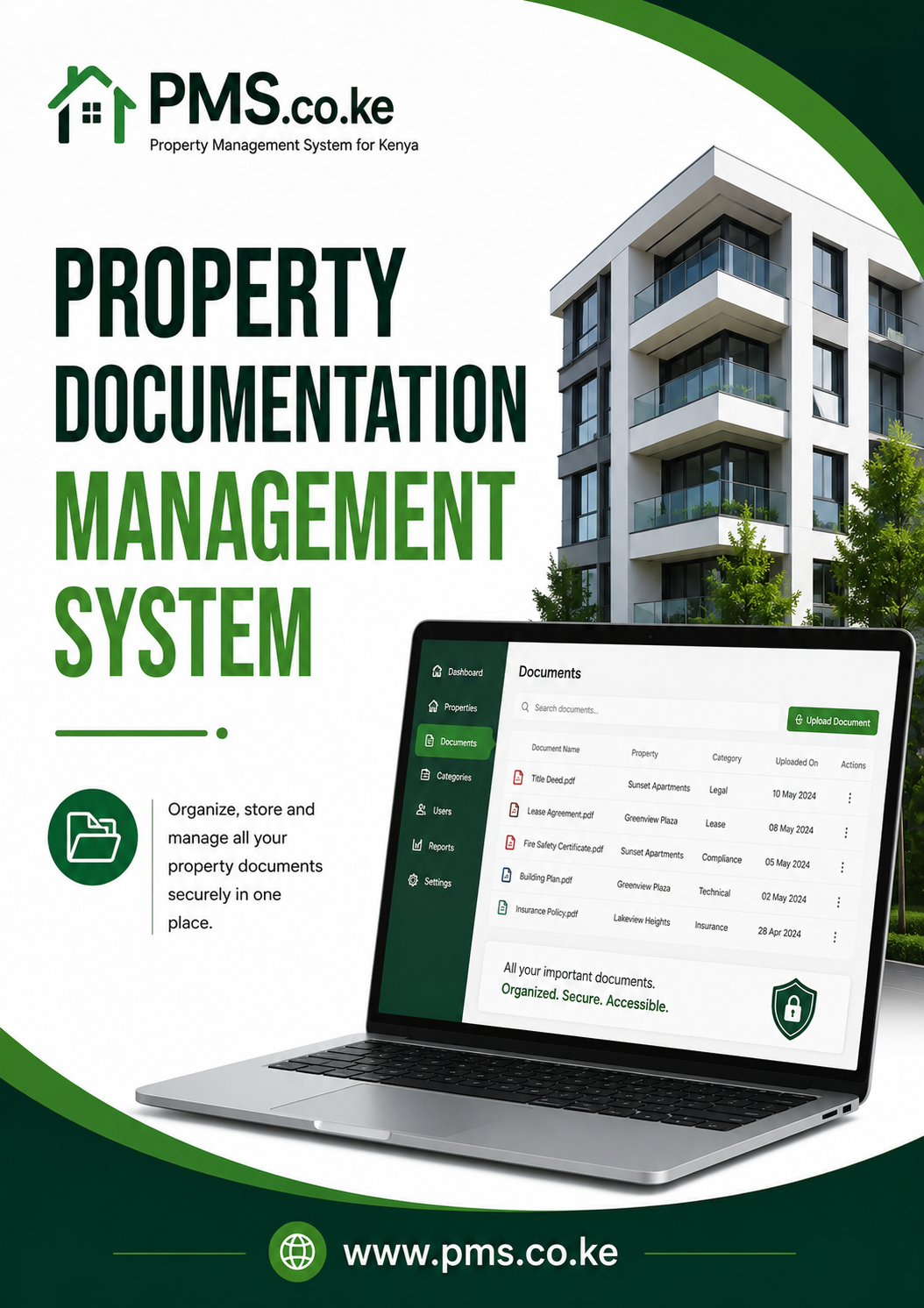
Property Documentation Management System solutions are transforming how property managers organize, secure, and access critical property records. In every property portfolio, documentation serves as the foundation for operational efficiency, regulatory compliance, financial accountability, and tenant management. Without proper documentation processes, property managers can face significant challenges ranging from lost records and compliance risks to delayed decision-making and poor service delivery.
As property portfolios continue to grow across Kenya, the volume of documents generated by property operations increases substantially. Lease agreements, tenant records, maintenance reports, inspection forms, ownership documents, invoices, receipts, contracts, compliance certificates, and financial statements must all be maintained accurately and securely. Managing these records manually often leads to inefficiencies and unnecessary administrative burdens.
Property Documentation Management System software provides a centralized platform where all property-related documents can be stored, organized, retrieved, updated, and secured. Instead of relying on filing cabinets, spreadsheets, email attachments, and disconnected storage systems, property managers gain complete visibility into their documentation processes through a unified digital environment.
Modern property management requires instant access to accurate information. Property owners demand transparency, tenants expect efficient service, and regulatory authorities require proper recordkeeping. Property Documentation Management System technology enables organizations to meet these expectations while improving operational performance.
As Kenya’s property sector continues embracing digital transformation, Property Documentation Management System platforms are becoming essential tools for residential, commercial, mixed-use, and institutional property management operations.
Table of Contents
- Understanding Property Documentation Management
- Why Property Documentation Is Critical
- Core Features of Modern Documentation Platforms
- Centralized Property Record Storage
- Tenant Documentation Management
- Lease and Contract Documentation
- Compliance and Regulatory Record Management
- Challenges of Traditional Documentation Methods
Understanding Property Documentation Management
Property documentation management refers to the process of organizing, maintaining, storing, tracking, securing, and retrieving all documents associated with property operations. These records support every stage of the property lifecycle and are essential for maintaining operational efficiency and compliance.
Property Documentation Management System software creates a structured environment where documents can be categorized according to properties, tenants, leases, maintenance activities, financial transactions, compliance requirements, and ownership records.
Without a centralized Property Documentation Management System, organizations often struggle with fragmented records scattered across filing cabinets, computers, email inboxes, cloud storage folders, and paper archives. This fragmentation makes it difficult to locate important documents when needed.
A modern Property Documentation Management System ensures that all documentation remains accessible from a single platform. Property managers can quickly retrieve records, update information, share files with authorized stakeholders, and maintain complete visibility into document activity.
The system also improves collaboration among departments. Leasing teams, maintenance personnel, finance staff, property owners, and administrators can access the information they need without duplicating records or creating communication bottlenecks.
As property portfolios expand, documentation requirements become increasingly complex. Property Documentation Management System solutions help organizations manage growth while maintaining consistency and accuracy across all records.
By digitizing documentation workflows, property managers can improve productivity, reduce administrative effort, and create a more organized operational environment.
Why Property Documentation Is Critical
Property documentation serves as the backbone of property management operations. Every transaction, agreement, inspection, maintenance activity, and compliance process generates records that must be maintained properly.
A Property Documentation Management System helps ensure that important information remains available whenever required. This is particularly important during audits, inspections, dispute resolution, lease renewals, and financial reporting processes.
Accurate documentation supports transparency and accountability throughout property operations. Property owners can review records confidently, tenants can receive timely information, and management teams can make informed decisions based on reliable data.
Property Documentation Management System software also helps reduce risks associated with lost documents. Missing records can create legal challenges, compliance violations, financial discrepancies, and operational delays.
Another critical benefit involves business continuity. Physical documents may be damaged by fire, water, theft, or accidental loss. Digital documentation systems provide backup and recovery capabilities that protect valuable records.
The increasing complexity of regulatory requirements further emphasizes the importance of structured documentation. Property managers must maintain records that demonstrate compliance with tenancy regulations, financial requirements, safety standards, and operational procedures.
Property Documentation Management System technology helps organizations meet these requirements while reducing administrative workload and improving efficiency.
As the Kenyan property market continues evolving, effective documentation management is becoming a competitive advantage for property management companies seeking operational excellence.
Core Features of Modern Documentation Platforms
Modern Property Documentation Management System platforms provide comprehensive functionality designed to support efficient document control and record management.
One of the most important features is centralized document storage. All records are maintained within a unified environment that eliminates duplication and fragmentation.
Advanced search capabilities allow users to locate documents quickly using keywords, property references, tenant names, lease numbers, dates, or custom categories.
Property Documentation Management System software also supports document categorization. Records can be organized according to property type, tenant profile, lease agreement, maintenance activity, financial transaction, or compliance requirement.
Access control features ensure that sensitive information remains protected. Administrators can assign permissions based on roles and responsibilities while maintaining security and confidentiality.
Version control functionality allows organizations to track document changes over time. This prevents confusion caused by outdated files and helps maintain document accuracy.
Automated notifications help users monitor document expiration dates, lease renewals, compliance deadlines, and required updates.
Cloud accessibility enables property managers to access records from multiple locations and devices. This flexibility supports remote work and field operations.
Audit trail capabilities provide visibility into document activity by recording uploads, edits, downloads, and approvals.
Together, these features make Property Documentation Management System platforms valuable tools for improving operational efficiency and document governance.
Centralized Property Record Storage
Centralized storage is one of the most significant advantages offered by Property Documentation Management System software.
Property managers often handle thousands of documents across multiple properties. Without centralized storage, locating specific records can become time-consuming and frustrating.
A Property Documentation Management System creates a single source of truth for all documentation. Every lease agreement, tenant record, inspection report, maintenance file, financial statement, and compliance certificate can be stored within one platform.
This centralized approach improves consistency and reduces duplication. Teams no longer need to maintain multiple copies of documents across different storage systems.
Property managers can organize records using structured folders, categories, tags, and property-specific identifiers. This makes information retrieval significantly faster and more reliable.
Centralized storage also improves collaboration between departments. Leasing teams, maintenance staff, accounting personnel, and property managers can access relevant information without requesting files from multiple sources.
The ability to retrieve documents instantly improves responsiveness and supports better decision-making throughout the organization.
Property Documentation Management System platforms help ensure that records remain secure, accessible, and organized regardless of portfolio size.
As organizations continue growing, centralized document management becomes increasingly important for maintaining operational efficiency and scalability.
Tenant Documentation Management
Tenant records represent some of the most important documentation within any property portfolio.
Property Documentation Management System software helps property managers maintain complete tenant files throughout the tenancy lifecycle.
Common tenant documents include:
- Identification records
- Contact information
- Lease agreements
- Application forms
- Employment verification
- Payment records
- Correspondence history
- Occupancy documents
Maintaining these records manually can create challenges related to organization, accessibility, and accuracy.
A Property Documentation Management System centralizes tenant documentation and ensures that records remain linked to specific tenant profiles.
Property managers can retrieve information quickly when responding to inquiries, processing renewals, resolving disputes, or preparing reports.
Digital document management also improves compliance by ensuring that required records remain complete and accessible.
Tenant documentation often contains sensitive personal information. Property Documentation Management System platforms provide security controls that protect confidentiality while allowing authorized access.
As tenant populations grow, efficient document management becomes essential for maintaining service quality and administrative efficiency.
Organizations that implement structured tenant documentation processes are better positioned to deliver professional property management services.
Lease and Contract Documentation
Lease agreements and contractual documents form the legal foundation of property management operations.
Property Documentation Management System software helps organizations manage lease-related records from creation and approval through renewal and termination.
Common lease documents include:
- Residential lease agreements
- Commercial lease agreements
- Renewal contracts
- Amendments
- Addendums
- Guarantor agreements
- Occupancy agreements
- Termination notices
Managing these records manually increases the risk of errors, lost documents, and missed deadlines.
A Property Documentation Management System provides centralized storage and tracking capabilities that improve lease administration.
Property managers can monitor renewal dates, access historical agreements, and ensure that current contracts remain available when needed.
Version control features help maintain document accuracy by tracking updates and modifications.
The ability to retrieve lease documents instantly supports faster decision-making and improved tenant service.
Property Documentation Management System platforms also contribute to compliance and legal protection by ensuring that contractual records remain complete and accessible throughout the lease lifecycle.
Compliance and Regulatory Record Management
Compliance management is a major responsibility for property managers.
Property Documentation Management System software helps organizations maintain records required for regulatory compliance, audits, inspections, and operational governance.
Examples of compliance-related documentation include:
- Safety certificates
- Inspection reports
- Insurance documents
- Licensing records
- Environmental compliance records
- Occupancy certifications
- Vendor compliance documents
- Financial audit records
Failure to maintain accurate compliance records can result in penalties, legal disputes, and operational disruptions.
A Property Documentation Management System centralizes these records while providing reminders for renewals, inspections, and reporting deadlines.
Digital storage also simplifies audit preparation by ensuring that required documents can be retrieved quickly.
Property managers gain greater visibility into compliance obligations and can monitor documentation status more effectively.
As regulatory requirements continue evolving, maintaining organized compliance records becomes increasingly important.
Property Documentation Management System solutions help organizations reduce risk while strengthening accountability and operational transparency.
Challenges of Traditional Documentation Methods
Many property management organizations still rely on paper files, spreadsheets, email attachments, and disconnected storage systems.
While these methods may appear manageable initially, they often create significant challenges as portfolios expand.
Common issues include:
- Lost documents
- Duplicate records
- Limited accessibility
- Slow information retrieval
- Security vulnerabilities
- Compliance risks
- Poor collaboration
- High administrative workload
Traditional documentation methods often require employees to spend excessive time searching for records, updating files, and coordinating information across departments.
Property Documentation Management System software eliminates these inefficiencies by centralizing documentation processes and automating key workflows.
Organizations gain improved visibility, stronger security, better compliance management, and faster access to information.
Instead of managing fragmented records, property managers can focus on strategic activities that improve tenant satisfaction and property performance.
As Kenya’s property industry continues modernizing, organizations that invest in Property Documentation Management System technology are better positioned to achieve operational efficiency, scalability, and long-term success.
Improving Operational Efficiency Through Documentation Automation
Automation is one of the most significant advantages of implementing a Property Documentation Management System.
Manual documentation processes often require repetitive administrative tasks that consume valuable time and resources. Property managers may spend hours filing documents, updating records, tracking approvals, locating files, and maintaining compliance records.
A Property Documentation Management System automates many of these processes, allowing teams to work more efficiently.
Automation capabilities include:
- Automatic document categorization
- Digital document routing
- Approval workflows
- Record updates
- Renewal reminders
- Compliance alerts
- Audit tracking
- Version control
These automated workflows reduce human error while ensuring consistency across property operations.
Property managers can quickly locate records, monitor documentation status, and maintain complete visibility into document lifecycles.
By reducing manual effort, a Property Documentation Management System enables organizations to allocate resources more effectively and focus on higher-value operational activities.
Automation also improves scalability, allowing property management companies to manage growing portfolios without significantly increasing administrative workload.
Enhancing Security and Data Protection
Property records often contain sensitive information that requires strong protection.
A Property Documentation Management System provides multiple layers of security to safeguard critical property and tenant information.
Security features commonly include:
- Role-based access controls
- Secure cloud storage
- User authentication
- Activity monitoring
- Audit trails
- Data encryption
- Backup management
- Disaster recovery support
These capabilities help protect documents from unauthorized access, accidental deletion, theft, and data loss.
Unlike traditional paper-based systems, digital documentation platforms provide greater control over who can view, edit, download, or share records.
Property Documentation Management System software also helps organizations comply with internal governance requirements and industry best practices for information management.
As cyber threats continue evolving, maintaining secure document management practices has become essential for modern property management organizations.
Strong data protection measures help preserve trust among tenants, property owners, vendors, and stakeholders.
Why RentalDesk Is the Ideal Solution
RentalDesk provides a comprehensive Property Documentation Management System designed specifically for modern property management operations in Kenya.
The platform enables property managers to centralize, organize, secure, and access critical documentation from a single environment.
With RentalDesk, organizations can manage:
- Tenant records
- Lease agreements
- Property documents
- Maintenance records
- Inspection reports
- Financial documents
- Compliance certificates
- Vendor documentation
RentalDesk eliminates the challenges associated with fragmented storage systems and manual filing processes.
Property managers gain instant access to records while maintaining security, compliance, and operational efficiency.
The platform integrates documentation management with broader property management functions, creating a unified system that supports daily operations.
Key RentalDesk advantages include:
- Centralized document storage
- Secure cloud accessibility
- Advanced search functionality
- Automated reminders
- Compliance tracking
- User permission controls
- Audit trail visibility
- Portfolio-wide document management
For organizations seeking a scalable Property Documentation Management System, RentalDesk delivers the tools necessary to improve efficiency and support long-term growth.
Future Trends in Property Documentation Management
The future of Property Documentation Management System technology will be shaped by automation, artificial intelligence, cloud computing, and advanced analytics.
Several trends are expected to influence document management practices across the property industry.
Artificial Intelligence
AI-powered systems will automatically classify documents, extract data, identify inconsistencies, and improve document search capabilities.
Predictive Compliance Monitoring
Future Property Documentation Management System platforms will proactively identify compliance risks and recommend corrective actions.
Mobile Document Management
Mobile accessibility will continue expanding, enabling property managers to capture, upload, and review documents directly from the field.
Smart Workflow Automation
Automation will become more intelligent, reducing manual intervention and streamlining document approval processes.
Digital Signatures
Electronic signatures will continue replacing paper-based approvals, accelerating lease execution and document processing.
Cloud-Based Collaboration
Enhanced cloud environments will improve collaboration among property managers, owners, tenants, contractors, and regulatory authorities.
Advanced Reporting
Future systems will provide deeper insights into documentation performance, compliance status, and operational efficiency.
Organizations that adopt modern Property Documentation Management System solutions today will be better positioned to benefit from these innovations.
Getting Started with a Property Documentation Management System
Implementing a Property Documentation Management System requires careful planning and structured execution.
Property managers should begin by evaluating their existing documentation processes and identifying operational challenges.
Key implementation steps include:
- Assess current documentation workflows
- Identify document categories
- Define access permissions
- Digitize existing records
- Establish storage standards
- Configure automation workflows
- Train users
- Monitor system performance
Successful implementation depends on clear procedures and user adoption.
Organizations should also establish document retention policies and governance frameworks to maintain consistency and compliance.
A well-implemented Property Documentation Management System creates a strong foundation for efficient property management operations and long-term portfolio growth.
