
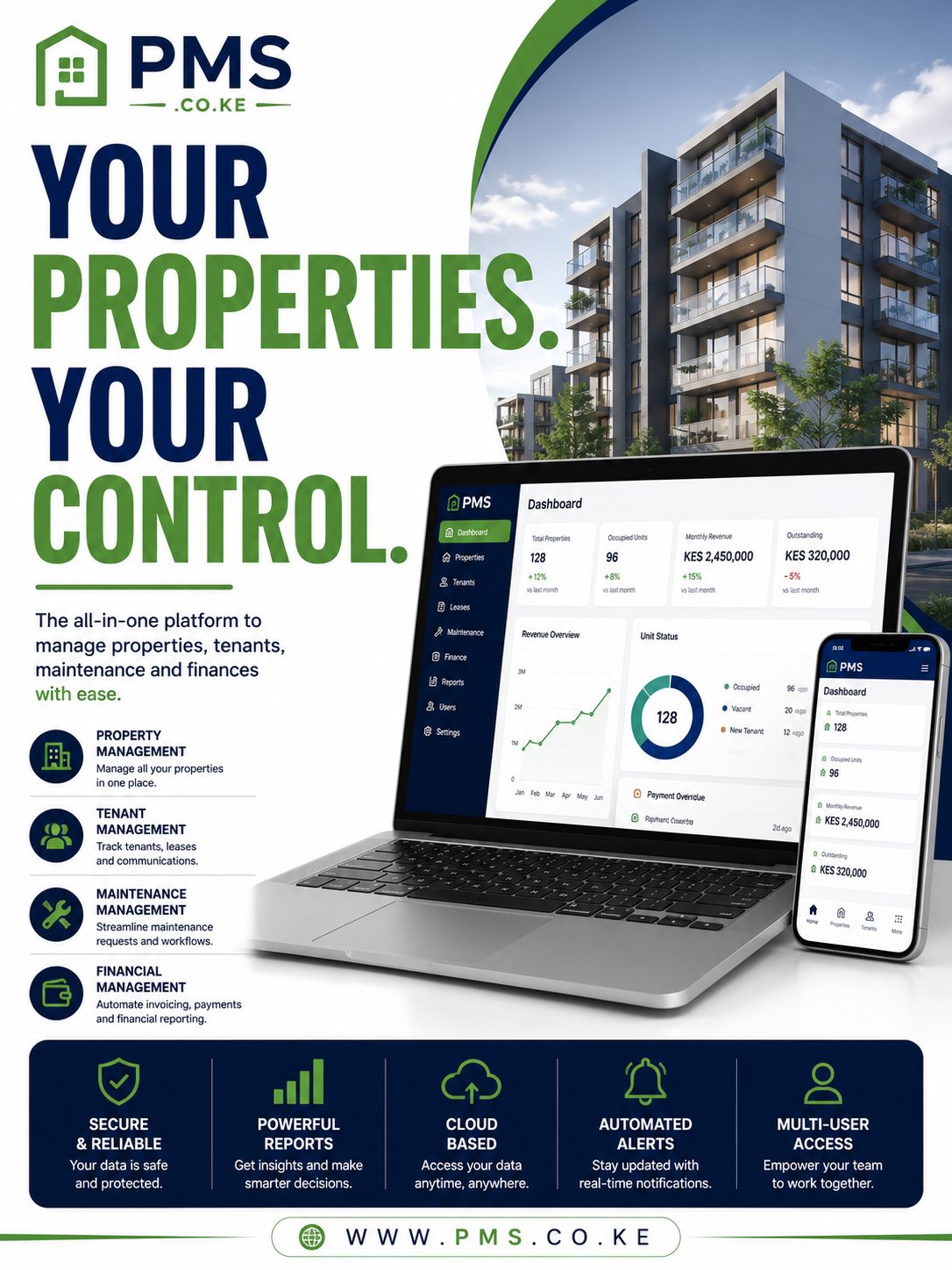
Estate management software Kenya is changing how property owners, estate managers, property management companies, and residential communities handle their daily operations. Managing an estate involves much more than collecting rent. Managers need to organize properties and units, register residents, track payments, manage service charges, monitor maintenance, communicate with residents, control expenses, and prepare accurate reports.
As estates become larger, managing these activities through notebooks, spreadsheets, paper files, and disconnected communication channels can become increasingly difficult. Modern property management platforms bring these functions together in a centralized digital environment. Current Kenyan solutions commonly emphasize features such as rent and service-charge collection, M-PESA and bank payments, maintenance, tenant or resident portals, accounting, and reporting.
For Kenyan property owners and estate managers, digital estate management can improve financial visibility, reduce repetitive administrative work, strengthen resident communication, and make it easier to manage growing portfolios.
This guide explains what estate management software is, how it works, the challenges of manual estate management, and the key features property managers should consider.
What Is Estate Management Software?
Estate management software Kenya refers to a digital platform designed to help property owners, estate managers, property management companies, and residential communities organize and manage their properties.
Depending on the platform, the software can bring together:
- Property management
- Unit management
- Tenant and resident records
- Rent collection
- Service charge billing
- Payment tracking
- Arrears management
- Maintenance requests
- Expense management
- Communication
- Financial reporting
Instead of maintaining separate records for every part of an estate, management can use one centralized system.
This creates a single source of information that authorized users can access when making operational and financial decisions.
A modern system can also support different user roles. For example, an estate manager may have access to financial and operational information, while a caretaker may only need access to assigned maintenance tasks.
Why Estate Management Is Becoming More Digital
Property management in Kenya has traditionally relied heavily on spreadsheets, handwritten records, payment messages, paper documents, and direct communication.
These methods may be manageable when an estate has only a few units. However, the workload increases significantly as the number of units and residents grows.
Consider an estate with 300 occupied units.
Every month, management may need to:
- Generate hundreds of rental charges
- Track hundreds of payments
- Monitor service charges
- Identify outstanding balances
- Respond to maintenance requests
- Record expenses
- Communicate with residents
- Prepare financial reports
Trying to manage all these activities manually can create delays and inconsistencies.
Digital platforms are increasingly designed around this exact problem. Kenyan property-management systems now commonly centralize properties, tenants, leases, rent collection, maintenance, service charges, and reports in one dashboard.
Challenges of Managing Estates Manually
Difficulty Tracking Multiple Units
Large residential estates can contain hundreds or even thousands of units.
Every unit may have its own:
- Unit number
- Resident
- Rental amount
- Lease
- Payment history
- Maintenance history
- Occupancy status
When this information is stored across different spreadsheets and files, finding the correct record can take time.
A centralized system allows managers to organize buildings and units systematically.
Manual Payment Tracking
Payment tracking is one of the most important responsibilities in estate management.
Managers may have to compare:
- M-PESA transactions
- Bank transfers
- Cash records
- Payment receipts
- Tenant statements
- Spreadsheets
Manual reconciliation can result in:
- Delayed updates
- Incorrect balances
- Duplicate entries
- Missing transactions
- Payment disputes
Modern Kenyan property platforms increasingly support M-PESA and bank payment workflows to reduce this administrative burden.
Monitoring Arrears
Outstanding rent and service charges can affect an estate’s cash flow.
When managers rely on spreadsheets, identifying every account with an outstanding balance may require manually reviewing multiple records.
Digital software can organize overdue accounts and show managers which residents require follow-up.
This allows management to prioritize arrears instead of discovering them much later.
Maintenance Tracking
Maintenance is another major challenge.
Residents may report:
- Plumbing problems
- Electrical faults
- Water leaks
- Broken lights
- Damaged doors
- Security concerns
- Cleaning problems
If requests are handled entirely through phone calls or messaging applications, some issues can become difficult to track.
A maintenance management module creates a structured process for receiving, assigning, monitoring, and completing requests.
How Estate Management Software Works
The implementation of estate management software Kenya usually begins by creating the estate structure inside the platform.
Step 1: Register the Estate
The estate manager creates a profile containing information such as:
- Estate name
- Location
- Property type
- Number of buildings
- Number of units
- Management information
This becomes the foundation for the rest of the estate’s records.
Step 2: Create Buildings and Units
If an estate contains several buildings, blocks can be organized individually.
For example:
Estate: Green Valley Estate
Block A: 50 units
Block B: 50 units
Block C: 50 units
Each unit can then be linked to the appropriate resident and financial information.
Step 3: Register Tenants and Residents
Resident profiles can contain:
- Full name
- Phone number
- Email address
- Unit
- Lease details
- Rental amount
- Deposit
- Payment history
Keeping these details together makes it easier for managers to answer questions and resolve account issues.
Step 4: Configure Charges
Recurring charges can be configured according to tenancy agreements and estate requirements.
These may include:
- Rent
- Service charges
- Parking
- Water
- Garbage collection
- Other approved charges
Automated billing helps ensure that recurring charges are applied consistently.
Step 5: Record Payments
Payments can then be recorded against the relevant tenant or resident account.
Where supported, payment integration can reduce manual entry and improve reconciliation.
Step 6: Generate Reports
Once information is recorded, management can generate reports covering areas such as:
- Rent collection
- Service charges
- Arrears
- Expenses
- Occupancy
- Maintenance
- Resident accounts
This gives property owners and managers a clearer view of estate performance.
Property and Unit Management
Property and unit management is one of the core functions of estate management software Kenya.
Managers need to know exactly which units exist, which ones are occupied, which are vacant, and who is responsible for each account.
A unit record may contain:
- Unit number
- Building
- Unit type
- Rental amount
- Occupancy status
- Tenant or resident
- Lease information
This makes managing large developments more organized.
Occupancy Monitoring
Vacant units represent potential lost income.
A digital dashboard can categorize units as:
- Occupied
- Vacant
- Reserved
- Under maintenance
- Awaiting move-in
This allows managers to identify vacancies quickly.
Occupancy information can also help property owners understand how effectively their estate is performing.
Tenant and Resident Management
Tenant and resident management is another essential component of digital estate operations.
Instead of storing resident information in physical folders, managers can maintain digital profiles.
A resident profile can provide access to:
- Contact information
- Payment history
- Current balance
- Lease information
- Maintenance requests
- Communication records
This reduces the amount of time spent searching for documents.
Better Resident Communication
Effective communication is important for maintaining a well-managed estate.
Digital platforms can support notifications relating to:
- Rent due dates
- Payment confirmations
- Service charges
- Maintenance updates
- Estate announcements
- Lease renewals
Automated communication can reduce repetitive work for estate managers while keeping residents informed.
Rent and Payment Management
One of the most important functions of estate management software Kenya is rent and payment management.
The platform can help managers:
- Generate rent charges
- Track payments
- Monitor outstanding balances
- Record partial payments
- Generate receipts
- Review collection performance
For Kenyan estates, support for M-PESA and other payment methods can make payment management more convenient. Several current Kenyan property-management platforms highlight M-PESA integration as a core feature.
Automated Rent Collection
Automated payment workflows can reduce manual work.
When a payment is correctly associated with a resident account, the system can update the account and reflect the new balance.
The manager can then view:
- Amount charged
- Amount paid
- Outstanding balance
- Payment date
- Transaction reference
This creates a more reliable financial record.
Service Charge Management
Service charges are an important part of many residential estates and gated communities.
They may contribute toward shared services such as:
- Security
- Cleaning
- Garbage collection
- Landscaping
- Common-area electricity
- Repairs
- Facility management
Estate management software Kenya can help managers create service charge invoices and monitor collections separately from rental income.
Modern estate-focused platforms commonly include recurring billing, payment tracking, arrears monitoring, resident statements, and reporting for service charges.
Service Charge Statements
Residents can receive statements showing:
- Service charge billed
- Payments made
- Previous balance
- Outstanding amount
Clear statements improve transparency and can help reduce disputes over what has been charged and paid.
Maintenance Management
A professionally managed estate requires an organized maintenance process.
A digital workflow can work as follows:
- A resident submits a maintenance request.
- Management reviews the issue.
- The request is assigned to the appropriate person.
- A technician or contractor is contacted.
- The work is completed.
- The request is closed.
- The related cost is recorded.
This creates accountability throughout the maintenance process.
Maintenance History
A digital maintenance history allows managers to identify recurring problems.
For example, if one building repeatedly experiences plumbing issues, management can review previous requests and determine whether a larger repair or replacement is more appropriate.
Historical maintenance records can also help with budgeting.
Financial Records and Reporting
Financial visibility is essential to effective estate management.
Estate management software Kenya can provide reports showing how the estate is performing financially.
Reports may cover:
- Rental income
- Service charge collections
- Outstanding balances
- Operating expenses
- Maintenance costs
- Occupancy
- Payment history
Managers can use these reports for budgeting, planning, accountability, and decision-making.
Benefits of Digital Estate Management
The adoption of estate management software Kenya can provide several important benefits.
Saves Time
Automation can reduce repetitive tasks such as:
- Payment entry
- Invoice preparation
- Receipt generation
- Balance calculations
- Report preparation
Improves Accuracy
Centralized records and automated calculations can reduce errors associated with manual data entry.
Improves Financial Visibility
Managers can quickly determine how much has been billed, how much has been collected, and what remains outstanding.
Improves Resident Service
Residents can receive clearer statements, faster responses, and more consistent communication.
Supports Growth
A digital system can accommodate additional units, properties, residents, and staff as an estate management business expands.
Who Should Use Estate Management Software?
Estate management software Kenya can benefit a wide range of property organizations.
Residential Estate Managers
Managers of gated communities and residential developments can use digital systems to coordinate residents, payments, maintenance, and communication.
Apartment Managers
Apartment buildings with multiple units can use software to organize occupancy, rent, service charges, and maintenance.
Property Management Companies
Professional property managers can use centralized systems to manage several estates on behalf of different property owners.
Real Estate Investors
Investors with growing rental portfolios can use digital tools to monitor income, occupancy, expenses, and property performance.
Mixed-Use Developments
Developments containing residential units, shops, offices, and other commercial spaces can benefit from centralized management while keeping different property categories organized.
Why Digital Estate Management Matters
As estates become larger and more complex, relying entirely on manual processes can create unnecessary administrative pressure.
Managers need accurate information about properties, residents, payments, maintenance, expenses, occupancy, and service charges.
Estate management software Kenya brings these activities together in one organized environment. Current Kenyan platforms demonstrate that estate-focused systems can combine service-charge billing, resident records, payments, maintenance, accounting, and reporting rather than forcing managers to maintain disconnected systems.
The result is a more organized management process that can improve efficiency while giving property owners, estate managers, and residents greater visibility.
Advanced Features for Modern Estates
As residential estates, apartment communities, and mixed-use developments continue to grow, property managers need more than basic tenant records and payment spreadsheets. They need a connected system that can handle financial management, resident communication, maintenance, service charges, reporting, and daily estate operations.
Estate management software Kenya provides a centralized platform where these activities can be coordinated from one place. Instead of relying on separate spreadsheets, paper files, payment messages, and manual reports, estate managers can use digital tools to create a more organized workflow.
Part 1 introduced the fundamentals of digital estate management. Part 2 focuses on the advanced features that can make estate operations more efficient, transparent, and scalable.
Automated Rent and Service Charge Reminders
Late payments can affect an estate’s ability to pay for security, cleaning, maintenance, utilities, and other shared services.
Modern estate management software Kenya can help automate payment reminders according to configured billing schedules.
For example, the system can send reminders:
- Before the due date
- On the payment due date
- After the due date
- When an account becomes overdue
Messages can contain the amount due, payment instructions, account information, and other relevant details.
Automation reduces the amount of time staff spend contacting residents individually.
M-PESA and Digital Payment Integration
Mobile payments are an important part of property management in Kenya.
A digital estate platform can integrate supported payment channels so that payments can be associated with the correct resident or unit.
When payment information is properly integrated, the system can help with:
- Recording transactions
- Updating account balances
- Matching payments to invoices
- Generating receipts
- Tracking payment references
- Preparing collection reports
This can reduce manual reconciliation and make financial records easier to maintain.
Automated Payment Reconciliation
One of the most time-consuming financial tasks in estate management is determining which tenant or resident made a particular payment.
Without automation, staff may need to compare payment notifications against spreadsheets and tenant records.
An integrated system can help match payments using relevant information such as:
- Account numbers
- Payment references
- Phone numbers
- Invoice numbers
- Unit information
Once a transaction has been matched, the resident’s account can be updated.
This improves the accuracy of financial records and reduces duplicate data entry.
Managing Partial Payments
Residents do not always pay the complete amount due in one transaction.
For example, a resident may owe KSh 30,000 and pay KSh 20,000.
The system should record:
Amount billed: KSh 30,000
Amount paid: KSh 20,000
Outstanding balance: KSh 10,000
This makes it easier for managers to identify accounts that are partially settled.
Partial payment tracking is especially useful for estates with large numbers of residents.
Digital Receipts
Digital receipts provide residents with confirmation that their payments have been recorded.
A receipt can contain:
- Resident name
- Unit number
- Property
- Amount paid
- Payment date
- Transaction reference
- Outstanding balance
Instead of printing and filing receipts manually, management can maintain digital records that can be retrieved when needed.
Resident Statements
A resident statement provides a complete financial history for an account.
It can show:
- Previous balance
- Current charges
- Payments
- Service charges
- Other approved charges
- Credits
- Outstanding amounts
This makes it easier to answer payment-related questions.
When a resident disputes a balance, management can review the statement rather than searching through multiple files.
Arrears Management
Arrears can create serious cash-flow challenges for an estate.
Estate management software Kenya can provide dashboards that show accounts with outstanding balances.
Managers can organize arrears based on:
- Amount outstanding
- Number of days overdue
- Property
- Unit
- Resident
- Payment history
This helps management prioritize follow-ups.
Instead of contacting residents randomly, staff can focus on accounts requiring immediate attention.
Financial Dashboards
A financial dashboard provides a quick overview of estate performance.
Depending on the system, managers may be able to view:
- Total billed income
- Total collections
- Outstanding balances
- Service charge collections
- Expenses
- Maintenance costs
- Occupancy
- Recent transactions
This information can help managers understand the current financial position of the estate without preparing reports manually.
Property-Level Reporting
Large developments may contain several buildings or sections.
A centralized platform can allow managers to generate reports for individual properties or blocks.
For example:
Block A
- Expected collections
- Actual collections
- Arrears
- Maintenance expenses
- Occupancy
Block B
- Expected collections
- Actual collections
- Arrears
- Maintenance expenses
- Occupancy
This makes it easier to compare performance.
Estate-Wide Reporting
Property owners may also need an overview of the entire estate.
A consolidated report can show:
- Total income
- Total expenses
- Total arrears
- Total occupied units
- Total vacant units
- Maintenance expenditure
- Collection performance
This gives owners and managers a broader understanding of estate operations.
Expense Management
Estate management involves many expenses.
These may include:
- Security
- Cleaning
- Landscaping
- Repairs
- Plumbing
- Electrical services
- Garbage collection
- Common-area utilities
- Staff costs
- Contractor payments
Estate management software Kenya can help managers record these expenses against specific properties, buildings, or categories.
This makes it easier to understand where estate funds are being spent.
Budget Management
Historical financial information can support better budgeting.
Managers can review previous expenses and estimate future costs.
For example, if security expenses consistently increase during certain periods, the management team can include this trend when preparing future budgets.
Budget monitoring can also help identify situations where actual expenditure is significantly higher than expected.
Maintenance Request Management
Maintenance requests can be managed through a structured digital workflow.
A resident can report an issue, after which management can:
- Review the request.
- Categorize the problem.
- Assign the task.
- Contact a technician.
- Monitor progress.
- Record the cost.
- Mark the request as completed.
This creates a clear record of the entire maintenance process.
Maintenance Prioritization
Not every maintenance issue has the same urgency.
For example:
High priority: Major water leak
Medium priority: Faulty electrical socket
Low priority: Minor cosmetic repair
Digital systems can allow management to categorize requests according to urgency.
This helps teams respond to critical problems more quickly.
Contractor Management
Estates often work with external contractors.
A digital platform can help maintain records of:
- Contractor names
- Services provided
- Assigned jobs
- Costs
- Completion dates
- Maintenance history
This creates better accountability when reviewing maintenance expenditure.
Resident Portal
A resident portal can improve communication between estate management and residents.
Depending on the platform, residents may be able to:
- View balances
- Download receipts
- Access statements
- Submit maintenance requests
- Receive announcements
- Review payment history
- Access important documents
This reduces the need for residents to contact the management office for routine requests.
Estate Announcements
Communication is essential when managing a residential community.
Management may need to notify residents about:
- Water interruptions
- Planned maintenance
- Security updates
- Cleaning schedules
- Service charge information
- Community meetings
- Emergency notices
Digital notifications allow management to communicate information more consistently.
Lease and Tenancy Management
Lease records are important for rental estates.
A digital system can store:
- Lease start dates
- Expiry dates
- Rental rates
- Deposits
- Renewal information
- Tenant details
- Lease documents
Automated reminders can notify management when leases are approaching expiry.
This gives managers time to communicate with residents and plan renewals.
Vacancy Management
Vacant units represent lost potential income.
A centralized system can provide an overview of units that are:
- Occupied
- Vacant
- Reserved
- Under maintenance
- Awaiting occupation
Managers can use this information to respond quickly when units become available.
Multi-Property Management
Property management companies may manage several estates for different owners.
Using separate spreadsheets for each property can create unnecessary complexity.
A centralized platform can organize:
- Multiple estates
- Multiple buildings
- Multiple units
- Multiple resident accounts
- Separate financial records
This allows management companies to expand their operations while maintaining organized records.
Multi-User Access
Estate management is rarely performed by one person.
A typical management team may include:
- Property manager
- Accountant
- Estate administrator
- Caretaker
- Maintenance staff
- Finance officer
Each person may require different permissions.
For example, an accountant may need access to financial information, while a maintenance worker may only need access to assigned maintenance tasks.
Role-based access helps protect sensitive information.
Cloud-Based Access
Cloud-based platforms allow authorized users to access estate information through internet-connected devices.
This means managers can review information while:
- Visiting properties
- Working from home
- Traveling
- Meeting property owners
- Inspecting buildings
Remote access is particularly useful for companies managing estates in different locations.
Mobile Management
Mobile access makes estate management more flexible.
Managers may be able to use smartphones or tablets to:
- Check payments
- Review arrears
- View resident information
- Approve expenses
- Monitor maintenance
- Respond to requests
- Review reports
This reduces dependence on an office computer.
Data Security
Estate management systems contain sensitive information, including resident contacts, payment records, financial information, and property details.
A reliable platform should therefore provide appropriate security measures.
These can include:
- User authentication
- Role-based permissions
- Secure data storage
- Backups
- Activity logs
- Controlled administrative access
Estate managers should also ensure that staff use secure passwords and do not share account credentials.
Audit Trails
An audit trail records important activities performed within a system.
Depending on the platform, managers may be able to see:
- Who changed a record
- When a payment was updated
- Who created an invoice
- Who modified a tenant account
- When a maintenance request was closed
This can improve accountability and make it easier to investigate discrepancies.
Better Estate Performance Analysis
One of the most valuable capabilities of estate management software Kenya is the ability to analyze historical data.
Management can compare:
- Monthly collections
- Service charge performance
- Expenses
- Occupancy
- Arrears
- Maintenance costs
These trends can help identify areas that require attention.
For example, if maintenance costs for one building consistently exceed those of other buildings, management can investigate the underlying cause.
Improving Decision-Making
Property owners need reliable information when making decisions.
Digital reports can help answer questions such as:
- Which property generates the highest income?
- Which building has the highest arrears?
- How much is spent on maintenance?
- Which units remain vacant?
- Are service charges being collected efficiently?
- Which expenses are increasing?
This transforms estate management from a largely reactive process into a more data-driven operation.
Improving Resident Satisfaction
Technology is not only about financial management.
Residents also benefit when routine services become easier.
A digital platform can provide:
- Faster payment confirmation
- Easy access to statements
- Digital receipts
- Convenient maintenance reporting
- Timely announcements
- Better communication
When residents receive clear information and faster service, overall satisfaction can improve.
Reducing Administrative Work
Automation can significantly reduce repetitive tasks.
Instead of manually:
- Preparing invoices
- Calculating balances
- Sending reminders
- Generating receipts
- Reconciling payments
- Preparing reports
the system can automate many of these activities.
Staff can then spend more time on activities that require human attention, such as inspections, resident relations, contractor coordination, and estate planning.
Supporting Estate Growth
A good digital platform should support an estate as it grows.
Management may begin with 50 units and eventually manage 500 or more.
Estate management software Kenya provides a structured foundation for adding more units, buildings, residents, transactions, and users without rebuilding the entire management process.
This scalability can be particularly valuable for property management companies and growing real estate businesses.
Choosing the Right Estate Management Platform
Before adopting a system, estate managers should evaluate their specific requirements.
Important considerations include:
- Property and unit management
- Resident management
- Rent collection
- M-PESA integration
- Service charge management
- Maintenance
- Expense tracking
- Financial reporting
- Resident portals
- Mobile access
- Security
- User permissions
- Scalability
The right platform should solve current management challenges while providing room for future growth.
