
Property Operations Intelligence Software
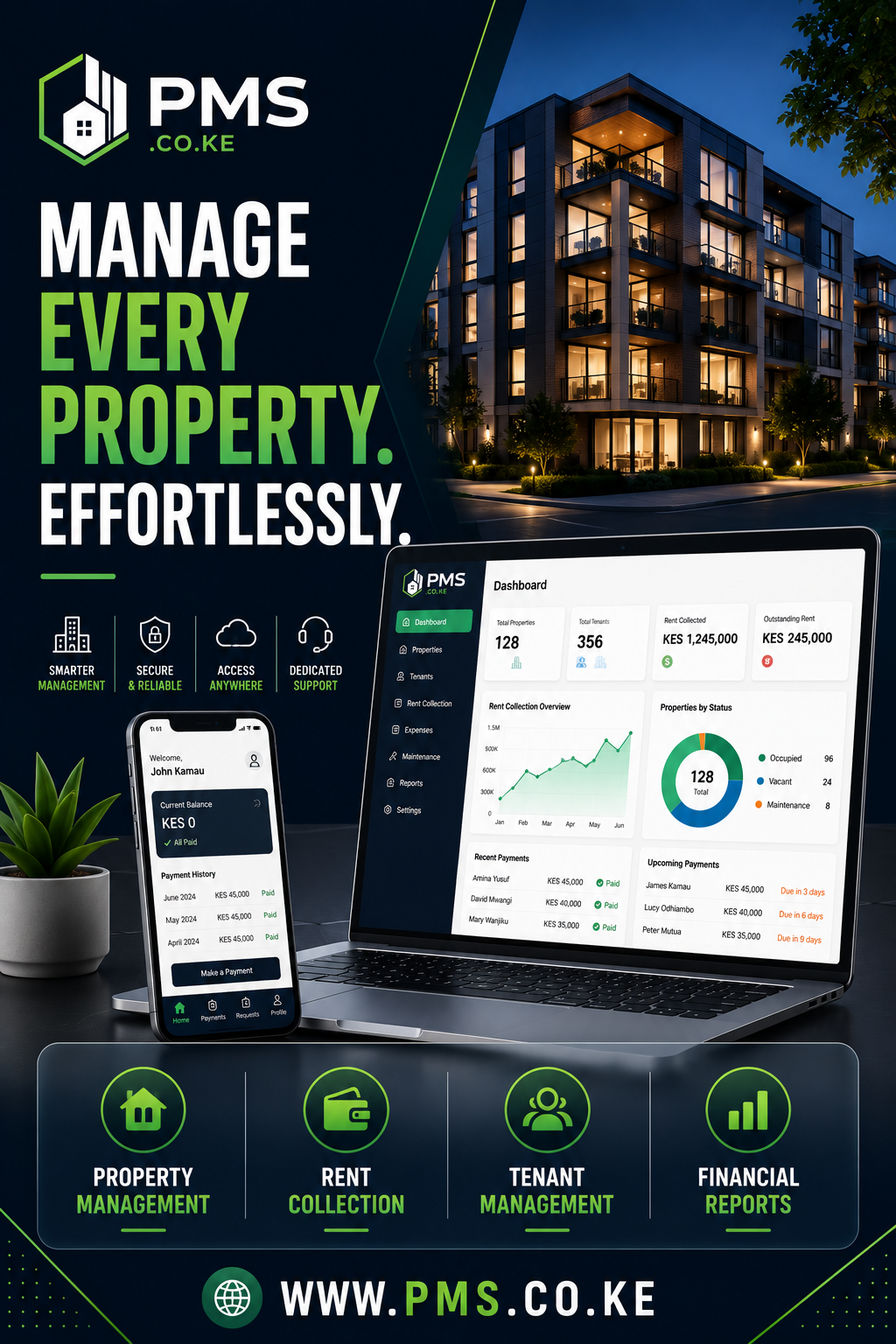
Managing modern real estate portfolios requires far more than collecting rent and responding to maintenance requests. Property managers today oversee multiple operational activities that generate vast amounts of data every day. From lease administration and tenant communications to maintenance scheduling, financial reporting, occupancy management, inspections, and vendor coordination, every operation contributes valuable information that can improve business performance when properly analyzed. Property Operations Intelligence Software enables organizations to collect, analyze, and transform this information into actionable insights that support better decision-making and long-term growth.
Across Kenya’s growing property sector, landlords and property management companies are managing increasingly diverse portfolios that include residential apartments, office buildings, shopping centres, industrial facilities, student accommodation, and mixed-use developments. As portfolios expand, relying on spreadsheets and disconnected management systems becomes inefficient and increases the risk of delayed decisions, inaccurate reporting, and operational bottlenecks.
A Property Operations Intelligence Software solution centralizes operational data from every managed property into one intelligent platform. Instead of reviewing separate reports from finance, maintenance, leasing, and administration departments, managers gain access to interactive dashboards that provide a complete overview of portfolio performance. These dashboards reveal operational trends, highlight inefficiencies, and support proactive planning before issues affect tenants or profitability.
For property businesses looking to remain competitive, adopting Property Operations Intelligence Software is no longer simply a technology upgrade—it is a strategic investment that strengthens operational efficiency, improves service delivery, enhances financial visibility, and supports sustainable business growth.
Table of Contents
- Understanding Property Operations Intelligence
- Why Operational Intelligence Matters
- Challenges of Traditional Property Operations
- How Property Intelligence Platforms Work
- Core Features of Modern Intelligence Solutions
- Improving Operational Visibility
- Using Data for Better Decision-Making
- Enhancing Property Performance
- Supporting Multi-Property Management
- Property Operations in Kenya
Understanding Property Operations Intelligence
Property operations involve every activity required to keep residential and commercial properties running efficiently. These activities include tenant management, lease administration, maintenance coordination, inspections, security oversight, financial management, compliance monitoring, contractor supervision, and asset performance tracking.
A Property Operations Intelligence Software platform collects information from these activities and converts it into meaningful business intelligence. Instead of viewing departments independently, management teams gain a unified perspective that reveals how operational performance affects financial results, tenant satisfaction, and overall portfolio growth.
This holistic approach enables organizations to identify trends, monitor key performance indicators, and continuously improve operational efficiency through data-driven management.
Modern intelligence platforms do more than store information. They actively analyze operational patterns, identify emerging issues, and present actionable recommendations that help managers allocate resources more effectively while maintaining high service standards.
Why Operational Intelligence Matters
Every operational decision has financial consequences. Delayed maintenance may increase repair costs. Slow lease renewals can contribute to vacancies. Poor vendor performance may reduce tenant satisfaction. Without reliable operational intelligence, these issues often remain hidden until they become expensive problems.
A Property Operations Intelligence Software solution provides continuous visibility into daily operations, enabling managers to respond quickly and make informed decisions based on accurate data rather than assumptions.
Some of the key advantages include:
- Improved operational transparency
- Faster management decisions
- Better allocation of resources
- Increased tenant satisfaction
- Reduced operating costs
- Stronger financial performance
- Better planning and forecasting
- Improved collaboration between departments
By connecting operational data with business objectives, organizations can improve productivity while maintaining consistent service delivery across every property.
Challenges of Traditional Property Operations
Many property management companies continue relying on spreadsheets, paper records, standalone accounting systems, and manual reporting processes. Although these methods may be manageable for smaller portfolios, they become increasingly inefficient as organizations grow.
Common operational challenges include:
- Duplicate data entry
- Delayed reporting
- Limited visibility across departments
- Manual performance tracking
- Inconsistent maintenance records
- Difficulty comparing property performance
- Slow communication between teams
- Limited forecasting capabilities
These inefficiencies often result in higher operating costs, slower response times, and reduced tenant satisfaction.
A Property Operations Intelligence Software platform addresses these challenges by centralizing operational information within one secure environment, ensuring every department works from the same accurate and up-to-date data.
How Property Intelligence Platforms Work
A Property Operations Intelligence Software platform integrates information from every operational function within a property management organization. Instead of maintaining isolated databases for finance, maintenance, leasing, and administration, the software creates a centralized data environment where all operational activities contribute to comprehensive performance analytics.
Information is typically collected from:
- Lease agreements
- Tenant records
- Rent collections
- Maintenance requests
- Inspection reports
- Vendor activities
- Occupancy records
- Financial transactions
- Compliance documentation
As new information enters the system, dashboards and reports update automatically. For example, completing a maintenance request immediately affects maintenance performance metrics, while a newly signed lease updates occupancy and revenue forecasts.
This continuous synchronization provides management with real-time visibility into portfolio performance while reducing manual reporting workloads.
Core Features of Modern Intelligence Solutions
An effective Property Operations Intelligence Software platform should provide comprehensive analytical capabilities that support both operational management and strategic planning.
Centralized Operational Dashboards
Interactive dashboards provide a real-time overview of portfolio performance using visual charts, graphs, and key performance indicators.
Performance Monitoring
Track operational metrics such as maintenance response times, occupancy rates, lease renewals, tenant satisfaction, and vendor performance.
Automated Reporting
Generate scheduled operational and financial reports without manually compiling information from multiple systems.
Workflow Analytics
Measure the efficiency of maintenance processes, inspections, approvals, and operational workflows to identify opportunities for improvement.
Financial Intelligence
Combine operational activities with financial reporting to evaluate profitability, operating costs, and revenue performance.
Multi-Property Analytics
Compare performance across residential, commercial, retail, and mixed-use properties from a single centralized platform.
Improving Operational Visibility
One of the greatest strengths of Property Operations Intelligence Software is its ability to provide complete visibility into every aspect of property operations. Managers no longer need to request separate reports from different departments or manually consolidate information before making decisions.
Instead, operational dashboards present live insights into:
- Property occupancy
- Maintenance performance
- Lease activity
- Vendor efficiency
- Financial performance
- Tenant requests
- Compliance status
- Operational workloads
This visibility enables faster decision-making while improving coordination between finance teams, maintenance personnel, leasing officers, and executive management.
By identifying operational trends early, organizations can implement corrective actions before they affect tenant satisfaction or business performance.
Using Data for Better Decision-Making
Successful property management depends on informed decision-making. A Property Operations Intelligence Software solution transforms operational data into actionable insights that support continuous improvement.
Managers can use analytics to answer important business questions such as:
- Which properties require additional maintenance resources?
- Which buildings generate the highest operational costs?
- Where are lease renewals declining?
- Which vendors consistently meet performance expectations?
- How efficiently are maintenance requests being resolved?
- Which operational processes require improvement?
These insights allow organizations to make proactive decisions that improve efficiency while supporting sustainable portfolio growth.
Benefits for Property Managers
Property managers are responsible for coordinating daily operations across residential apartments, commercial buildings, office parks, shopping centres, and mixed-use developments. As property portfolios grow, so does the complexity of managing leases, maintenance, inspections, tenant requests, vendor relationships, financial reporting, and compliance. Property Operations Intelligence Software provides property managers with a centralized platform that transforms operational data into actionable insights, enabling them to make informed decisions quickly and efficiently.
Instead of manually collecting reports from multiple departments, property managers can access interactive dashboards that provide a real-time overview of operational performance. Every maintenance request, lease update, tenant inquiry, inspection report, and financial transaction contributes to a complete picture of property operations.
One of the most valuable advantages of Property Operations Intelligence Software is the ability to identify operational issues before they become costly problems. For example, if maintenance response times begin increasing in a particular property, the platform highlights this trend immediately, allowing managers to investigate staffing levels, contractor performance, or workflow bottlenecks before tenant satisfaction declines.
The software also improves communication across departments by providing a single source of accurate information. Finance teams, maintenance personnel, leasing officers, and executive management all work from synchronized operational data, reducing misunderstandings and improving collaboration.
Property managers benefit through:
- Centralized operational dashboards
- Improved maintenance oversight
- Better occupancy monitoring
- Faster decision-making
- Reduced administrative workload
- Enhanced team collaboration
- Improved tenant service delivery
- Better portfolio performance
For growing property management companies in Kenya, Property Operations Intelligence Software provides the operational intelligence required to manage expanding portfolios efficiently while maintaining high service standards.
Benefits for Landlords and Property Owners
Landlords depend on accurate operational information to protect property value, maximize rental income, and maintain satisfied tenants. Managing several properties without reliable reporting often results in delayed decisions, increased operating costs, and missed investment opportunities.
A Property Operations Intelligence Software platform gives landlords complete visibility into how every property performs operationally and financially. Rather than relying solely on monthly reports, landlords gain access to continuously updated dashboards showing occupancy trends, maintenance performance, lease activity, financial indicators, and operational efficiency.
The software allows landlords to compare properties side by side, making it easier to identify high-performing investments as well as buildings requiring additional attention.
Benefits include:
- Better operational visibility
- Improved budgeting
- Faster investment decisions
- Increased rental profitability
- Enhanced property performance monitoring
- Reduced operating costs
- Improved tenant retention
- Stronger long-term portfolio growth
With reliable analytics available at any time, landlords can make proactive decisions that strengthen both operational efficiency and financial performance.
Benefits for Operations and Maintenance Teams
Maintenance departments are responsible for ensuring that buildings remain safe, functional, and attractive for tenants. As portfolios expand, coordinating preventive maintenance, emergency repairs, contractor schedules, and inspections becomes increasingly complex.
Property Operations Intelligence Software enables maintenance teams to monitor workloads, prioritize tasks, analyze recurring issues, and evaluate contractor performance through centralized reporting.
Managers can monitor:
- Outstanding maintenance requests
- Average response times
- Repair completion rates
- Preventive maintenance schedules
- Contractor performance
- Equipment reliability
- Asset lifecycle trends
- Maintenance expenditure
Instead of reacting to maintenance issues after failures occur, teams can implement preventive strategies that reduce repair costs and extend asset life.
Operational intelligence also improves resource allocation by identifying which properties require additional maintenance support and which operational processes require improvement.
Benefits for Finance and Executive Teams
Financial performance depends heavily on operational efficiency. Poor maintenance coordination, delayed lease processing, or inefficient workflows often increase costs while reducing tenant satisfaction and rental income.
A Property Operations Intelligence Software platform connects operational activities with financial performance, enabling executives and finance managers to evaluate how day-to-day operations influence business profitability.
Finance teams gain immediate access to:
- Operating expenses
- Maintenance costs
- Revenue performance
- Occupancy analytics
- Portfolio profitability
- Budget comparisons
- Performance indicators
- Executive dashboards
Rather than spending significant time preparing reports manually, finance professionals can focus on interpreting data, improving budgeting, and supporting strategic planning.
Executives benefit from comprehensive portfolio-wide analytics that simplify decision-making while supporting long-term business growth.
Improving Efficiency Through Automation
Automation has become essential for organizations managing multiple properties. Manual workflows often involve repetitive data entry, delayed approvals, fragmented communication, and inconsistent reporting. Property Operations Intelligence Software eliminates many of these inefficiencies through intelligent automation.
Instead of updating multiple spreadsheets whenever operational activities occur, the platform automatically synchronizes information across departments.
Common automated capabilities include:
Automated Operational Reporting
Performance dashboards update continuously as operational data changes, ensuring management always works with current information.
Maintenance Workflow Automation
Maintenance requests are automatically assigned, prioritized, tracked, and reported throughout their lifecycle.
Inspection Management
Inspection schedules, findings, corrective actions, and completion reports are managed automatically.
Lease Activity Monitoring
New leases, renewals, expirations, and occupancy changes immediately influence operational analytics.
Executive Performance Dashboards
Senior management receives continuously updated reports highlighting key operational indicators across every managed property.
Vendor Performance Analytics
Contractor response times, completion quality, and service reliability are automatically measured to improve vendor management.
Automation reduces administrative effort while increasing reporting accuracy and improving service delivery across the organization.
Compliance, Security and Risk Management
Property management organizations handle significant amounts of confidential tenant, financial, operational, and contractual information. Protecting this information is essential for maintaining trust, ensuring regulatory compliance, and supporting long-term business continuity.
A Property Operations Intelligence Software platform incorporates robust security controls designed to safeguard sensitive operational data.
Key security features include:
- Role-based access permissions
- Secure cloud infrastructure
- Data encryption
- Automated backups
- Audit trails
- Activity monitoring
- Multi-factor authentication
- Disaster recovery capabilities
These controls help ensure that authorized users access only the information relevant to their responsibilities while maintaining complete accountability for operational changes.
For businesses operating throughout Kenya, maintaining organized digital records also simplifies internal audits, financial reporting, compliance reviews, and operational governance.
Why PMS is the Ideal Solution
Operational intelligence delivers maximum value when integrated into a complete property management ecosystem rather than functioning as an isolated analytics tool.
PMS combines the capabilities of Property Operations Intelligence Software with lease administration, tenant management, receivables tracking, maintenance coordination, inspection management, financial reporting, asset monitoring, and executive dashboards within one centralized platform.
Because every operational module shares the same database, property intelligence updates automatically whenever business activities occur. Lease renewals influence occupancy analytics, maintenance requests affect operational performance indicators, financial transactions contribute to profitability reports, and inspection outcomes update compliance dashboards in real time.
PMS enables organizations to:
- Monitor multiple properties from one centralized dashboard.
- Improve operational efficiency through automation.
- Generate executive reports instantly.
- Analyze operational trends using real-time analytics.
- Improve maintenance performance.
- Strengthen financial oversight.
- Support strategic decision-making.
- Scale operations as property portfolios continue to grow.
For residential developments, commercial buildings, retail centres, office complexes, and mixed-use properties across Kenya, Property Operations Intelligence Software integrated within PMS provides the operational visibility needed to improve service quality, optimize resources, increase profitability, and support sustainable long-term growth.
Future Trends in Property Operations Intelligence
The real estate industry is evolving rapidly as technology reshapes how properties are managed, maintained, and optimized. As property portfolios become larger and more complex, organizations require deeper operational insights to remain competitive. Property Operations Intelligence Software is expected to become the foundation of intelligent property management by combining artificial intelligence, predictive analytics, automation, and cloud computing into one unified operational platform.
Rather than simply displaying operational reports, future versions of Property Operations Intelligence Software will continuously analyze business performance, identify operational risks, recommend corrective actions, and support strategic planning using real-time data.
For property management companies throughout Kenya, embracing these innovations will create opportunities to improve efficiency, reduce operating costs, strengthen tenant satisfaction, and maximize long-term profitability.
Artificial Intelligence and Predictive Intelligence
Artificial Intelligence (AI) is transforming property management by helping organizations move from reactive operations to proactive decision-making.
A modern Property Operations Intelligence Software platform will use AI to analyze maintenance trends, tenant behaviour, lease performance, operational workloads, financial performance, and occupancy patterns.
Instead of waiting for monthly reports, management teams will receive intelligent recommendations such as:
- Properties requiring immediate operational attention.
- Buildings with increasing maintenance costs.
- Assets approaching replacement cycles.
- Vendors whose performance is declining.
- Departments experiencing workflow bottlenecks.
- Properties with improving investment potential.
Machine learning algorithms will continuously improve forecasting accuracy by learning from historical operational data and identifying recurring business patterns.
This intelligence enables property managers to resolve problems before they affect tenants or financial performance.
Cloud-Based Operational Intelligence
Cloud computing has fundamentally changed how organizations manage property operations.
A cloud-enabled Property Operations Intelligence Software platform allows users to securely access dashboards, reports, inspections, maintenance records, lease information, and financial analytics from any location.
Benefits include:
- Secure remote access
- Real-time collaboration
- Automatic software updates
- Reduced infrastructure costs
- Centralized document storage
- Improved disaster recovery
- Multi-office accessibility
- Faster information sharing
For organizations managing properties across Nairobi, Mombasa, Kisumu, Nakuru, Eldoret, Thika, and other regions of Kenya, cloud technology simplifies portfolio management while supporting business expansion.
Mobile-First Property Management
Property managers increasingly perform operational activities away from the office.
Future Property Operations Intelligence Software solutions will provide complete mobile functionality, allowing users to:
- Monitor maintenance requests
- Approve operational workflows
- Review executive dashboards
- Track occupancy
- Analyze financial performance
- View inspection reports
- Monitor contractor activities
- Receive operational alerts
Mobile access enables faster response times while improving overall operational flexibility.
Business Intelligence Dashboards
Business intelligence continues to become more advanced.
Interactive dashboards within Property Operations Intelligence Software transform complex operational information into visual reports that simplify decision-making.
Typical dashboard indicators include:
- Occupancy performance
- Maintenance efficiency
- Vendor performance
- Lease activity
- Financial performance
- Tenant satisfaction
- Asset utilization
- Operational KPIs
These dashboards allow executives and property managers to evaluate portfolio performance quickly while identifying opportunities for continuous improvement.
Getting Started with Property Operations Intelligence Software
Successfully implementing Property Operations Intelligence Software begins with evaluating current operational processes and identifying opportunities for digital transformation.
Organizations should follow a structured implementation strategy that aligns technology with business objectives.
Evaluate Existing Operations
The first step involves reviewing how operational activities are currently managed.
Questions to consider include:
- How are maintenance requests tracked?
- How are inspections documented?
- How are operational reports generated?
- How are vendor activities monitored?
- How are financial reports prepared?
- How are occupancy trends measured?
Understanding existing workflows makes it easier to identify areas where automation and analytics will deliver the greatest value.
Define Operational Objectives
Every organization has different priorities.
Common implementation objectives include:
- Improving operational efficiency
- Reducing maintenance delays
- Increasing tenant satisfaction
- Improving reporting accuracy
- Strengthening financial visibility
- Enhancing portfolio performance
- Supporting business growth
- Improving decision-making
Clearly defined objectives ensure Property Operations Intelligence Software delivers measurable business improvements.
Prepare Operational Data
Accurate analytics depend on reliable information.
Before implementation, organizations should organize:
- Lease records
- Tenant information
- Maintenance history
- Financial transactions
- Inspection reports
- Vendor contracts
- Asset registers
- Compliance documentation
High-quality operational data improves reporting accuracy from the beginning.
Employee Training
Technology succeeds when employees understand both the software and the operational processes it supports.
Training should cover:
- Dashboard navigation
- Operational reporting
- Workflow management
- Maintenance tracking
- Inspection management
- Performance analysis
- Financial reporting
- Data quality standards
Well-trained teams maximize the value of Property Operations Intelligence Software while maintaining consistent operational standards.
Continuous Performance Improvement
Operational excellence requires ongoing evaluation.
Organizations should regularly monitor key performance indicators, review operational reports, evaluate workflow efficiency, and refine management processes.
A Property Operations Intelligence Software platform supports continuous improvement by providing measurable operational insights that guide strategic decision-making and long-term business planning.
Conclusion
Efficient property management requires complete visibility into every operational activity affecting portfolio performance. As property portfolios continue growing across Kenya, organizations need more than basic management tools—they require intelligent systems capable of transforming operational data into actionable business insights.
Property Operations Intelligence Software enables property managers, landlords, investors, and executive teams to monitor operational performance, improve maintenance efficiency, strengthen financial oversight, optimize resource allocation, and make informed strategic decisions using real-time analytics.
Integrated platforms such as PMS combine operational intelligence with lease management, tenant administration, receivables management, maintenance coordination, inspections, financial reporting, and executive dashboards. This unified approach creates a centralized ecosystem where every operational activity contributes to improved decision-making and sustainable business growth.
Organizations that invest in Property Operations Intelligence Software position themselves to improve service quality, reduce operating costs, strengthen tenant relationships, and maximize long-term portfolio performance in an increasingly competitive real estate market.
