
Table of Contents
ToggleWhat Is M-Pesa Rent Collection Automation Kenya?
M-Pesa rent collection automation Kenya refers to the process of automatically invoicing tenants, collecting rent through M-Pesa Paybill or Till numbers, matching payments to the correct tenant, issuing receipts, tracking arrears, generating reports, and reconciling transactions without manual intervention.
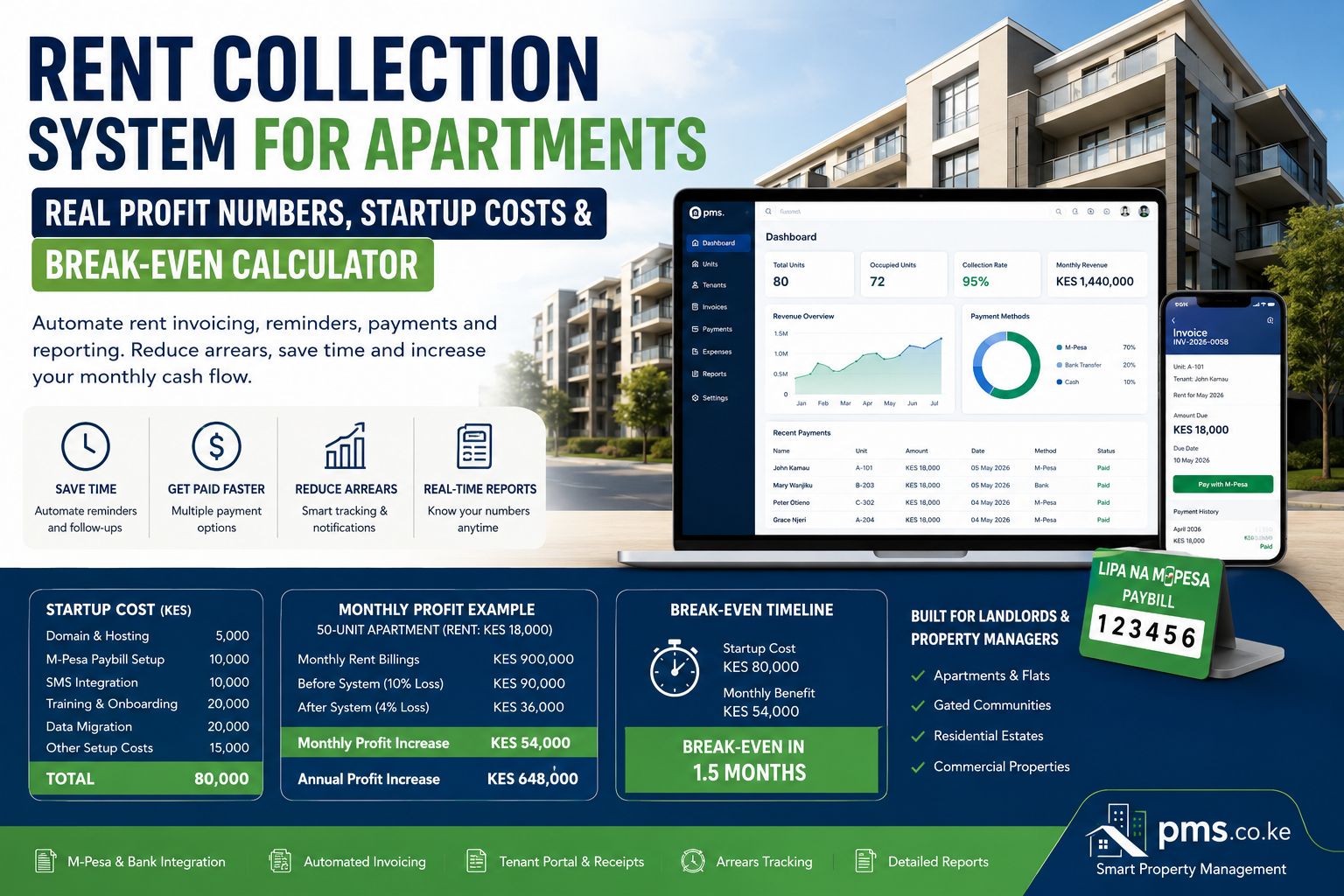
Many Kenyan landlords still rely on WhatsApp screenshots, spreadsheets, notebooks, and caretaker updates. While these methods work for small portfolios, they become expensive as unit counts increase. Modern platforms now automate invoicing, reminders, payment matching, and reporting. The result is improved cash flow, reduced arrears, and better visibility into property performance.
The problem is that most articles discussing M-Pesa rent collection automation Kenya use vague phrases such as:
- “Save time”
- “Collect rent faster”
- “Reduce arrears”
- “Improve efficiency”
Those statements are true, but they rarely quantify the actual financial impact.
This guide replaces vague claims with real KES calculations.
Why Arrears Are the Biggest Threat to Property Profitability
Most landlords think vacancies are the biggest threat to their property business. In reality, arrears often cause more financial damage than vacant units. A tenant occupying a unit but consistently paying late creates cash flow uncertainty that affects maintenance, loan repayments, service providers, and overall property performance. This is where M-Pesa rent collection automation Kenya becomes a strategic business tool rather than simply a payment collection platform. By automating reminders, generating payment references, and tracking balances in real time, landlords gain visibility into collection trends before arrears become a major problem.
Consider a property with 40 apartments renting at KES 22,000 each. Monthly expected revenue equals KES 880,000. If arrears average only 6%, the landlord loses access to KES 52,800 every month. Over a year, delayed cash flow exceeds KES 633,600. Most property owners would never knowingly accept losing more than half a million shillings annually, yet many experience exactly that because collections remain manual. A properly configured M-Pesa rent collection automation Kenya platform can identify overdue balances immediately, trigger reminders automatically, and generate reports that allow property managers to intervene early. The result is improved collection performance and stronger cash flow predictability.
Cash flow predictability is particularly important for landlords servicing loans. Mortgage repayments, contractor payments, security costs, and utility bills continue regardless of whether tenants pay on time. Even profitable properties can experience financial stress if collections are inconsistent. Through automated billing cycles and structured follow-up processes, M-Pesa rent collection automation Kenya helps property owners stabilize monthly revenue and reduce financial uncertainty.
How Property Managers Scale Faster with Automation
Many successful property managers begin with a handful of units and eventually grow into portfolios containing dozens or even hundreds of apartments. During the early stages, manual processes may appear manageable. A property manager can personally follow up with tenants, send payment reminders through WhatsApp, and maintain records in spreadsheets. However, as the portfolio grows, these methods become increasingly inefficient.
Imagine managing 100 apartments. Each month, tenants request statements, ask for receipts, report payment issues, and inquire about balances. Without automation, administrative tasks consume substantial amounts of time. A M-Pesa rent collection automation Kenya solution centralizes these functions into a single platform. Payments are automatically matched to tenant accounts, receipts are generated instantly, and arrears reports become available with a few clicks.

The efficiency gains are significant. Instead of hiring additional administrative staff to handle growing workloads, property managers can leverage automation to scale operations without proportionally increasing costs. This improves profit margins while allowing management teams to focus on leasing, tenant retention, maintenance planning, and expansion opportunities. Over time, the operational advantages provided by M-Pesa rent collection automation Kenya become increasingly valuable as portfolio size increases.
Property management companies also benefit from improved client relationships. Property owners expect timely financial reports and accurate statements. Automated systems reduce reporting delays and increase confidence in management operations. Investors are more likely to retain property managers who provide transparent reporting and predictable results.
The Impact of M-Pesa Rent Collection Automation Kenya on Tenant Experience
Tenant experience plays a major role in occupancy levels and retention rates. While landlords often focus on rental income, the quality of the tenant experience directly affects profitability. Tenants prefer convenience, transparency, and reliability. When payment processes are confusing or inconsistent, disputes become more common and satisfaction declines.
A modern M-Pesa rent collection automation Kenya system enhances tenant experience in several ways. Tenants receive automated reminders before due dates, reducing the risk of accidental late payments. Digital receipts provide immediate confirmation that payments have been received and recorded correctly. Online statements allow tenants to review balances and payment histories whenever needed.
These seemingly small improvements contribute to stronger tenant relationships. Satisfied tenants are more likely to renew leases, recommend properties to friends, and cooperate during maintenance activities. Higher retention rates reduce vacancy periods and marketing expenses. In competitive rental markets, improved tenant experience can become a meaningful differentiator.
For example, a 50-unit apartment block charging KES 18,000 monthly generates KES 900,000 in revenue when fully occupied. Increasing occupancy from 92% to 96% creates additional monthly revenue of KES 36,000. Annualized, this represents KES 432,000. While occupancy depends on many factors, professional systems such as M-Pesa rent collection automation Kenya contribute to a smoother tenant experience that supports higher retention and occupancy rates.
Data-Driven Decision Making for Property Owners
One of the most overlooked benefits of M-Pesa rent collection automation Kenya is access to reliable business intelligence. Traditional collection methods provide limited visibility into financial performance. Property owners often rely on monthly summaries prepared manually by managers or accountants. By the time problems become visible, significant revenue may already be lost.
Automation changes this dynamic. Real-time dashboards provide immediate access to key performance indicators such as occupancy rates, arrears levels, collection percentages, payment trends, and tenant balances. This information enables faster decision-making and more proactive management.
Suppose a landlord notices that arrears are increasing within a specific apartment block. Rather than waiting until year-end financial statements reveal the issue, corrective action can begin immediately. Payment plans, tenant communication campaigns, or revised collection strategies can be implemented before arrears become unmanageable. The ability to identify trends quickly is one of the strongest advantages of M-Pesa rent collection automation Kenya.
Data also improves budgeting accuracy. Property owners can forecast cash flow more effectively when they have access to historical collection patterns and current payment performance. This supports better maintenance planning, capital expenditure decisions, and expansion strategies.
Why the Future of Property Management Depends on Automation
The property sector is becoming increasingly digital. Tenants expect online services. Property owners demand transparency. Regulators and financial institutions require accurate reporting. Manual systems struggle to meet these expectations efficiently.
Over the next decade, adoption of M-Pesa rent collection automation Kenya is likely to accelerate as landlords seek better control over collections and operations. Integration with mobile money platforms, accounting systems, maintenance tools, and communication platforms will create increasingly connected property management ecosystems. These integrations will reduce administrative workloads while improving service delivery.
Technology is also transforming how property managers compete. Companies that rely on manual processes face higher operating costs, slower reporting cycles, and greater exposure to errors. In contrast, firms using M-Pesa rent collection automation Kenya can offer faster service, more accurate reporting, and better financial performance. This competitive advantage becomes increasingly important as portfolios grow and tenant expectations evolve.
Ultimately, successful property businesses are built on strong systems. Revenue collection is the foundation of every rental operation. Without consistent collections, even well-located properties can struggle financially. By implementing M-Pesa rent collection automation Kenya, landlords create a framework for sustainable growth, improved cash flow, and long-term profitability. The investment is not simply about technology—it is about protecting revenue, improving efficiency, and positioning the business for future success.
How M-Pesa Rent Collection Automation Kenya Improves Cash Flow and Property Value
One of the most important benefits of M-Pesa rent collection automation Kenya is its direct impact on cash flow consistency and long-term property value. Many landlords focus heavily on occupancy rates but overlook the importance of collection efficiency. A fully occupied apartment block is not necessarily profitable if tenants regularly pay late or if property managers struggle to reconcile payments accurately.
Cash flow is the lifeblood of any rental business because it funds maintenance, security, cleaning services, loan repayments, and future investments. When rent payments are delayed, even profitable properties can experience financial strain. A properly implemented M-Pesa rent collection automation Kenya solution eliminates many of the bottlenecks associated with manual collection processes by automating reminders, matching payments automatically, generating receipts instantly, and providing real-time visibility into outstanding balances.
This allows landlords to identify collection issues early and take corrective action before arrears become significant. For example, a property generating KES 1 million in monthly rental income can lose tens of thousands of shillings every month through delayed payments, manual reconciliation errors, and poor follow-up procedures. By reducing arrears by even 5%, landlords can recover substantial amounts of revenue annually without increasing rent or acquiring additional units.
Beyond cash flow improvements, M-Pesa rent collection automation Kenya also contributes to higher property values. Investors and buyers often evaluate income-generating properties based on their financial performance and operational efficiency. Properties with organized collection systems, transparent reporting, and low arrears levels are generally viewed as lower-risk investments. This can increase investor confidence and potentially improve property valuations.
Furthermore, automation enhances professionalism, creating a better experience for tenants who receive timely invoices, digital receipts, and clear account statements. Improved tenant satisfaction can lead to higher retention rates, reducing vacancy costs and marketing expenses. As the Kenyan property market becomes increasingly competitive, landlords who adopt M-Pesa rent collection automation Kenya gain a significant operational advantage over those relying on spreadsheets and manual processes.
The ability to collect rent efficiently, monitor performance in real time, and maintain accurate financial records creates a foundation for sustainable growth. Whether managing ten apartments or several hundred units, automation transforms rent collection from a time-consuming administrative burden into a streamlined financial process that supports profitability, scalability, and long-term business success.
For property owners seeking to maximize returns while minimizing administrative complexity, investing in M-Pesa rent collection automation Kenya is no longer simply a technological upgrade—it is a strategic decision that can significantly improve financial outcomes over the life of the property portfolio.
Why Most Articles Avoid Real Numbers
The top-ranking websites focus on features:
- Automated reminders
- M-Pesa integration
- Tenant portals
- Reporting dashboards
- Auto-reconciliation
However, they rarely calculate how much money a landlord gains from implementing M-Pesa rent collection automation Kenya.
Consider a landlord managing 50 apartments at KES 18,000 monthly rent.
Monthly billings:
50 × 18,000
= KES 900,000
If manual collections create:
- 6% arrears
- 2% reconciliation errors
Revenue leakage equals:
900,000 × 8%
= KES 72,000 monthly
Annual loss:
72,000 × 12
= KES 864,000
If M-Pesa rent collection automation Kenya reduces leakage from 8% to 3%, recovered revenue becomes:
900,000 × 5%
= KES 45,000 monthly
Annual improvement:
KES 540,000
That is the math most competitors never show.
Startup Cost Breakdown
Implementing M-Pesa rent collection automation Kenya is significantly cheaper than many landlords assume.
Table 1: Startup Costs
| Item | Low Cost (KES) | High Cost (KES) |
|---|---|---|
| Paybill/Till setup | 0 | 25,000 |
| SMS integration | 3,000 | 20,000 |
| Data migration | 5,000 | 40,000 |
| Staff training | 5,000 | 25,000 |
| Tenant onboarding | 5,000 | 20,000 |
| Reporting setup | 5,000 | 30,000 |
| Software configuration | 0 | 20,000 |
| Contingency budget | 10,000 | 50,000 |
| Total | 33,000 | 230,000 |
For most landlords, implementing M-Pesa rent collection automation Kenya costs less than one month of lost rent caused by arrears.
Revenue Model 1: 10-Unit Apartment
Assumptions:
- 10 units
- Rent per unit: KES 20,000
Monthly billing:
10 × 20,000
= KES 200,000
Manual collection problems:
- 8% late payments
- 2% reconciliation errors
Revenue leakage:
200,000 × 10%
= KES 20,000 monthly
With M-Pesa rent collection automation Kenya, leakage drops to 3%.
Recovered revenue:
200,000 × 7%
= KES 14,000 monthly
Annual benefit:
14,000 × 12
= KES 168,000
Revenue Model 2: Roadside Kiosk Complex
Assumptions:
- 20 kiosks
- Monthly rent: KES 8,000
Monthly billing:
20 × 8,000
= KES 160,000
Average manual arrears:
12%
Revenue loss:
KES 19,200
After implementing M-Pesa rent collection automation Kenya, arrears fall to 4%.
Recovered revenue:
KES 12,800 monthly
Annual benefit:
KES 153,600
Revenue Model 3: School Fee Collection
Schools face many of the same challenges as landlords.
Assumptions:
- 400 students
- Average fee balance: KES 15,000
Expected collections:
KES 6,000,000
Delayed collections:
10%
Collection gap:
KES 600,000
Automation improves collections by 6%.
Recovered revenue:
KES 360,000 per term
Annual gain:
KES 1,080,000
Many schools now deploy systems similar to M-Pesa rent collection automation Kenya because recurring billing challenges are nearly identical.
Revenue Model 4: Event Space
Assumptions:
- 12 bookings monthly
- Average booking value: KES 50,000
Monthly revenue:
KES 600,000
Late or missing payments:
5%
Revenue leakage:
KES 30,000
After automation:
Recovered revenue:
KES 24,000 monthly
Annual gain:
KES 288,000
Break-Even Calculator
Table 2: Break-Even Timeline
| Scenario | Startup Cost | Monthly Benefit | Break-Even |
|---|---|---|---|
| 10-unit apartment | 50,000 | 14,000 | 3.6 months |
| Kiosk complex | 60,000 | 12,800 | 4.7 months |
| School | 120,000 | 90,000 | 1.3 months |
| Event space | 45,000 | 24,000 | 1.9 months |
These numbers demonstrate why M-Pesa rent collection automation Kenya is increasingly viewed as a revenue recovery investment rather than an expense.
Ongoing Monthly Costs
Table 3: Monthly Operating Costs
| Cost Item | Monthly Cost (KES) |
|---|---|
| Software subscription | 2,500 |
| SMS reminders | 1,500 |
| Payment processing | 3,000 |
| Maintenance | 2,000 |
| Backups & security | 1,000 |
| Administration | 5,000 |
| Total | 15,000 |
Compared to the revenue recovered through M-Pesa rent collection automation Kenya, ongoing costs remain relatively low.
The Hidden Cost of Manual Collections
Most landlords focus on rent collected rather than rent delayed.
Consider:
30 apartments
Rent = KES 18,000
Expected revenue:
KES 540,000
If only three tenants delay payment each month:
3 × 18,000
= KES 54,000
Annual delayed cash flow:
KES 648,000
A properly configured M-Pesa rent collection automation Kenya system significantly reduces these delays through reminders, payment links, and automated reconciliation.
How Automation Improves Occupancy
Tenants appreciate convenience.
When tenants receive:
- Automated invoices
- SMS reminders
- Instant receipts
- Online statements
Trust improves.
A property with 50 units charging KES 15,000 monthly earns:
KES 750,000 monthly
Increasing occupancy from 90% to 95% produces:
KES 37,500 additional monthly revenue
KES 450,000 annually
This is another indirect benefit of M-Pesa rent collection automation Kenya.
Risks and Mitigation
1. Tenant Resistance
Some tenants prefer cash.
Solution
Provide:
- Paybill
- Till
- STK Push
- Bank transfer
2. Data Migration Errors
Poor data quality creates reconciliation issues.
Solution
Clean tenant records before migration.
3. SMS Delivery Failures
Missed reminders can affect collections.
Solution
Use SMS plus WhatsApp notifications through platforms like Zivo.
4. Fraud
Manual receipts increase fraud risks.
Solution
Use automated digital receipts.
5. Internet Downtime
Cloud systems require connectivity.
Solution
Maintain backup procedures and redundant connections.
SaaS Platforms That Power Automation
A complete automation ecosystem often includes:
| Product | Website | Purpose |
|---|---|---|
| PMS Kenya | Property management | Rent & tenant management |
| RentalDesk | Rental management | Apartment automation |
| EstateAdmin | Estate management | Service charge tracking |
| Pawa | Billing automation | Payment collection |
| Ratibu | School management | Fee collection |
| Vega POS | Retail billing | POS collections |
| Dereva | Driver marketplace | Logistics support |
| Dexa | HR & workflows | Operations management |
External references:
Is M-Pesa Rent Collection Automation Kenya Worth It?
Yes.
For landlords managing more than five units, the financial case is strong.
The average property owner loses more money through:
- Late payments
- Arrears
- Manual reconciliation
- Missing receipts
- Administrative inefficiencies
than they spend on software.
The strongest returns occur when M-Pesa rent collection automation Kenya is integrated with property management, tenant communication, and financial reporting systems.
For portfolios exceeding 20 units, the ROI becomes difficult to ignore.
FAQ
1. How much does M-Pesa rent collection automation Kenya cost?
Most implementations cost between KES 33,000 and KES 230,000 depending on complexity.
2. How quickly can I recover my investment?
Most businesses break even within 1–5 months.
3. Does M-Pesa rent collection automation Kenya work with existing Paybills?
Yes. Most platforms integrate directly with existing M-Pesa Paybill and Till numbers.
4. Can small landlords benefit?
Absolutely. Even landlords managing 5–10 units often recover enough revenue to justify the investment.
5. What is the biggest advantage?
Reduced arrears, improved cash flow, automated reconciliation, and stronger financial visibility.
The best time to implement M-Pesa rent collection automation Kenya is before arrears and reconciliation problems become expensive. The numbers show that even modest improvements in collection efficiency can generate hundreds of thousands of shillings in additional annual revenue.
