
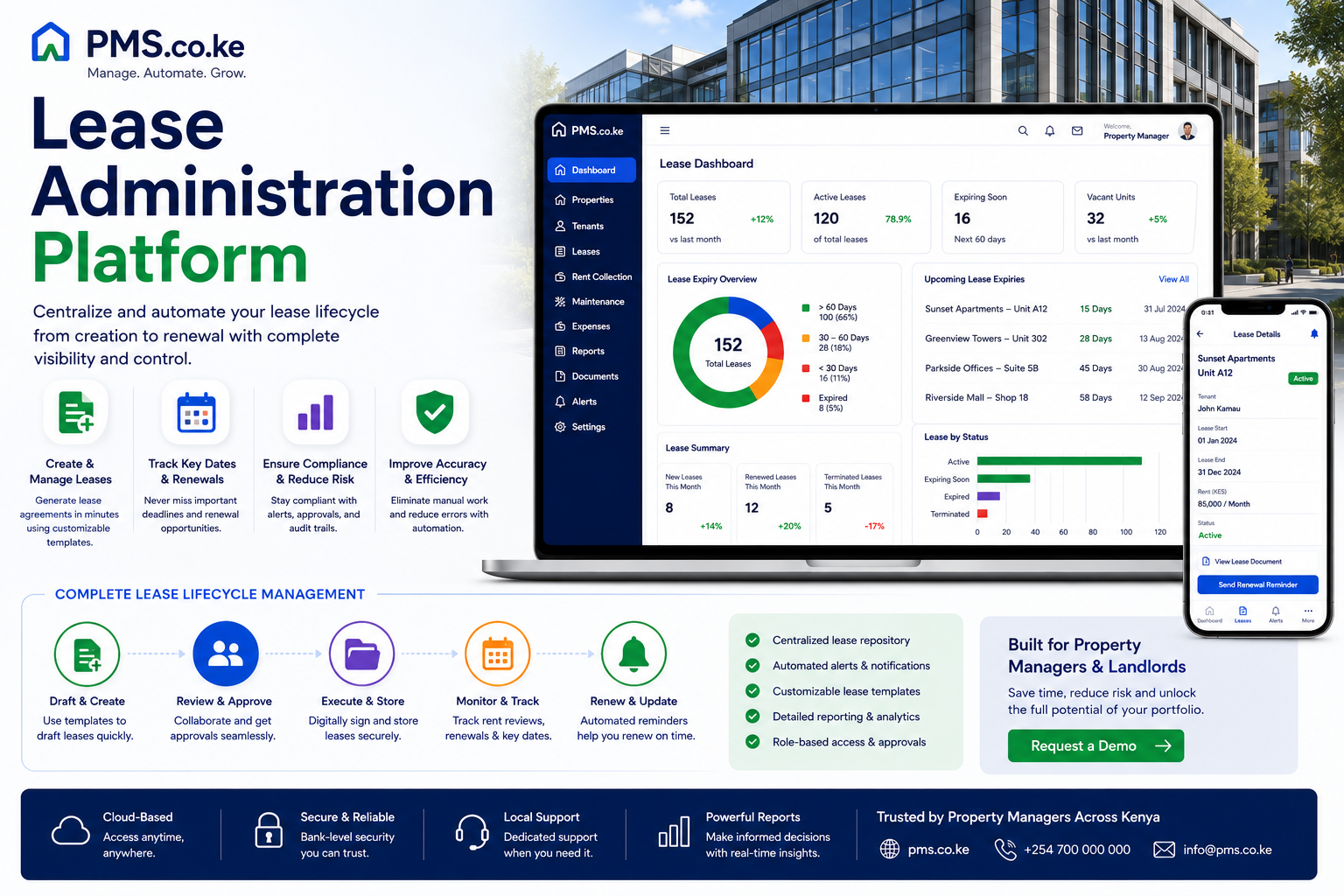
Lease Administration Platform
solutions are transforming how property owners, landlords, and property managers manage lease agreements across residential, commercial, and mixed-use properties. As rental portfolios continue to grow in Kenya, manual lease tracking methods are becoming inefficient, creating operational risks that can lead to missed renewals, revenue leakage, compliance issues, and tenant disputes.
A modern lease administration platform provides centralized lease management, automated workflows, document storage, rent tracking, renewal monitoring, and reporting tools that help property managers maintain complete control over their rental operations. Instead of relying on spreadsheets, paper files, emails, and disconnected systems, organizations can manage every lease from a single platform.
Table of Contents
- Understanding Modern Lease Operations
- Why Digital Lease Management Matters
- Challenges of Traditional Lease Tracking
- Core Features of a Lease Management System
- Managing Lease Lifecycles
- Tenant Documentation Management
- Rent and Payment Administration
- Renewals and Expiry Monitoring
- Compliance and Risk Management
- Portfolio-Wide Lease Visibility
- Reporting and Analytics
- Benefits for Property Managers
- Benefits for Landlords and Investors
- Supporting Residential Properties
- Supporting Commercial Properties
- Automation and Workflow Management
- Why RentalDesk Is the Right Choice
- Future of Lease Management Technology
- Getting Started Today
Understanding Modern Lease Operations
A Lease Administration Platform serves as the operational backbone of property management. Every tenancy relationship begins with a lease agreement, making lease administration one of the most critical aspects of rental management. Property managers must track lease start dates, expiration dates, payment schedules, rent adjustments, deposits, notices, renewals, tenant obligations, and compliance requirements.
When these activities are managed manually, organizations often struggle with incomplete records, delayed actions, and communication gaps. A centralized system ensures that all lease information remains accurate, accessible, and up to date throughout the entire lease lifecycle.
Modern property management requires real-time access to lease information, especially when managing multiple buildings, units, or tenants. A digital platform helps teams operate efficiently while maintaining accuracy and transparency.
Why Digital Lease Management Matters
The complexity of property management increases significantly as portfolios expand. Managing ten leases manually may be possible, but managing hundreds or thousands requires technology.
Digital lease management eliminates the risks associated with scattered documents and manual reminders. Teams can quickly locate agreements, track critical dates, review payment histories, and monitor lease obligations without spending hours searching through records.
Organizations that adopt digital lease administration often experience improved operational efficiency, better tenant satisfaction, reduced administrative costs, and stronger financial performance. Automation also reduces human error, which is one of the most common causes of lease management problems.
Property managers can focus more on tenant relationships and portfolio growth while allowing software to handle routine administrative processes.
Challenges of Traditional Lease Tracking
Traditional lease administration methods create numerous challenges that can affect operational performance and profitability.
One common issue is missed lease renewal opportunities. When lease expiration dates are tracked manually, managers may overlook upcoming renewals, resulting in vacancy periods and lost income.
Document management presents another challenge. Lease agreements, amendments, notices, inspection reports, and supporting documents are often stored across multiple locations, making retrieval difficult and time-consuming.
Financial inaccuracies may also occur when rent adjustments, escalations, deposits, and payment schedules are not consistently monitored. These errors can impact revenue collection and create disputes between landlords and tenants.
As property portfolios grow, these problems become more frequent and costly, making technology adoption increasingly important.
Core Features of a Lease Management System
An effective Lease Administration Platform provides comprehensive tools for managing lease-related activities.
Key features typically include:
- Digital lease storage
- Tenant record management
- Lease creation and tracking
- Renewal monitoring
- Expiry notifications
- Rent scheduling
- Payment tracking
- Document management
- Reporting dashboards
- Compliance tracking
- Portfolio analytics
- Workflow automation
These capabilities help property managers standardize operations while maintaining visibility across all properties and tenants.
Centralized management improves consistency, accountability, and efficiency throughout the organization.
Managing Lease Lifecycles
Every lease follows a lifecycle that begins with tenant onboarding and ends with termination, renewal, or extension.
A Lease Administration Platform enables managers to monitor every stage of this process from a single dashboard. Lease creation workflows ensure that agreements are properly documented and stored. Active leases remain visible throughout their duration, while automated alerts help managers prepare for upcoming renewals.
The ability to track lifecycle events improves operational planning and reduces the likelihood of missed deadlines.
Organizations can create standardized procedures that ensure consistency across their entire portfolio.
Tenant Documentation Management
Managing tenant documents is a critical responsibility for property managers. Lease agreements represent only one component of the tenant relationship.
Additional documents may include:
- Identification records
- Application forms
- Inspection reports
- Deposit documentation
- Maintenance requests
- Insurance certificates
- Compliance records
- Communication logs
A centralized platform provides secure storage and easy retrieval of these documents whenever needed.
Having complete tenant records available in one location improves service quality while reducing administrative workload.
Rent and Payment Administration
Revenue management is among the most important functions within property management.
A Lease Administration Platform helps organizations maintain accurate rent schedules and payment records. Managers can track expected payments, monitor balances, identify arrears, and review payment histories without relying on manual spreadsheets.
Automation ensures that recurring charges remain consistent while reducing calculation errors.
Improved payment visibility helps organizations maintain stable cash flow and strengthen financial oversight.
Renewals and Expiry Monitoring
Lease renewals directly affect occupancy rates and revenue stability.
Without automated monitoring, managers risk overlooking upcoming expirations. A Lease Administration Platform provides advance notifications that allow teams to initiate renewal discussions before lease terms end.
Early engagement improves tenant retention and reduces vacancy risks.
Organizations gain sufficient time to negotiate terms, prepare documentation, and ensure uninterrupted occupancy.
Compliance and Risk Management
Property managers must comply with various legal and operational requirements. Failure to maintain accurate records can expose organizations to disputes and regulatory challenges.
A Lease Administration Platform helps ensure compliance by maintaining complete lease histories, document archives, and audit trails.
Managers can verify that agreements remain current and that required documentation is properly maintained.
This visibility reduces risk while strengthening governance practices.
Portfolio-Wide Lease Visibility
Large property portfolios require centralized oversight.
A Lease Administration Platform provides a portfolio-wide view of all leases, tenants, occupancy levels, renewals, and financial commitments.
Managers can quickly identify trends, evaluate occupancy performance, and monitor upcoming lease events across multiple properties.
This level of visibility supports informed decision-making and proactive management.
Reporting and Analytics
Data-driven decision-making is becoming increasingly important in modern property management.
Reporting tools allow managers to analyze lease performance, tenant retention, occupancy trends, renewal success rates, and revenue generation.
Advanced analytics help identify operational opportunities and areas requiring attention.
By converting lease data into actionable insights, organizations can improve both efficiency and profitability.
Benefits for Property Managers
Property managers benefit from improved organization, reduced administrative workload, and enhanced operational control.
Key advantages include:
- Faster document access
- Improved accuracy
- Reduced manual work
- Better communication
- Automated reminders
- Enhanced reporting
- Improved compliance
- Increased efficiency
These benefits allow management teams to focus on strategic priorities rather than repetitive administrative tasks.
Benefits for Landlords and Investors
Property owners gain significant value from structured lease administration.
A Lease Administration Platform improves revenue visibility, strengthens tenant retention efforts, and supports informed investment decisions.
Owners can access accurate performance reports and maintain confidence in portfolio operations.
Greater transparency often leads to stronger financial outcomes and improved asset management.
Supporting Residential Properties
Residential property managers must oversee numerous tenant relationships, payment schedules, maintenance activities, and lease agreements.
A Lease Administration Platform streamlines these responsibilities by providing centralized management tools that improve efficiency and tenant service.
Organizations can maintain accurate records while reducing administrative complexity.
Supporting Commercial Properties
Commercial leases often involve more complex terms, including escalations, service charges, maintenance obligations, and customized agreements.
A Lease Administration Platform provides the structure required to manage these complexities effectively.
Managers can monitor obligations, maintain documentation, and ensure compliance with contractual requirements.
Automation and Workflow Management
Automation represents one of the most valuable capabilities within modern property management technology.
Routine processes such as reminders, notifications, approvals, renewals, and document management can be automated to reduce workload and improve consistency.
Workflow automation accelerates operations while ensuring critical tasks are not overlooked.
Organizations benefit from greater efficiency and stronger operational performance.
Why RentalDesk Is the Right Choice
RentalDesk provides an all-in-one property management platform designed to simplify lease administration and portfolio management.
Property managers can manage leases, tenants, maintenance activities, financial operations, and reporting from a single system.
The platform supports efficient workflows, enhanced visibility, and improved tenant engagement while helping organizations scale their operations effectively.
By centralizing lease administration processes, RentalDesk enables property managers to operate with greater confidence and control.
Future of Lease Management Technology
The future of lease administration will continue to focus on automation, analytics, cloud accessibility, and integrated property management workflows.
Organizations increasingly require systems that deliver real-time visibility and actionable insights.
Technology will play a growing role in helping property managers improve efficiency, strengthen compliance, and enhance tenant experiences.
Forward-thinking organizations that adopt modern platforms today will be better positioned for future growth.
Getting Started Today
Implementing a Lease Administration Platform is one of the most effective ways to improve property management operations. By centralizing lease information, automating critical workflows, and improving visibility across the portfolio, organizations can reduce administrative burden while increasing efficiency and profitability.
Whether managing residential units, commercial buildings, or mixed-use developments, a modern lease administration solution provides the tools needed to maintain control, improve tenant relationships, and support long-term growth.
